
When moving companies start buying leads, the shared vs exclusive moving leads decision is where most of the confusion lives. The price gap is hard to ignore — $15 versus $45 for a local lead, $20 versus $85 for an interstate one — but price alone does not tell you which delivers better ROI. That depends on your close rate, your market speed, and how your team follows up. If you have never calculated what a lead actually costs you per booked job, start with our moving leads ROI calculator to build your baseline.
In 2026, moving companies have three real options: shared leads, exclusive leads, and live call transfers. This guide breaks down the math, the benchmarks, and the decision logic so you can stop guessing and start allocating your lead budget where it actually pays off.
What Are Shared Moving Leads?
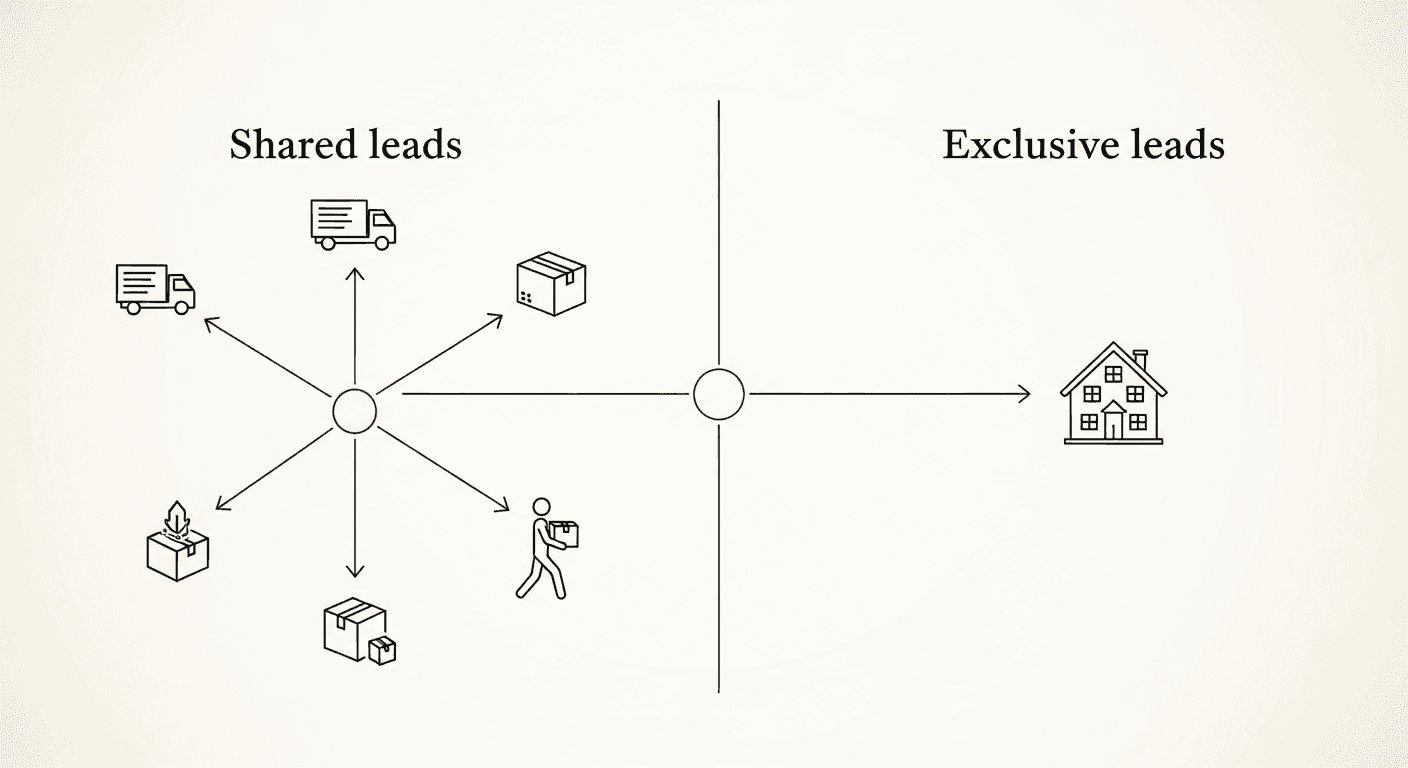
Shared moving leads are customer inquiries distributed to up to four moving companies simultaneously. The customer fills out a quote request, and within seconds, multiple movers receive the same contact via SMS, email, or their CRM.
How Shared Leads Work
- Customer submits a move request (name, phone, email, origin, destination, size, move date)
- Lead is verified via SMS confirmation and data validation
- Lead is distributed to up to 4 movers in the service area
- All receiving movers are notified at roughly the same time
- The first mover to connect typically sets the tone for the customer's decision
Network Leads pricing for shared leads:
| Move Type | Price Per Lead |
|---|---|
| Local (intrastate) — up to 4 movers | $15 |
| Interstate — up to 4 movers | $20 |
| Local (intrastate) — only 2 movers | $28 |
| Interstate — only 2 movers | $38 |
Shared leads deliver higher volume at lower cost per lead. The tradeoff is competition — you are in a race from the moment the lead arrives.
What Are Exclusive Moving Leads?
Exclusive moving leads go to one mover only. You are the only company that receives the contact, which eliminates the competition immediately and lets you have an uncontested conversation with the customer.
How Exclusive Leads Work
- Customer submits a request through a form designated for exclusive delivery
- Lead is verified (same process as shared)
- Lead is sent to a single mover — you
- No other company sees the contact information
- You own the relationship from the first call
Network Leads pricing for exclusive leads:
| Move Type | Price Per Lead |
|---|---|
| Local (intrastate) | $45 |
| Interstate | $85 |
The higher price buys you an uncontested conversation. The customer is not fielding calls from three other movers while you are quoting them.
Live Call Transfers: The Third Option
Live call transfers are a distinct category that often gets overlooked. Instead of receiving a lead and calling back later, you are connected to the customer in real time while they are actively on the phone looking for a mover.
| Transfer Type | Price |
|---|---|
| Local live call transfer | $60 per call |
| Interstate live call transfer | $100 per call |
The customer is already engaged and expecting to speak with a mover. No voicemail tag. No waiting. No competing movers calling first. For high-value interstate moves, live calls consistently deliver the highest close rates of any lead type.
Shared vs Exclusive Moving Leads: Full Comparison Table
Before running the ROI math, here is the complete picture across all three lead types:
| Factor | Shared ($15–$20) | Exclusive ($45–$85) | Live Calls ($60–$100) |
|---|---|---|---|
| Competition on the lead | Up to 3 other movers | None | None |
| Speed to contact required | Critical — under 5 min | Moderate | Real-time answer required |
| Typical close rate | 10–20% | 20–35% | 30–45% |
| Best for | High-volume, fast follow-up teams | Premium service, quality focus | Interstate, high-value jobs |
| Lead volume available | High | Moderate | Lower |
| Estimated cost per booked job | $70–$190 | $130–$425 | $125–$300 |
The "cost per booked job" row is the real comparison — not cost per lead. A $15 lead that converts 15% of the time costs $100 per booked job. A $45 exclusive lead that converts 25% of the time costs $180. Context determines which is better for your operation.
ROI Math: Shared Leads at $15–$20 Per Lead
Let us run the numbers on local shared leads at $15 each with a realistic 15% close rate.
Local shared lead scenario:
| Metric | Value |
|---|---|
| Lead cost | $15 |
| Close rate | 15% |
| Leads needed per booked job | 6.7 |
| Cost per booked job | $100 |
| Average local job value | $900 |
| Gross revenue minus lead cost | $800 |
At 20% close rate (a strong, fast-responding team), the numbers improve significantly:
| Close Rate | Leads Needed | Cost Per Booked Job |
|---|---|---|
| 10% | 10 | $150 |
| 15% | 6.7 | $100 |
| 20% | 5 | $75 |
| 25% | 4 | $60 |
Interstate shared leads at $20 are often the biggest ROI opportunity in the entire lead market:
- 15% close rate → cost per booked job: $133
- Average interstate job value: $2,500 – $5,000
- Gross revenue minus lead cost: $2,367 – $4,867
One closed interstate job typically pays for 100+ shared leads. The volume math on interstate is extremely favorable.
Pro tip: If your close rate on shared leads is below 10%, the problem is almost always response speed or sales process — not lead quality. Track your time-to-first-call before making any conclusions about lead quality.
ROI Math: Exclusive Leads at $45–$85 Per Lead
Exclusive leads cost more upfront but remove the competition factor entirely. Industry close rates for exclusive leads typically run 20–35% because you are not racing other movers.
Local exclusive lead scenario:
| Metric | Value |
|---|---|
| Lead cost | $45 |
| Close rate | 25% |
| Leads needed per booked job | 4 |
| Cost per booked job | $180 |
| Average local job value | $900 |
| Gross revenue minus lead cost | $720 |
Here is the full cost-per-booked-job comparison across close rates:
| Close Rate | Shared Local ($15) | Exclusive Local ($45) |
|---|---|---|
| 10% | $150 | $450 |
| 15% | $100 | $300 |
| 20% | $75 | $225 |
| 25% | $60 | $180 |
| 30% | $50 | $150 |
Shared leads win the cost-per-job comparison at almost every close rate for local moves. Where exclusive leads shift the calculus is with interstate moves and higher average job values:
- Interstate exclusive at $85, 30% close rate → cost per booked job: $283
- Average interstate job value: $3,500+
- Gross revenue minus lead cost: $3,217+
When average job value exceeds $2,500, the economics of exclusive leads become much more competitive.
ROI Math: Live Calls at $60–$100 Per Call
Live calls eliminate the speed-to-lead problem. The customer is already on the phone — you answer, you engage, you quote.
Local live call scenario at $60:
| Metric | Value |
|---|---|
| Call cost | $60 |
| Close rate | 35% |
| Calls needed per booked job | 2.86 |
| Cost per booked job | $171 |
| Average local job value | $900 |
| Gross revenue minus call cost | $729 |
Interstate live calls at $100:
- Close rate 40% → cost per booked job: $250
- Average interstate job value: $3,500
- Gross revenue minus call cost: $3,250
Live calls typically deliver the lowest cost-per-booked-job for teams with skilled closers available during business hours. The constraint: you must be ready to answer immediately, and your rep needs to be able to quote and close in a single conversation.
Which Lead Type Is Right for Your Business?
When Shared Leads Make More Sense
- Your team responds within 5 minutes. Speed is your competitive moat in the shared lead market. Learn the exact timing framework in our guide on how to follow up with moving leads.
- You are building volume. Early-stage operations benefit from more at-bats to learn their market and test their sales approach.
- Your close rate is already 15%+. At that rate, shared leads deliver a cost per booked job of about $100 — hard to match anywhere else.
- You operate in a high-demand urban market. More leads are available, and fast teams can win a disproportionate share.
- You are starting with leads for the first time. Shared leads offer the lowest entry cost and the fastest way to test whether your pitch works.

Pro tip: In competitive shared lead environments, call within 60 seconds of receiving the notification — not 5 minutes. The first mover to reach the customer often secures the relationship before the others even dial.
When Exclusive Leads Make More Sense
- Your shared lead close rate is below 12%. If you cannot win the race, buy out of it. Exclusives remove the speed pressure entirely.
- You sell premium services at higher prices. When your average local job is $1,500+, the exclusive lead math improves significantly.
- You are in a smaller market. Fewer leads available means exclusive pricing may be the only way to ensure consistent volume.
- You want a relationship-building approach. Exclusive leads let you call without urgency, build rapport, and close at a better price rather than competing under time pressure.
- You serve a specific high-value niche. Specialty movers (pianos, art, corporate relocation) often find exclusives essential because customer trust is part of the sale.
When Live Calls Make the Most Sense
- You have a skilled closer available during business hours. Calls arrive live — someone must be ready to answer and engage immediately.
- You are targeting interstate, high-value moves. At $100/call with 40% close rates on $3,500+ jobs, live calls can be your best-performing channel by ROI.
- You want zero speed-to-lead risk. The customer is already on the line. No competition, no delay.
- Your team can quote on the spot. Live calls require immediate pricing confidence. If your estimating process needs days, this format is challenging.
For a broader view of all the lead types available and how they fit a full acquisition strategy, see our overview of leads for moving companies.
Hybrid Strategy: The Best of Both Worlds
The highest-performing moving companies do not choose one lead type — they allocate budget across types based on capacity and market conditions.
Example monthly hybrid allocation:
| Lead Type | Monthly Budget | Volume | Why |
|---|---|---|---|
| Shared local | $700 | 50 leads | Volume, fill capacity, test markets |
| Exclusive interstate | $510 | 6 leads | High-value jobs, margin focus |
| Live calls (interstate) | $450 | 5 calls | Highest close rate for premium jobs |
| Total | $1,660 | 61 contacts | Diversified risk, consistent pipeline |
Estimated returns from this $1,660 allocation:
- 50 shared leads × 15% close rate = 7.5 booked jobs × $900 avg = $6,750
- 6 exclusive + 5 live calls × 30% close rate = 3.3 booked jobs × $3,500 avg = $11,550
- Total estimated revenue: $18,300 from $1,660 in lead spend
The blend fills the local calendar with volume while protecting margins through high-value interstate work. Adjust the ratio as you learn which performs better in your specific market.
How to Test and Track Which Works for Your Market
The benchmarks in this guide are starting points — your market will perform differently. Here is the testing process:
- Run shared leads for 30 days. Track leads received, calls made, quotes given, jobs booked, and revenue per booked job.
- Calculate your actual close rate (jobs booked ÷ leads received). Above 18% means shared leads are working well. Below 12% means it is time to test exclusives.
- Add 5–10 exclusive leads in the same period with the same tracking.
- Try 3–5 live calls if you have an interstate service area.
- Compare cost per booked job across all three types. Allocate more budget toward whichever is lowest.
Simple tracking columns for a spreadsheet:
- Date received
- Lead type (shared / exclusive / live call)
- Lead cost
- Call made — yes/no and time delay
- Quote given — yes/no
- Job booked — yes/no
- Job value
- Cost per booked job (calculated field)
After 30 days of real data, you have your own benchmarks — not industry averages. That is when budget decisions become obvious.

Frequently Asked Questions
Are exclusive leads always worth the higher price? Not always. If your shared lead close rate is already 20%+, shared leads often deliver a lower cost per booked job than exclusives. Run the math for your actual numbers before switching.
Do shared leads have worse quality than exclusive leads? No — both come from the same verified customer pool. The difference is distribution, not quality. A shared lead you call in 60 seconds is often more valuable than an exclusive lead that sits uncalled for an hour.
How many movers compete on a shared lead? Up to four. In practice, active buyers vary by market — some areas see less competition than the maximum.
Can I mix shared and exclusive in the same account? Yes. You can adjust your lead type preferences by service area, move type, or budget at any time.
What close rate should I expect starting out? New teams typically see 8–12% on shared leads. With consistent follow-up processes, 15–25% is a realistic goal. Live calls often outperform both, especially on interstate inquiries.
How do I get credit for a bad lead? Credits are available for leads with disconnected numbers or customers not seeking full-service moving. Requests must be submitted within 7 days with proof of contact attempts. Verified leads (SMS-confirmed) are not creditable.
The Bottom Line
The shared vs exclusive moving leads question does not have a universal answer — it has a math answer. Run the calculation for your market, your close rate, and your average job value:
- Shared leads win when you respond fast and want to maximize volume per dollar spent.
- Exclusive leads win when you have higher-value jobs, slower follow-up, or a close rate below 12% on shared.
- Live calls win when you have a strong closer available and are targeting high-value interstate moves.
- A hybrid wins when you have the budget and tracking discipline to optimize across all three.
The only real mistake is staying locked into one type without measuring your actual cost per booked job. The data will tell you exactly where to put your next dollar.
Ready to find your ideal lead mix? Network Leads offers shared leads, exclusive leads, and live call transfers with no long-term contracts — you pay only for the leads you receive. Browse our full lead options to check service area availability, or start your account today and test all three types with real data from your own market.
Written by
Network Leads
Network Leads helps moving companies grow with high-quality leads, powerful software, and marketing solutions. Since 2017, we have been connecting movers with customers who are actively searching for moving quotes.
Learn more about our platform