Most moving company owners spend money on leads without ever knowing if they are actually profitable. They look at their bank account, see money going out and money coming in, and hope the math works out.
Hope is not a strategy.
This guide gives you the exact formulas, real-world examples, and a simple tracking system to know — with certainty — whether your lead investment is making or losing you money. By the end, you will be able to calculate your ROI on any lead source in under five minutes.
Why Most Movers Do Not Track Lead ROI
Before we get into the math, let us address why this is a problem in the first place.
The three most common reasons movers skip ROI tracking:
-
"I'm too busy running jobs." Understandable — but not tracking ROI means you might be running jobs that lose money. Twenty minutes a week of tracking can save (or earn) you thousands per month.
-
"I don't know which leads turned into jobs." This is a systems problem, not a math problem. A simple CRM or lead management system solves it.
-
"Leads are leads — some work, some don't." This is the most expensive mindset in the business. Not all lead sources are equal. Without tracking, you cannot tell which ones to scale up and which ones to cut.

The ROI Formula for Moving Leads
Here is the formula, simplified:
ROI = ((Revenue from Leads - Cost of Leads) / Cost of Leads) x 100
But to use this formula, you need three numbers:
- Cost per lead — What you pay for each lead
- Close rate — What percentage of leads you book
- Average job value — How much revenue a typical booked job generates
Let us put real numbers to this.
The Key Metrics You Need to Track
Before running any ROI calculation, you need to know your own numbers. If you do not know these yet, start tracking them this week.
| Metric | What It Means | How to Track |
|---|---|---|
| Cost per lead (CPL) | Price paid per lead received | Your lead provider invoice |
| Close rate | % of leads that become booked jobs | Booked jobs / total leads received |
| Average job value (AJV) | Average revenue per completed move | Total revenue / number of jobs |
| Cost per acquisition (CPA) | What you spend to get one booked job | Total lead spend / booked jobs |
| Gross profit per job | Revenue minus direct costs (labor, fuel, etc.) | Revenue - direct job costs |
Industry benchmarks for reference:
- Average close rate on shared leads: 10% – 20%
- Average close rate on exclusive leads: 25% – 40%
- Average close rate on live call transfers: 30% – 50%
- Average local move value: $800 – $2,500
- Average interstate move value: $2,500 – $7,000
Your numbers may be higher or lower. That is okay — what matters is that you know them and track them consistently.
Example 1: Shared Leads ROI (Local Moves)
Let us start with the most common scenario — a moving company buying shared local leads.
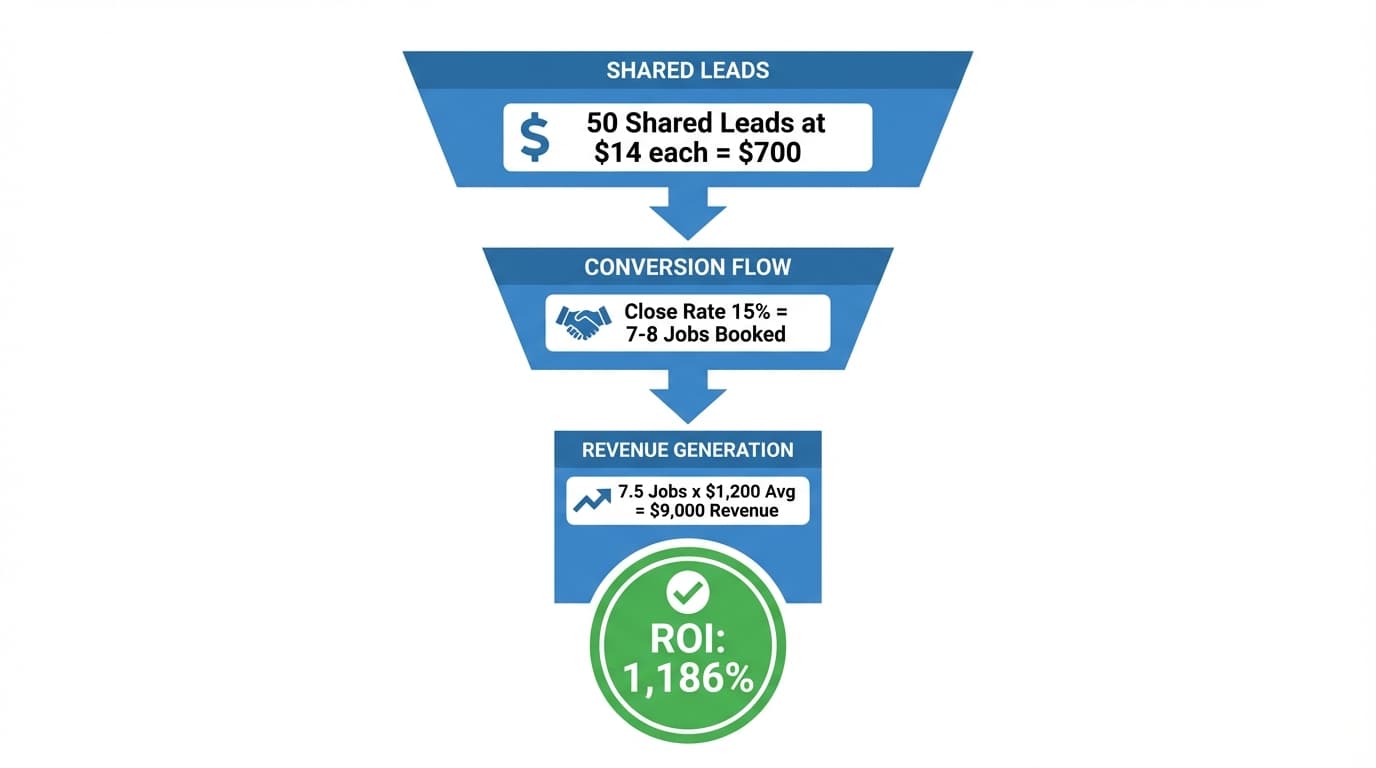
The numbers:
- Lead type: Shared local leads
- Cost per lead: $15
- Leads purchased per month: 50
- Monthly lead spend: $750
- Close rate: 15% (conservative — you compete with up to 3 other movers)
- Jobs booked: 7.5 per month
- Average job value: $1,200
- Monthly revenue from leads: $9,000
The math:
- Cost per acquisition: $750 / 7.5 = $100 per booked job
- ROI: (($9,000 - $750) / $750) x 100 = 1,100% ROI
For every $1 you spend on shared leads, you get back $12.00 in revenue.
Even if your close rate is only 10% (5 jobs per month), the revenue is $6,000 against a $750 spend — still a 700% ROI.
When shared leads work best:
- You have a fast response time (call within 5 minutes)
- Your sales process is tight and competitive
- You are price-competitive in your market
- You want to maximize volume at the lowest cost per lead
Example 2: Exclusive Leads ROI (Local Moves)
Exclusive leads cost more per lead, but you are the only mover who receives them. No competition.
The numbers:
- Lead type: Exclusive local leads
- Cost per lead: $45
- Leads purchased per month: 20
- Monthly lead spend: $900
- Close rate: 30% (no competition — higher close rate)
- Jobs booked: 6 per month
- Average job value: $1,200
- Monthly revenue from leads: $7,200
The math:
- Cost per acquisition: $900 / 6 = $150 per booked job
- ROI: (($7,200 - $900) / $900) x 100 = 700% ROI
Your CPA is higher ($150 vs $93), but you spend less time chasing leads and your close rate is more predictable. For many movers, the time savings alone justify the premium.
When exclusive leads work best:
- You prefer quality over quantity
- Your team is smaller and cannot handle high lead volume
- You want a more predictable booking rate
- You are willing to pay more per lead for less competition
Example 3: Live Call Transfers ROI (Local Moves)
Live call transfers are the highest-intent lead type. The customer is on the phone, actively looking for a mover, and gets transferred directly to you.

The numbers:
- Lead type: Live call transfer (local)
- Cost per call: $60
- Calls received per month: 15
- Monthly lead spend: $900
- Close rate: 40% (highest intent — they are on the phone right now)
- Jobs booked: 6 per month
- Average job value: $1,200
- Monthly revenue from leads: $7,200
The math:
- Cost per acquisition: $900 / 6 = $150 per booked job
- ROI: (($7,200 - $900) / $900) x 100 = 700% ROI
Live calls combine the best of both worlds: high close rate like exclusive leads, with a reasonable CPA. The trade-off is you must answer the phone immediately — a missed call is a lost lead.
Example 4: Interstate Leads ROI
Interstate leads cost more, but the job values are dramatically higher.
Shared interstate leads:
- Cost per lead: $20
- Leads per month: 30
- Monthly spend: $600
- Close rate: 12%
- Jobs booked: 3.6 per month
- Average job value: $3,500
- Monthly revenue: $12,600
- ROI: 2,000%
Exclusive interstate leads:
- Cost per lead: $85
- Leads per month: 10
- Monthly spend: $850
- Close rate: 30%
- Jobs booked: 3 per month
- Average job value: $3,500
- Monthly revenue: $10,500
- ROI: 1,135%
Interstate moves are where the real money is. Even at the higher exclusive lead price of $85, one closed interstate job at $3,500 pays for over 40 shared leads or 7 exclusive leads.
The Complete Comparison Table
Here is every lead type side by side:
| Lead Type | Cost/Lead | Close Rate | CPA | Avg Revenue | ROI |
|---|---|---|---|---|---|
| Shared Local (up to 4 movers) | $15 | 15% | $100 | $1,200 | 1,100% |
| Shared Local (only 2 movers) | $28 | 22% | $127 | $1,200 | 843% |
| Exclusive Local | $45 | 30% | $150 | $1,200 | 700% |
| Live Call Local | $60 | 40% | $150 | $1,200 | 700% |
| Shared Interstate (up to 4 movers) | $20 | 12% | $167 | $3,500 | 2,000% |
| Shared Interstate (only 2 movers) | $38 | 18% | $211 | $3,500 | 1,558% |
| Exclusive Interstate | $85 | 30% | $283 | $3,500 | 1,135% |
| Live Call Interstate | $100 | 40% | $250 | $3,500 | 1,300% |
Close rates in this table are illustrative planning assumptions, not measured averages — your own numbers will vary with your market, your speed to first contact, and your sales process. The only close rate that matters is the one you track yourself, using the system in the next section.
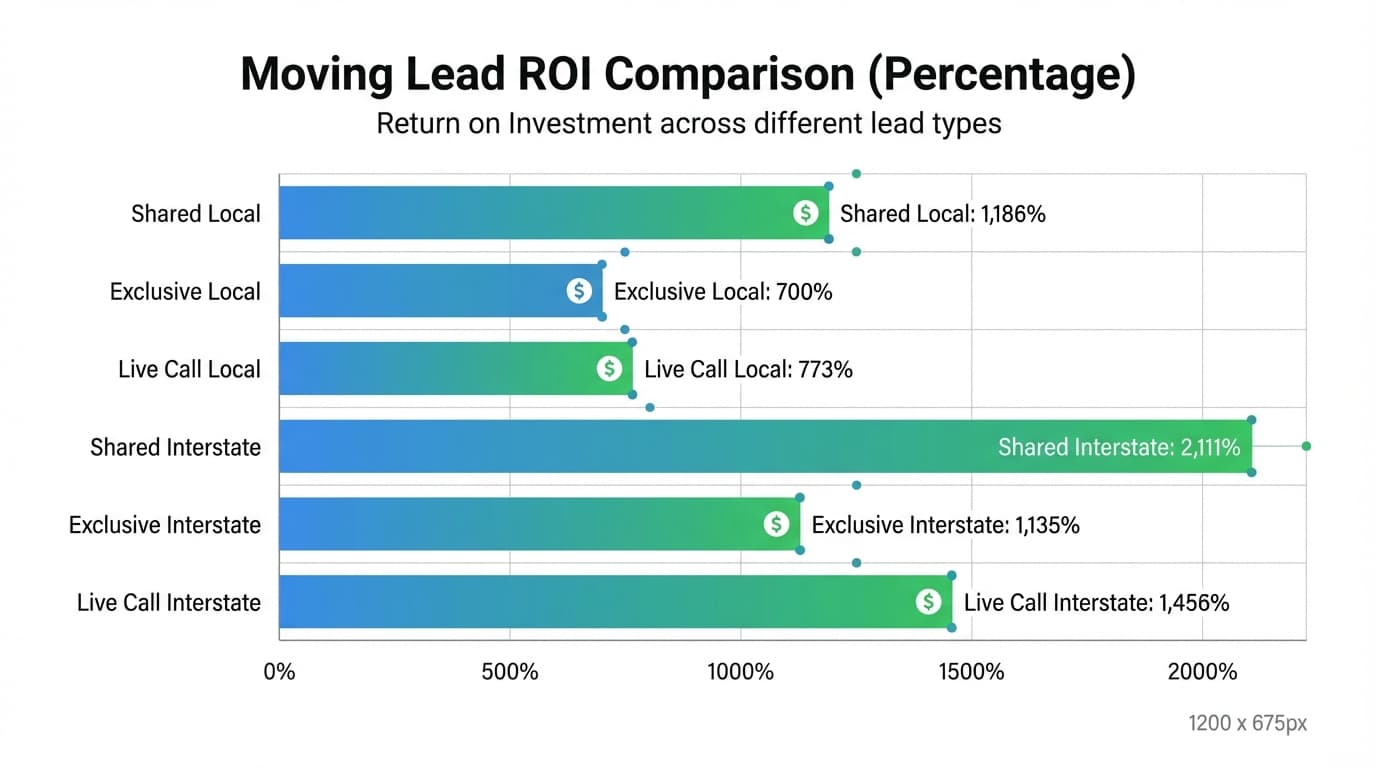
Every single lead type delivers a positive ROI — and not by a small margin. The worst-performing option (exclusive local at 700%) still returns $7 for every $1 spent.
How to Improve Your Close Rate (and Multiply Your ROI)
Your close rate is the single biggest lever you have. Moving it from 15% to 25% on shared leads nearly doubles your booked jobs with zero additional lead spend.
Here are the five highest-impact ways to improve your close rate:
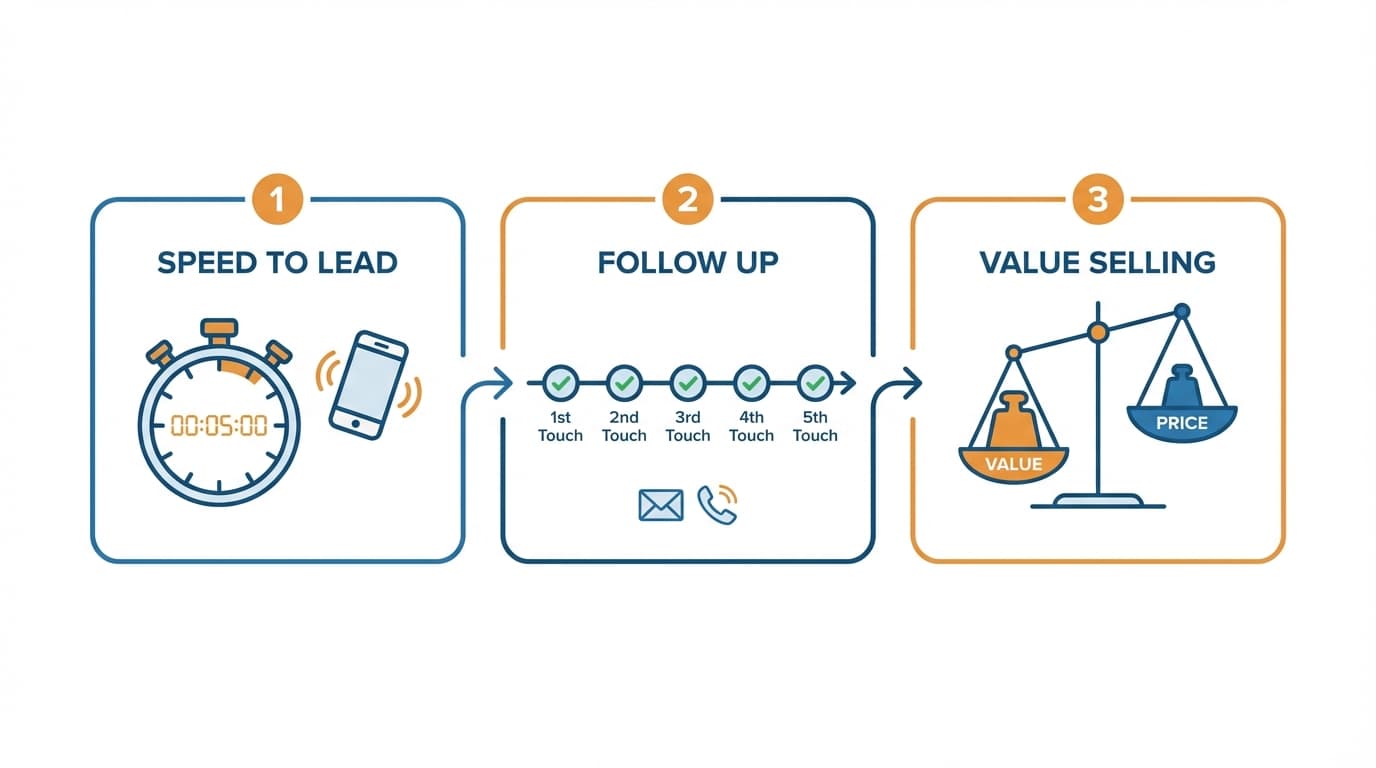
1. Speed to Lead
The data is clear: movers who call leads within 5 minutes of receiving them close at 2-3x the rate of those who wait an hour or more. On shared leads, where you are competing with other movers, speed is the number one differentiator.
Set up your phone and notifications so that new leads trigger an immediate alert. If you cannot call personally, assign someone whose only job during business hours is responding to new leads.
2. Follow Up Relentlessly
Most movers give up after one call attempt. The reality is:
- 48% of salespeople never follow up after the first contact
- 80% of sales require 5+ follow-ups to close
- The average mover who follows up 3-5 times closes at 2x the rate of one-and-done callers
Build a follow-up sequence: call immediately, text if no answer, email the same day, call again the next day, text on day three. Automate as much of this as possible with CRM software.
3. Lead with Value, Not Price
When you get a customer on the phone, do not start with "What's your budget?" or immediately quote a number. Instead:
- Ask about their move (date, size, concerns)
- Listen for what matters to them (careful handling, timing, storage needs)
- Present your company's strengths that match their needs
- Then present the price in context of the value
Movers who sell on value close at higher rates AND at higher prices.
4. Sound Professional
Customers are evaluating you from the first second of the call. Simple things matter:
- Answer with your company name, not "Hello?"
- Speak clearly and confidently
- Have your CRM open so you know who is calling
- Confirm their move details to show you are prepared
- End every call with a clear next step
Need help crafting the perfect pitch? Check out our guide on how to create sales scripts for moving companies.
5. Remove Friction from Booking
Make it as easy as possible for the customer to say yes:
- Offer to send a digital estimate they can sign on their phone
- Provide flexible payment options
- Give a clear, no-surprise quote (avoid "it depends" when possible)
- Follow up the quote with a short text: "Just sent your estimate — let me know if you have any questions"
The Hidden Cost of NOT Buying Leads
Some movers resist buying leads because they see it as an expense. But consider the alternative costs:
| Alternative | Monthly Cost | Leads Generated | Time to Results |
|---|---|---|---|
| Google Ads (self-managed) | $1,500 – $3,000 | 20 – 40 | 1-3 months to optimize |
| Google Ads (agency-managed) | $2,500 – $5,000+ | 25 – 50 | 2-4 months to optimize |
| SEO (organic) | $1,000 – $3,000 | 10 – 30 | 6-12 months |
| Social media marketing | $500 – $1,500 | 5 – 15 | 3-6 months |
| Doing nothing (waiting for referrals) | $0 | 0 – 5 | Unpredictable |
The average cost per lead from Google Ads in the moving industry is $40 – $80. That is 2-4x more expensive than shared leads at $15-20, with the added risk of wasted ad spend during the learning period.
Buying leads is not an expense — it is the most efficient customer acquisition channel available to moving companies. You pay only for verified customers who are actively looking for quotes, with zero wasted spend on clicks that never convert. Learn more about how moving leads work.
How to Set Up a Simple ROI Tracking System
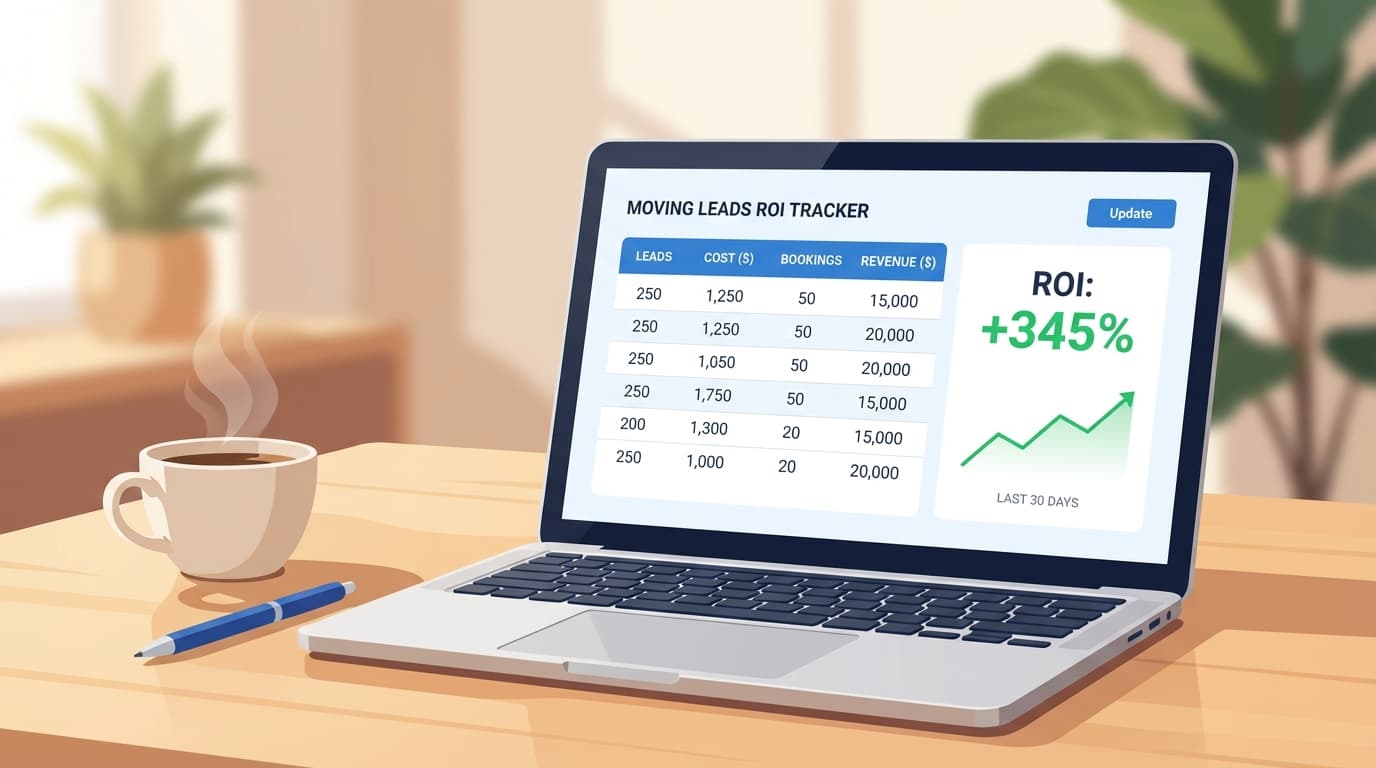
You do not need expensive software for this. A simple spreadsheet works:
Track These Columns for Every Lead
| Column | Example |
|---|---|
| Date received | 04/15/2026 |
| Lead source | Network Leads - Shared |
| Customer name | John Smith |
| Move type | Local |
| Cost of lead | $15 |
| Status | Booked / Lost / No Contact |
| Job value (if booked) | $1,450 |
| Notes | Called back in 3 min, booked on first call |
Monthly Summary
At the end of each month, calculate:
- Total leads received by source
- Total spend by source
- Leads booked by source
- Total revenue by source
- Close rate (booked / received)
- CPA (spend / booked)
- ROI ((revenue - spend) / spend x 100)
This takes 15-20 minutes at month end and gives you a clear picture of exactly where your money is working hardest.
Even better: Use a CRM that tracks this automatically. Moving company software like Network Leads' platform tracks lead source, status, and revenue so you can pull ROI reports without manual spreadsheet work.
When to Scale Up Your Lead Budget
You have proven ROI. The numbers work. Now the question is: should you buy more leads?
Scale up when:
- Your close rate is stable at 15%+ (shared) or 25%+ (exclusive)
- You have crew capacity to handle more jobs
- Your current leads are profitable (positive ROI for 3+ consecutive months)
- You can maintain response time even with higher volume
Do not scale up when:
- Your close rate is below 10% (fix your sales process first)
- You are already missing calls or responding slowly
- You do not have enough crews to handle more work
- You have not tracked ROI for at least 2-3 months
Scaling strategy:
- Start with shared leads to prove the model and build volume
- Add exclusive leads for your highest-value move types (interstate, large local)
- Add live call transfers when your phone team can handle immediate answers
- Increase volume gradually — 20% per month — and monitor close rate
- If close rate drops, pause scaling and fix the bottleneck before adding more leads
The Math Does Not Lie
Moving leads are one of the highest-ROI investments a moving company can make. At $15 per shared lead with a 15% close rate, you are paying $100 to acquire a customer worth $1,200+. That is a return most businesses can only dream of.
The movers who struggle with leads almost always have one of two problems: slow response time or no follow-up system. Fix those two things, and leads become the most predictable, scalable revenue source in your business. If you are just getting started, read our full guide on how to start a moving company to understand the full cost picture.
Stop guessing. Start tracking. And let the numbers guide your decisions.
Ready to see the ROI for yourself? Sign up with Network Leads and start receiving verified, high-intent moving leads. No contracts, no minimums — just real customers looking for quotes. Fund your account, set your service areas, and the leads start flowing.
Written by
Network Leads
Network Leads helps moving companies grow with high-quality leads, powerful software, and marketing solutions. Since 2017, we have been connecting movers with customers who are actively searching for moving quotes.
Learn more about our platform