
Google Ads can fill your schedule or drain your bank account — and for moving companies in 2026, the difference almost always comes down to setup and strategy. When run correctly, search advertising puts your business in front of customers at the exact moment they are searching for a mover. When run poorly, you are paying $10–$20 per click for homeowners comparing prices with no intention of booking anyone.
This guide covers everything you need to know to run Google Ads for a moving company: which campaign types to use, how to structure your account, what keywords to bid on, how to write ad copy that books jobs, and — honestly — how paid search stacks up against buying verified leads directly. If the math side interests you, pair this guide with the moving leads ROI calculator to model what different acquisition costs mean for your bottom line.
Should Your Moving Company Run Google Ads?
Google Ads works for moving companies — but not automatically, and not for every budget. Before committing spend, weigh these factors honestly.
The Case For Google Ads
- High purchase intent. Someone searching "movers in [city]" is ready to book. They are not browsing; they have a move date in mind.
- Immediate visibility. Unlike SEO, which takes months to build, ads appear the day you launch a campaign.
- Precise geographic control. You only pay to be shown in your service area — down to specific zip codes if needed.
- Seasonally scalable. Increase budget during peak moving season (May–September); pull back in January and February.
The Case Against
- High cost per click. Moving keywords are competitive. CPC in major metro areas regularly runs $8–$25 per click — meaning a 10% conversion rate still puts your cost per lead at $80–$250.
- Requires active management. Campaigns left on autopilot waste budget fast. Google's default "Smart" campaigns look easy but often produce the worst results.
- No guarantee. You pay for clicks, not calls. A slow landing page or a 24-hour follow-up response turns expensive clicks into nothing.
The honest verdict: Google Ads is a viable growth channel for moving companies with marketing budgets above $1,000/month, a willingness to manage (or pay someone to manage) campaigns properly, and a fast follow-up process. For newer movers or those with tighter budgets, verified moving leads with no wasted-click risk often deliver a better return per dollar.
How Google Ads Works for Local Moving Companies
Google Ads is an auction. Every time someone in your target area searches a relevant term, Google runs an instant auction among all advertisers competing for that query. The highest combination of bid and Quality Score wins the visible ad slots.
Quality Score (rated 1–10) is Google's measure of how relevant and useful your ad is. It is based on three factors:
- Expected click-through rate (how often people click your ad vs. competing ads)
- Ad relevance to the specific search query
- Landing page experience (speed, relevance, ease of converting)
A high Quality Score directly lowers your cost per click. A moving company with tight, relevant ad copy and a fast landing page can outrank a competitor spending twice as much per click.
How a search-to-lead works:
- You choose keywords to bid on (search terms that trigger your ad).
- You set a maximum CPC bid or an automated bidding strategy (e.g., Target CPA).
- Someone searches your keyword in your target area.
- Google auctions the ad slots. If you win, your ad appears.
- You pay only when someone clicks the ad.
- The click lands on your page and submits a quote form or calls your number.

Google Local Service Ads vs. Search Ads vs. Display: Which Is Right for Movers?
Three distinct Google ad products exist for moving companies. They serve different purposes with very different cost structures.
| Ad Type | How You Pay | Typical Cost | Best For |
|---|---|---|---|
| Local Service Ads (LSA) | Per verified lead (call or message) | $25–$75 per lead | Maximum trust, local residential moves |
| Search Ads | Per click | $8–$25 per click | High-intent searchers, all move types |
| Display Ads | Per click or impression | $0.50–$3 per click | Brand awareness, retargeting |
Google Local Service Ads (LSA)
LSAs appear above everything else in search results — above regular Search Ads, above the map pack, above organic listings. They display your business name, star rating, and a "Google Guaranteed" badge. You pay per verified lead (an actual call or message from a local searcher), not per click.
For moving companies, LSA is often the best starting point because:
- You pay for real leads, not clicks that go nowhere
- The "Google Guaranteed" badge builds immediate trust and improves booking rates
- No keyword management is required — Google matches you to relevant queries automatically
To qualify, your business must pass Google's verification process: background checks, license verification, and insurance confirmation. As of 2026, verification typically takes 2–4 weeks. Confirm current requirements directly at ads.google.com/local-services-ads.
Search Ads (the main focus of this guide)
Search Ads give you full control: keywords, bids, ad copy, scheduling, and geographic targeting. They appear below LSAs but above organic results and drive the highest volume once properly configured. The rest of this guide focuses on Search Ads.
Display Ads
Display Ads appear as visual banners across Google's vast network of websites. They are generally not cost-effective for movers as a primary lead channel — someone reading a news article is not in active booking mode. Display works better for retargeting (showing follow-up ads to people who already visited your site) than for cold acquisition.
Campaign Structure: Separating Local and Long-Distance Moves
Running one campaign for all move types is the most common structural mistake moving companies make. Local and interstate moves are completely different products with different keywords, different customer concerns, and very different margins.
Recommended account structure:
- Campaign 1: Local Moves — targets same-city and same-state searches
- Campaign 2: Long-Distance / Interstate Moves — targets out-of-state and cross-country queries
- Campaign 3: Branded (if budget allows) — protects your name when competitors bid on it
- LSA — managed separately through the LSA dashboard
Within each campaign, create tightly themed ad groups:
| Ad Group | Example Keywords |
|---|---|
| Local moving services | "movers [city]", "local moving company near me" |
| Apartment moving | "apartment movers [city]", "studio apartment moving" |
| Residential house moving | "house movers [city]", "residential movers" |
| Long-distance / interstate | "long distance moving company", "interstate movers" |
| Specialty items | "piano movers [city]", "pool table movers" |
Each ad group should contain 5–15 closely related keywords and 2–3 ads written specifically for that theme. This tight grouping is the single biggest driver of Quality Score improvement — and Quality Score is what lowers your CPC.
Keyword Research for Moving Companies: What to Bid On
Moving keywords fall into three intent tiers. Where you focus your budget should match where your close rate is highest.
High-intent (bid aggressively):
- "movers near me"
- "moving company [city]"
- "local movers [city]"
- "moving company quotes [city]"
- "residential movers [city]"
- "interstate movers"
- "long distance moving company [state]"
Medium-intent (bid selectively, monitor CPA closely):
- "moving services"
- "moving company prices"
- "best movers [city]"
- "affordable moving company"
- "how much does moving cost [city]"
Low-intent / research keywords (exclude or use only for retargeting):
- "how to move yourself"
- "renting a moving truck"
- "moving tips"
- "packing boxes cheap"
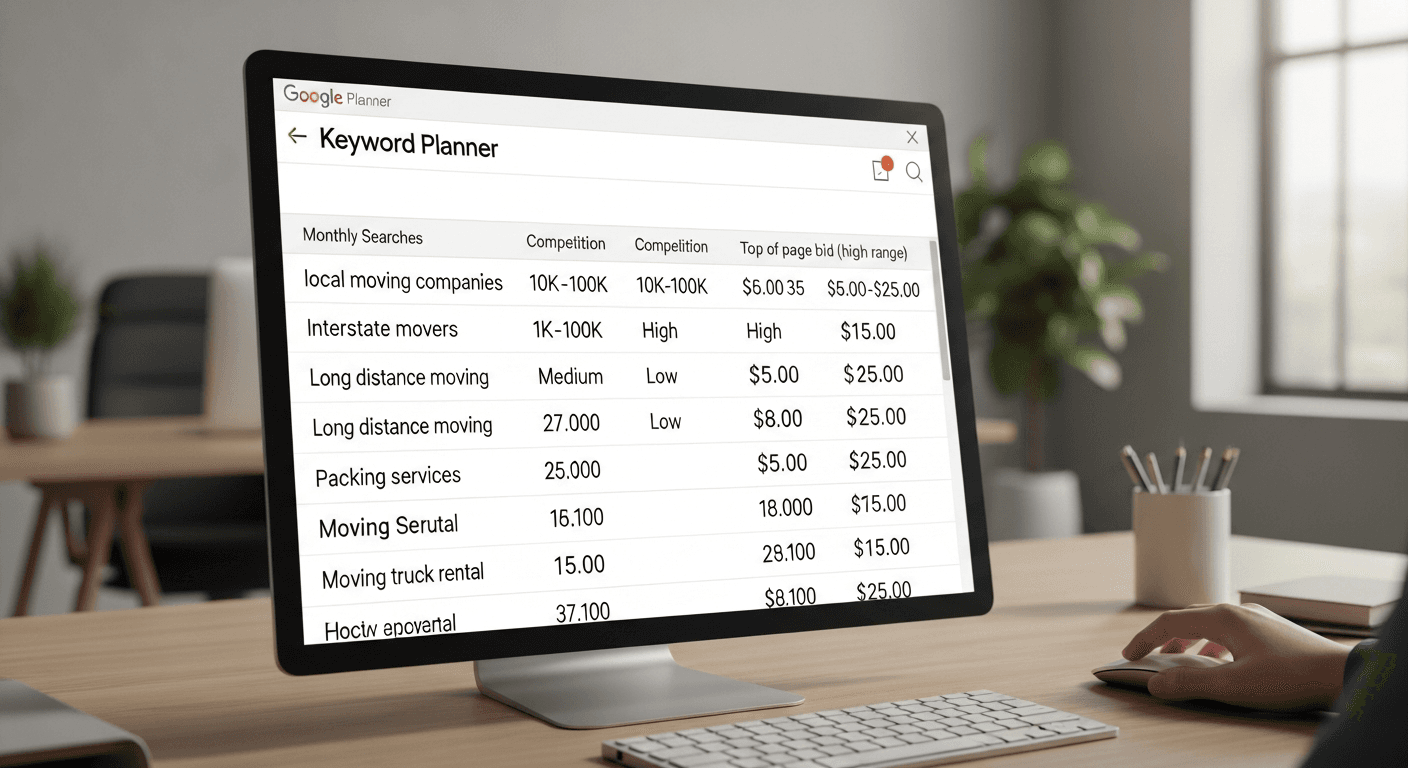
Start with phrase match and exact match keyword types rather than broad match. Broad match will show your ad for searches like "moving pictures," "moving to a new job," and "fast and furious 9 moving scene" — none of which will become customers calling for a quote. For keyword research tools, Google Keyword Planner (free inside Google Ads) and Think with Google's consumer insights can reveal local search volumes and competitive benchmarks in your specific market.
Pro tip: Check what your competitors are bidding on before you finalize your keyword list. In Google Keyword Planner, "Competitor" insights show ad presence by keyword. If six movers are all aggressively bidding on "movers [city]," your CPC will be high — focusing on more specific terms like "apartment movers [city]" or "same day movers [city]" may produce better results at a fraction of the cost.
Negative Keywords That Protect Your Budget
Negative keywords tell Google when NOT to show your ad. Without a solid negative keyword list, you can expect 20–35% of your budget to go to irrelevant clicks in the first few weeks of a new campaign.
Build your negative keyword list before you launch:
- DIY and rental terms: free, rent, rental, U-Haul, Penske, Budget, "do it yourself," "rent a truck"
- Job seeker terms: job, jobs, hiring, career, employment, salary, hourly, apply, resume
- Consumer research terms: "how to," tips, guide, checklist, tutorial, "packing supplies," "packing boxes"
- Services you do not offer: "car shipping," "boat moving," "car transport," "vehicle moving"
- Price shopping with no intent: "cheapest ever," "free estimate," "no cost moving"
- Insurance and claims searches: "moving company insurance claim," "damage claim moving"
Add these at the campaign level so they apply to every ad group. Then check your Search Terms report weekly — especially in the first month — to catch new irrelevant queries and block them. During the initial weeks, spending time on negative keywords often reduces waste more than any bid adjustment.
Writing Google Ads Copy That Converts Moving Leads
Most moving company ads look identical: "Licensed & Insured Movers," "Free Estimate," "Call Today." Standing out with differentiated, specific copy wins more clicks at lower CPCs and attracts more qualified traffic.
What Makes Moving Ad Copy Work
- Lead with your strongest differentiator — not what every mover says, but what makes your company specifically worth calling.
- Use specific numbers — "$149 minimum," "2-man crew available today," "15+ years in [city]" — specificity builds trust.
- Address the fear — customers worry about damage and hidden fees. "No hidden fees. Every item insured." directly answers that concern.
- Fill every available field — Google Responsive Search Ads allow up to 15 headlines and 4 descriptions. The more options you provide, the better Google can match copy to individual search intent.
Headline Examples for a Moving Company RSA
| Headline | What It Does |
|---|---|
| Licensed & Insured Movers in [City] | Local relevance + trust |
| 5-Star Rated Local Moving Company | Social proof |
| No Hidden Fees — Free Written Quote | Addresses fear objection |
| Same-Week Availability — Call Now | Urgency + ease |
| Full-Service Move from $[Rate] | Price anchor |
| Google Guaranteed Moving Company | Authority signal |
| Trusted by 1,000+ [City] Families | Volume-based social proof |
Pro tip: Pin your city-name headline to position 1 (use the "pin" function in the headline field) so that one always appears regardless of which combination Google selects. This keeps every ad impression locally relevant.
Landing Page Best Practices for Moving Companies
Your ad gets the click. Your landing page closes the lead. These two elements need to work together seamlessly — and most moving company landing pages fail at the basics.
Must-Have Landing Page Elements
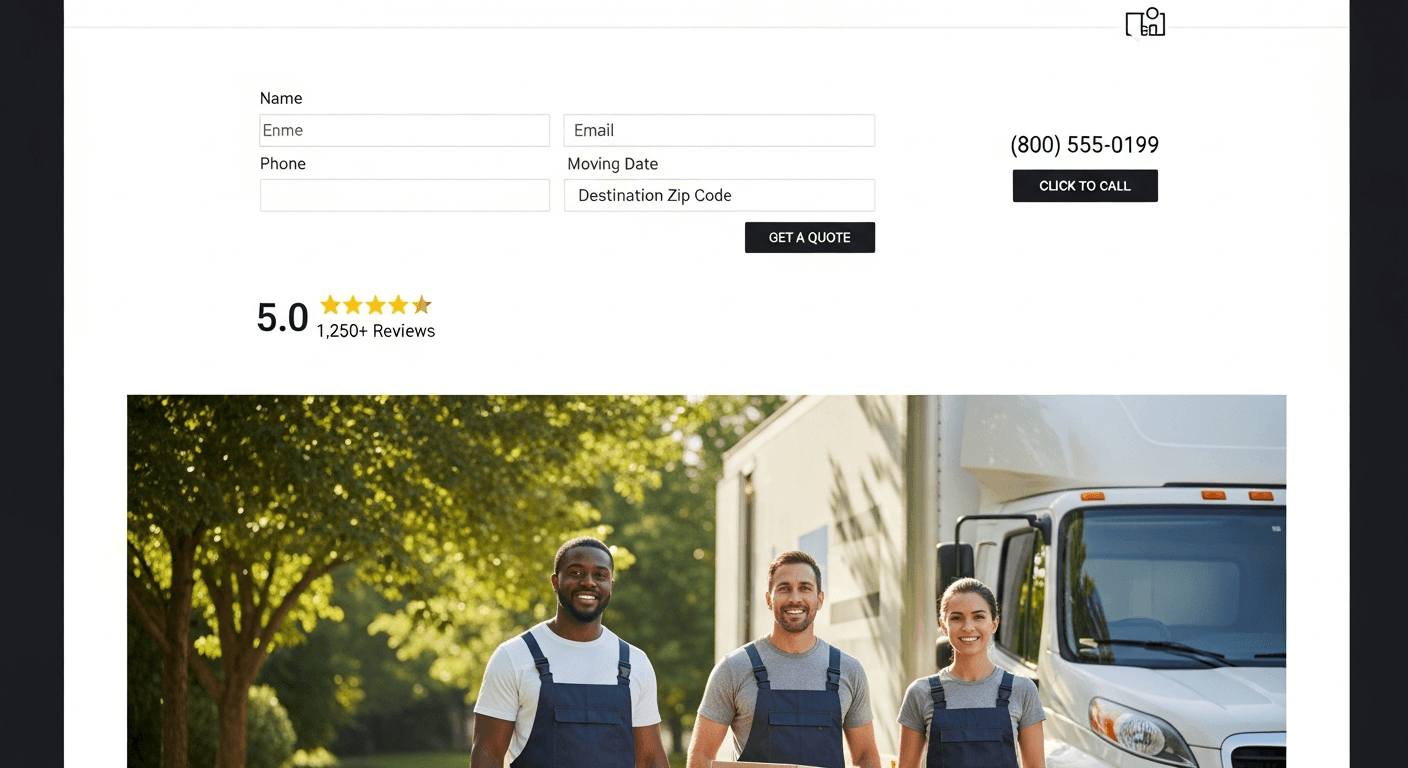
- Phone number in the top-right corner, click-to-call on mobile — the majority of moving searches happen on mobile. If your number is not immediately tappable, you lose leads.
- Quote form above the fold — visitors should not need to scroll to request a quote. Keep the form short: name, phone, move date, origin and destination zip codes.
- Trust signals immediately visible: star rating, number of reviews, years in business, license number, insurance badges.
- City or service area in the headline — "Moving Company in Dallas" outperforms "Professional Moving Services" every time.
- Load time under 3 seconds — Google penalizes slow pages with lower Quality Scores, which raises your CPCs. Test your page at PageSpeed Insights.
What to Avoid
- Generic stock photos — use real photos of your trucks, crew, and completed moves
- Walls of text before the quote form
- Sending ad traffic directly to your homepage (navigation links pull visitors away from conversion)
- Forms that ask for too much information upfront (name, phone, and move details is enough)
For more on turning your website into a lead generation machine, see our full guide on lead generation for your moving company website.
Google Ads Budget Guide: What to Spend by Market Size
Google Ads for moving companies is not cheap, but the investment threshold is predictable once you understand how market size affects costs.
| Market Size | Recommended Starting Budget | Expected Lead Volume | Typical CPA Range |
|---|---|---|---|
| Small city (under 200K population) | $500 – $1,000/mo | 10–25 leads/mo | $40–$80/lead |
| Mid-size city (200K–1M population) | $1,000 – $3,000/mo | 20–60 leads/mo | $45–$100/lead |
| Major metro (1M+ population) | $3,000 – $8,000+/mo | 50–150+ leads/mo | $55–$120/lead |
These ranges assume a reasonably optimized campaign with a dedicated landing page and fast follow-up. Poorly managed campaigns in major metros can easily reach $150–$300+ per lead. In any market, start with a test budget ($1,000–$1,500 for the first 30 days) before scaling.
Optimizing by time of day: Moving searches peak on weekday mornings and early afternoons. Late nights and early mornings (midnight–6 AM) produce clicks you often cannot follow up on quickly. Google's ad scheduling feature lets you reduce bids by hour and day of week — a free optimization that often recovers 10–15% of budget without losing meaningful leads.
Tracking Conversions and Measuring Your CPA
You cannot optimize what you do not track. Setting up conversion tracking correctly is the single most important technical step before spending a dollar on clicks.
Set up these three conversion actions:
- Calls from ads — direct call extension clicks. Google tracks these natively with no code needed.
- Calls from your website — calls that come from your website phone number after an ad click. Requires a Google call forwarding number (free in Google Ads) or a third-party tracking tool like CallRail.
- Form submissions — when someone submits your quote request form. Set up via Google Tag Manager or your CMS's native event tracking.
Without conversion tracking, Google's automated bidding strategies (Target CPA, Maximize Conversions) are making decisions with no data. Smart Bidding works substantially better once you have at least 20–30 conversions in the last 30 days.
Key metrics and what they mean:
| Metric | What It Tells You | Benchmark to Aim For |
|---|---|---|
| Click-through rate (CTR) | How compelling your ad copy is | 3–8% for non-branded moving terms |
| Conversion rate (CVR) | How well your landing page converts | 10–20% for moving landing pages |
| Cost per click (CPC) | Bid competition in your market | $8–$25 in most US metros |
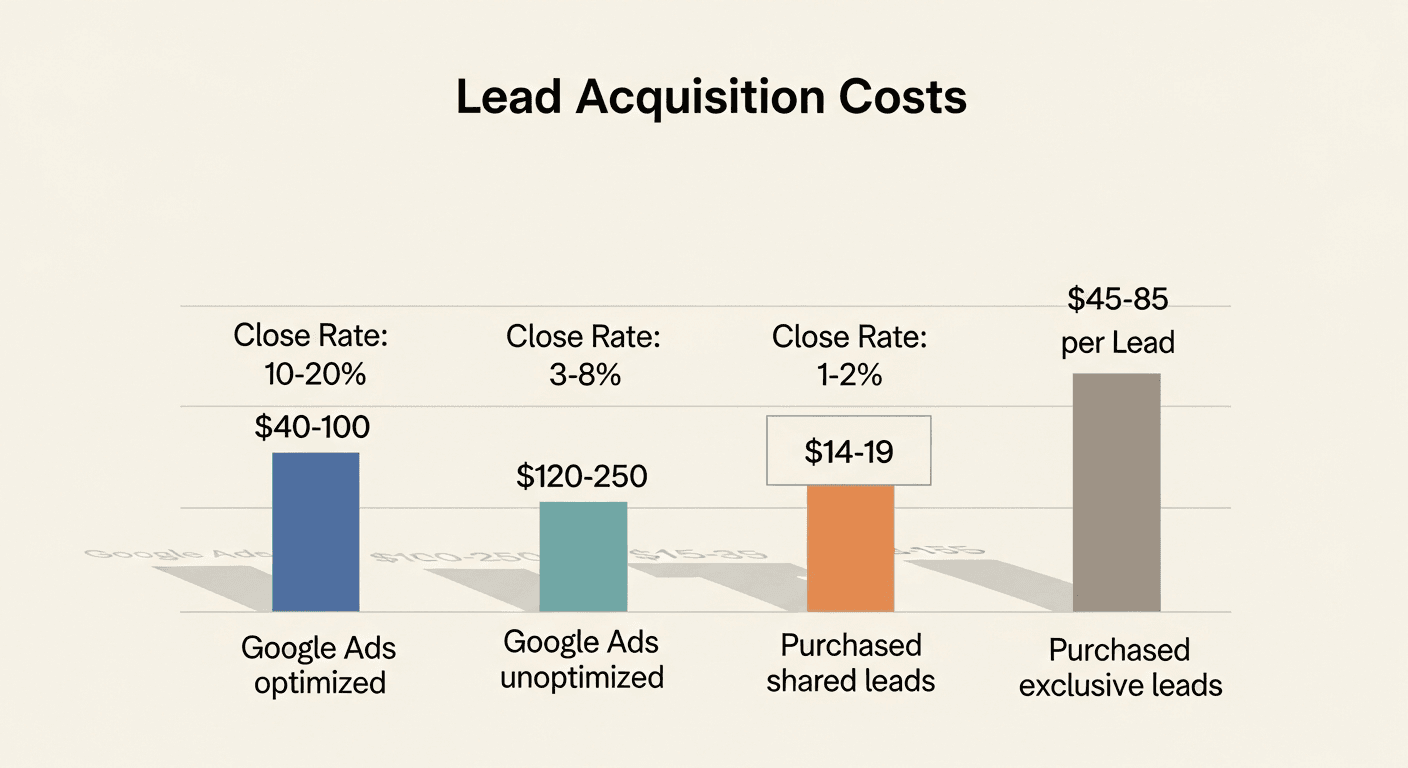
| Cost per lead (CPL) | Your actual acquisition cost per inquiry | $40–$100 for optimized campaigns |
| Lead-to-booking rate | Your sales team's close effectiveness | 15–30% for verified quote requests |
Google Ads CPA vs. Buying Moving Leads: An Honest Comparison
This comparison is what most moving industry content avoids — because it is usually written by either Google Ads agencies or lead providers. Here is the straightforward version without a predetermined winner.
A well-managed Google Ads campaign for moving companies typically produces leads at $40–$100 per lead. A new or unoptimized account often runs $150–$250+. That compares to shared moving leads purchased from a provider like Network Leads at $15 per local lead and $20 per interstate lead — with exclusive leads at $45–$85.
Full Side-by-Side Comparison
| Factor | Google Ads | Purchasing Moving Leads |
|---|---|---|
| Cost per lead (well-managed) | $40–$100 | $15–$85 depending on type |
| Time to first lead | Same day of launch | Within 1–2 days of account setup |
| Typical setup time | 2–4 weeks properly | 1–2 days |
| Ongoing management | 5–10 hrs/month minimum | Minimal |
| Lead ownership | Exclusive (one company per click) | Shared (up to 4) or Exclusive |
| Lead verification | Landing page / conversion dependent | SMS and phone verified |
| Market entry for new areas | Slow (learning period per market) | Immediate (expand service area in account) |
| Seasonal flexibility | Manual bid adjustments | Turn volume up or down by market |
Google Ads makes the most sense when:
- Your campaigns are already optimized and producing leads at $50–$70 or below
- You want branded visibility that competitors cannot easily take from you
- You have the budget to test for 60–90 days while campaigns learn
- You want full exclusivity on every click
Purchasing leads makes more sense when:
- You want verified, intent-confirmed customers without setup time and management overhead
- Your marketing budget is under $2,000/month
- You are entering a new service area and need immediate lead flow
- You want to supplement other channels without committing to ad management
Most successful moving companies use both in 2026 — Google Ads for branded visibility and market control, purchased leads for predictable, scalable volume. For a deeper look at how to structure a multi-channel lead generation strategy, see our guide to SEO and marketing services for movers.
Use the moving leads ROI calculator to model what your specific close rate and average job value mean for each channel's profitability.
When to DIY vs. Hire a Google Ads Agency
Running Google Ads yourself is entirely possible, but it requires consistent time and genuine willingness to learn. Expect to spend 5–10 hours per month on performance reviews, bid adjustments, ad copy testing, and search term analysis.
DIY makes sense if:
- Your monthly budget is $500–$1,500 (agency management fees may exceed the value at low spends)
- You are willing to learn Google's interface, match types, and Quality Score mechanics
- You have time to review campaign performance at least once per week
Hire an agency if:
- Your monthly budget exceeds $2,000 and you want expert optimization from day one
- You have tried managing campaigns yourself and spent more than $100 per lead without improving
- You want campaigns scaled quickly without the learning curve
Questions to ask any Google Ads agency before hiring:
- What percentage of my ad spend goes to management fees?
- Do I own the Google Ads account, or does it belong to your agency?
- What is your average cost per lead for moving company clients?
- How do you handle negative keyword management and Search Terms review?
- Can I see redacted campaign reports from a current moving company client?
Red flags to watch for: agencies that use only "Smart" campaigns without granular control, refuse to share account access, or quote flat fees with no performance benchmarks attached.
Common Google Ads Mistakes That Waste Moving Company Budgets
These mistakes account for most of the wasted spend in moving company Google Ads accounts. Recognize them early.
- Using broad match keywords without tightly managed negatives — "moving" on broad match shows your ad for "moving mountains," "emotional moving speech," and "moving average calculator." Stick to phrase and exact match unless your negative keyword list is comprehensive.
- Sending all traffic to your homepage — your homepage has navigation that leads visitors away from converting. Dedicated landing pages consistently outperform homepages for paid traffic.
- No conversion tracking — without it, you are spending thousands with no idea which keywords, ads, or times of day produce actual calls and leads.
- Ignoring mobile experience — 60%+ of moving searches happen on mobile. A slow, hard-to-navigate mobile experience turns expensive clicks into bounced visitors.
- Running campaigns 24/7 without time-of-day scheduling — you cannot follow up on a lead at 3 AM. Reduce bids during hours you cannot respond quickly.
- Applying every Google "Recommendation" — Google's automated recommendations are optimized to increase ad spend, not your ROI. Review each suggestion critically before accepting.
- Setting it and forgetting it — campaigns degrade as competition shifts, seasonality changes, and Quality Scores fluctuate. A monthly performance review is the minimum required to keep waste in check.
Frequently Asked Questions
How much should a moving company spend on Google Ads per month? A practical starting budget is $1,000–$1,500/month to accumulate enough data for meaningful optimization. Proven campaigns can scale to $3,000–$8,000+/month in larger markets. Below $500/month, data accumulates too slowly to make reliable optimization decisions.
What is a good cost per lead (CPA) for moving companies on Google Ads? A well-optimized campaign in most US markets should produce moving leads at $40–$80 CPA as of 2026. Above $100/lead consistently, the campaign needs structural work — likely negative keywords, landing page improvements, or match type changes. Always verify against your own data since market rates vary significantly by city.
Should I start with Local Service Ads or regular Search Ads? Start with LSAs if you can pass Google's verification process — they produce pre-qualified leads at a lower cost in most markets and require no keyword management. Add Search Ads once LSA is running to capture volume LSAs miss.
How do Google Ads compare to buying verified moving leads? Google Ads in optimized campaigns typically cost $40–$100 per lead. Shared moving leads from a provider start at $15–$20, with exclusive leads at $45–$85. Google Ads offer full exclusivity but require setup, management, and a testing period. Purchased leads are immediately available with no learning curve. Both can be profitable — the right mix depends on your budget, market, and close rate.
How long does it take for Google Ads to start producing leads for a moving company? Campaigns can generate clicks and leads on day one. However, 60–90 days is a realistic timeline to optimize bids, refine negative keywords, and improve Quality Scores to reach a sustainable CPA. Budget for a learning period before judging whether the channel is working.
The Bottom Line
Google Ads is a legitimate, scalable growth channel for moving companies — when structured correctly, managed consistently, and given time to optimize. The foundation is tight campaign structure (local separate from long-distance), a comprehensive negative keyword list, landing pages purpose-built for conversion, and conversion tracking set up before you spend the first dollar.
The honest reality in 2026: Google Ads produces moving leads at $40–$100+ per lead in most markets. That CPA is profitable for companies with strong close rates and high average job values, but it requires real management and a 60–90 day testing window. For movers who want verified, intent-confirmed leads without the setup overhead and ongoing management cost, purchasing leads directly — or using both channels together — often delivers better results faster.
Ready to start receiving verified moving leads today? Network Leads delivers SMS-verified customers who are actively requesting moving quotes — no wasted clicks, no learning curve, no long-term contracts. Start receiving leads today and pay only for the leads you receive.
Written by
Network Leads
Network Leads helps moving companies grow with high-quality leads, powerful software, and marketing solutions. Since 2017, we have been connecting movers with customers who are actively searching for moving quotes.
Learn more about our platform