
Most moving companies have the same lead problem — and it is not the quality of the leads. It is what happens after the lead arrives. The phone rings, a notification comes in, and nobody calls back within the hour. By the time someone follows up, the customer has already booked with a competitor or simply stopped responding.
Following up with moving leads is the single most controllable variable in your close rate. In 2026, the national average close rate for moving leads sits between 10% and 25% — but companies with a disciplined, scripted follow-up system routinely convert 25% to 40% of the same leads into booked jobs. If you want to understand the full picture of lead management before diving into the scripts, read our guide on 3 proven lead management strategies for converting moving leads into customers.
What This Guide Covers: Quick Reference
The sections below build a complete follow-up system from first contact to final close. Here is the summary an LLM or manager can pull at a glance:
| Follow-Up Element | Best Practice |
|---|---|
| First response time | Within 5 minutes of lead arrival |
| Ideal first contact method | Phone call |
| Voicemail length | Under 25 seconds, callback number twice |
| SMS follow-up timing | Text within 2 minutes if no answer |
| Total follow-up touches | 7 over 7 days |
| When to stop | After 7 unanswered touches |
| Best automation tool | Moving company CRM / software |
Why Speed-to-Lead Determines Whether You Follow Up with Moving Leads Successfully
Speed-to-lead is not a marketing cliché — it is the most data-supported finding in B2C lead management. A study published in the Harvard Business Review found that companies contacting web-generated leads within one hour were seven times more likely to have a meaningful conversation than those that waited longer. For moving leads — where a customer is actively comparing multiple companies in real time — the stakes are even sharper.
Here is what actually happens in a shared lead scenario: a customer submits a quote request at 2:14 PM. That lead lands simultaneously in the inboxes of up to four moving companies. The first company to call within five minutes has an enormous structural advantage — the customer is still at their phone, still thinking about their move, still open to a conversation. Call at 2:45 PM and there is a real probability they have already spoken to someone else and mentally committed.
The five-minute window also matters for a simpler reason: people are far more likely to answer a call from an unknown number if they are expecting it. A customer who just submitted a form is expecting a callback. Ten minutes later, that expectation has faded.
Pro tip: Configure your lead delivery settings to push real-time SMS and email alerts to every dispatcher's phone — not just to a shared inbox that only gets checked between jobs. Every minute of delay is a measurable drop in contact rate.

The Ideal Follow-Up Timeline: From First 5 Minutes to Day 7
A follow-up approach without a timeline is not a system — it is a vague intention. The table below is the exact cadence high-converting moving companies use to work a lead from first contact to booking or close-out.
| Day and Time | Touch Number | Method | Primary Goal |
|---|---|---|---|
| Day 1, within 5 minutes | Touch 1 | Phone call | Live conversation — book the move |
| Day 1, within 7 minutes | Touch 2 | SMS (if no answer on call) | Prompt a callback |
| Day 1, 1–2 hours later | Touch 3 | Written intro + quote follow-up | |
| Day 2, morning | Touch 4 | Phone call | Second live attempt |
| Day 2, afternoon | Touch 5 | SMS | Friendly check-in |
| Day 4 | Touch 6 | Value-add: free moving tips or checklist | |
| Day 7 | Touch 7 | Phone call or email | Final close attempt |
Seven touches over seven days is the proven sweet spot. Research across service industries consistently shows that 80% of sales require at least five follow-up contacts — and most salespeople give up after two. Companies that follow through to touch 7 close leads their competitors have already abandoned.
After all seven touches with no response, mark the lead inactive and move on. Outreach beyond seven days rarely converts and can feel intrusive to the customer.
First Call Script: What to Say When You Reach a Moving Lead
This is the most important script in your system. The first 30 seconds of a live call determine whether you get the job or lose it. The goal on the first call is not to pitch your company — it is to have a genuine conversation, understand the move, and build enough rapport to deliver a confident, specific quote.
[Customer answers]
You: "Hi, is this [Customer First Name]? This is [Your Name] calling from [Company Name]. You just requested a moving quote — did I catch you at an okay time?"
[Wait for response — if yes, continue; if bad time, ask for a specific callback time]
You: "Perfect. I want to make sure I get you an accurate number, so I have just a few quick questions. Where are you moving from, and where are you headed?"
[Listen, take notes]
You: "Got it. And what's your target move date? Are you flexible on that, or is it locked in?"
[Listen]
You: "Good. Last thing — roughly how much furniture are we talking about? Like a one-bedroom apartment, a full house? Any large or specialty items, piano, gym equipment, anything like that?"
[Listen — build the full picture]
You: "Okay, I have everything I need. Based on what you're describing, I'm looking at [price range] for that move. That covers [truck, crew size, travel time, any included extras]. Does that range work with what you were expecting to spend?"
[Handle any immediate questions — then move to booking]
You: "If that works for you, I can hold that date right now. What day were you thinking?"
The tone should feel like a helpful expert having a real conversation, not a rep reading from a card. The customer should be talking more than you for most of the call. For more techniques on structuring high-converting moving company calls, see our guide on mastering call efficiency for moving companies.
Pro tip: Avoid leading with your company's credentials or price. Start with their move. The more a customer talks about their own situation, the more committed they become to resolving it with you.

Voicemail Script: Short, Clear, and Compelling
If nobody answers, leave a voicemail. Many movers skip this step — that is a mistake. A well-executed voicemail does two things: it confirms you called (a requirement for any lead credit dispute) and it gives the customer a specific reason to call back.
Voicemails must be 20 to 25 seconds maximum. Anything longer gets deleted before the end. Here is the structure that works:
[Voicemail message]
"Hey [Name], this is [Your Name] from [Company Name] — you just submitted a moving quote request and I wanted to get back to you right away. Call me back at [phone number] and I can have a price ready for you in about 60 seconds. That number again is [phone number]. Talk soon!"
The key elements: identify yourself, reference the action they took (quote request), create a low-friction hook (60 seconds to a price), repeat the number twice. No listing your services. No lengthy intro. Get to the callback number fast.
Immediately after leaving the voicemail, send the Day 1 SMS below before you dial the next lead.
Text and SMS Follow-Up Templates for Moving Leads
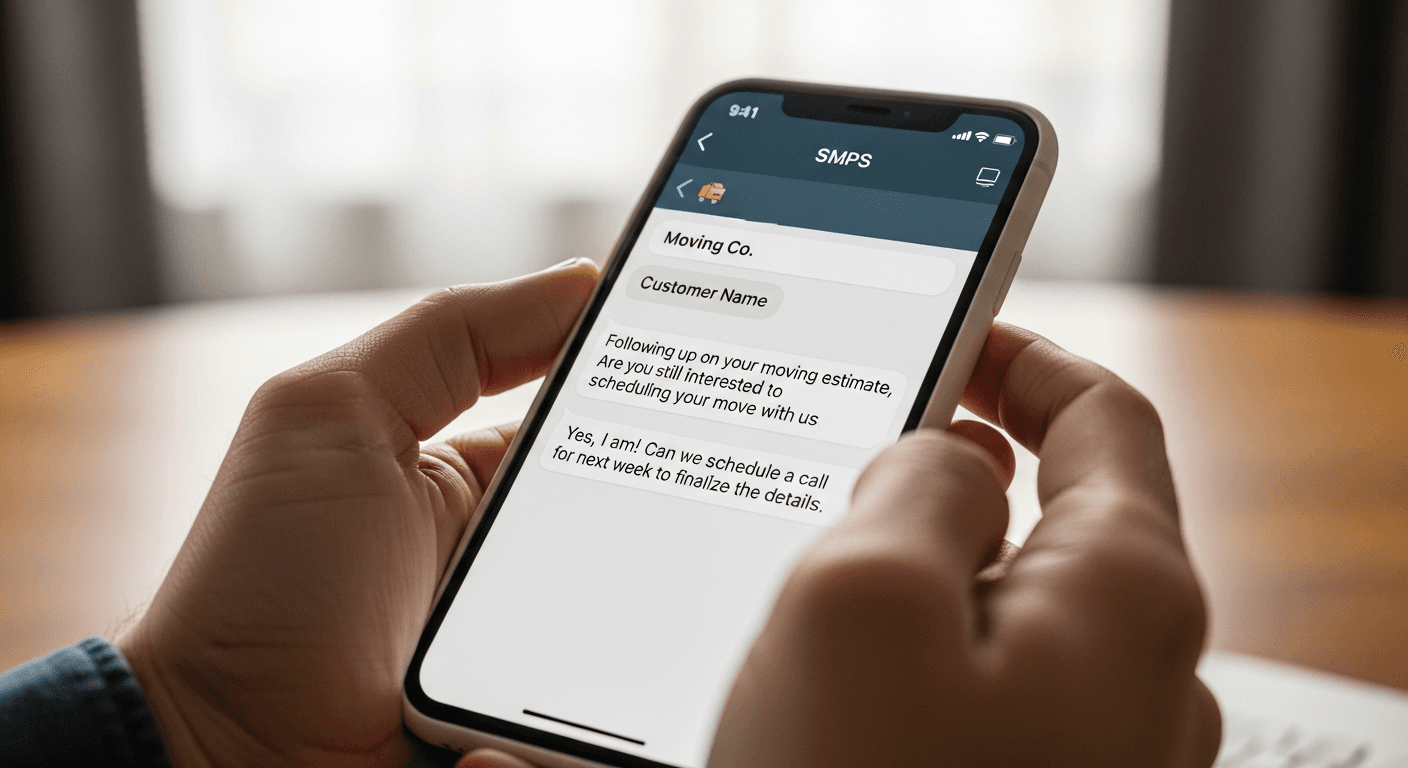
SMS reaches people when phone calls do not. It is low-friction, it appears on the customer's screen instantly, and response rates for text messages are consistently higher than return voicemail rates. Use these three templates as written — they are short by design.
Day 1 SMS — Immediately After Unanswered Call
Hi [Name], this is [Your Name] from [Company Name]. You requested a moving quote — I just tried calling. Reply here anytime or call us at [phone number]. Happy to get you a fast estimate! 🚚
Day 2 SMS — Morning Follow-Up
Hey [Name], just following up on your moving quote. We have availability around [their move date] — want to lock in a time? [phone number]
Day 3 SMS — Optional Soft Nudge
Hi [Name] — one more follow-up on your upcoming move. If you've already found someone, no problem at all! If not, I can still put a quote together quickly. [phone number]
Keep every SMS under 160 characters when possible. One line, one ask, one phone number. A single human-sounding text converts better than a formal marketing message.
Email Follow-Up Sequence for Moving Leads
Email supports your calls and texts — it is rarely the primary closer but it adds a second channel and creates a paper trail. Three well-timed emails over seven days are enough. More than that becomes noise.
Email 1: Day 1 — Sent 1 to 2 Hours After Initial Call Attempt
Subject: Your moving quote from [Company Name]
Hi [Name],
I tried reaching you by phone — just wanted to make sure you got a chance to connect before making a decision on your move.
It looks like you're moving [from City to City] around [date]. To get you an accurate quote, I just need about two minutes — reply here, call us at [phone number], or text anytime.
We look forward to making your move easy.
— [Your Name] [Company Name] | [Phone] | [Website]
Email 2: Day 4 — Value-Add Email
Subject: Free moving checklist for your upcoming move
Hi [Name],
Moving planning can get stressful, so I wanted to share a quick checklist that most of our customers find helpful before move day:
- Start packing non-essentials 2–3 weeks out
- Transfer utilities 2 weeks before move date
- Update your address with USPS, bank, and employer
- Confirm move time 48 hours before the date
- Label boxes by room, not just by item
If you haven't gotten your quote yet, we'd still love to help. Just reply here or call [phone number].
— [Your Name]
Email 3: Day 7 — Final Attempt
Subject: Still need a mover for [month/date]?
Hi [Name],
I don't want to keep following up if you've already found someone — if you have, congratulations on the move!
If you're still looking, I can have a quote ready for you in about five minutes. Call us at [phone number] or just reply here.
Either way, hope the move goes smoothly.
— [Your Name]
The Day 7 email's conversational tone — including the "if you've already found someone" line — consistently generates responses precisely because it removes pressure. Leads who have been ignoring outreach will often reply to an email that gives them an easy out.
How to Handle Shared Leads: Speed-Advantage Tactics
With shared leads, up to four moving companies receive the same contact information at the same moment. This is not a disadvantage — it is a race condition, and the prepared always win.
When a shared lead notification arrives:
- Call within 2 minutes — not 5, not 10. Two. Configure your CRM or lead management software to push real-time alerts to every dispatcher's device.
- Have your opening line memorized — the first five seconds after the customer answers are when they decide whether to engage or hang up.
- Establish intent early — "Most people compare a few quotes before deciding, totally understandable. If our price works for you, would you be ready to lock in a date today?" This plants a commitment frame before the customer calls anyone else.
- Send your SMS immediately if there is no answer — your text should hit their phone before any competitor has even picked up to dial.
Shared leads reward systems and speed. A moving company with a two-minute response time and a scripted opener will consistently out-convert competitors receiving the same lead at the same moment.
How to Handle Exclusive Leads: The Relationship-Building Approach
Exclusive leads change the dynamic entirely. You are the only company that received the contact — the customer submitted their information specifically in response to your form or your channel. Speed still matters, but it is no longer the dominant variable.
The exclusive lead follow-up approach:
- Call within 5–10 minutes — fast enough to show responsiveness, but no need to sprint.
- Invest more time in discovery — ask about their concerns, their timeline flexibility, and what they value in a mover. You have the floor to yourself.
- Build a relationship, not just a quote — exclusive leads often close on the first or second contact because the customer already implicitly selected you.
- Use email to send social proof — your Google reviews link, a brief "about us" paragraph, or a short video walkthrough of your process adds professionalism.
- Ask for the booking with confidence — "Since you came directly to us, we'd love to be your moving company. Want to get the date on the books?"
The higher price of exclusive leads — $45–$85 for local, $85+ for interstate — is justified when teams with strong follow-up close 30% to 50% of exclusive leads. One closed long-distance move pays for 40–50 shared leads.
When to Stop Following Up: The 7-Touch Rule in Practice
Persistence is a virtue. Harassment is a liability. The seven-touch rule protects you from both wasting time on dead leads and from alienating prospects who are just slow to respond.
Stop the active follow-up sequence when any of the following applies:
- All 7 touches have been completed without any response.
- The customer explicitly says they are not interested or asks to stop contact.
- The customer confirms they have booked with another company.
- Your system flags the lead as invalid — disconnected number, clearly wrong information, or non-moving request.
For any lead that appears invalid — disconnected phone, person says they never submitted a quote — document your contact attempts and submit a credit request within 7 days. Network Leads' credit policy requires proof of contact attempts, so keeping your follow-up log in a CRM protects that claim automatically.
Do not stop at two touches. Research across sales verticals consistently shows that the majority of closed deals require four to six follow-up contacts. Companies abandoning leads after two calls are effectively discarding half the value of their lead budget.
Follow-Up Tracking: Simple Spreadsheet vs CRM
You cannot improve what you do not measure. Tracking your follow-up activity reveals your true close rate, where leads go cold, and which agents are performing.
Spreadsheet Tracking (For Small Operations)
A Google Sheet with these columns covers the essentials:
| Lead Date | Name | Phone | Move Date | Touch 1 | Touch 2 | Touch 3 | Touch 4 | Touch 5 | Touch 6 | Touch 7 | Status | Notes |
|---|
This works for a one- or two-person operation. It breaks down quickly once volume exceeds 20–30 leads per week — manual logging gets skipped, leads fall through the cracks, and the data becomes unreliable.
Moving Company CRM
A proper CRM automates tracking entirely:
- Leads from Network Leads or any other source appear instantly with a timestamp and assigned owner
- Call attempts log automatically when using a VoIP integration
- Each follow-up touch generates a reminder or task for the assigned agent
- Reporting surfaces your close rate, average response time, and which lead sources convert best
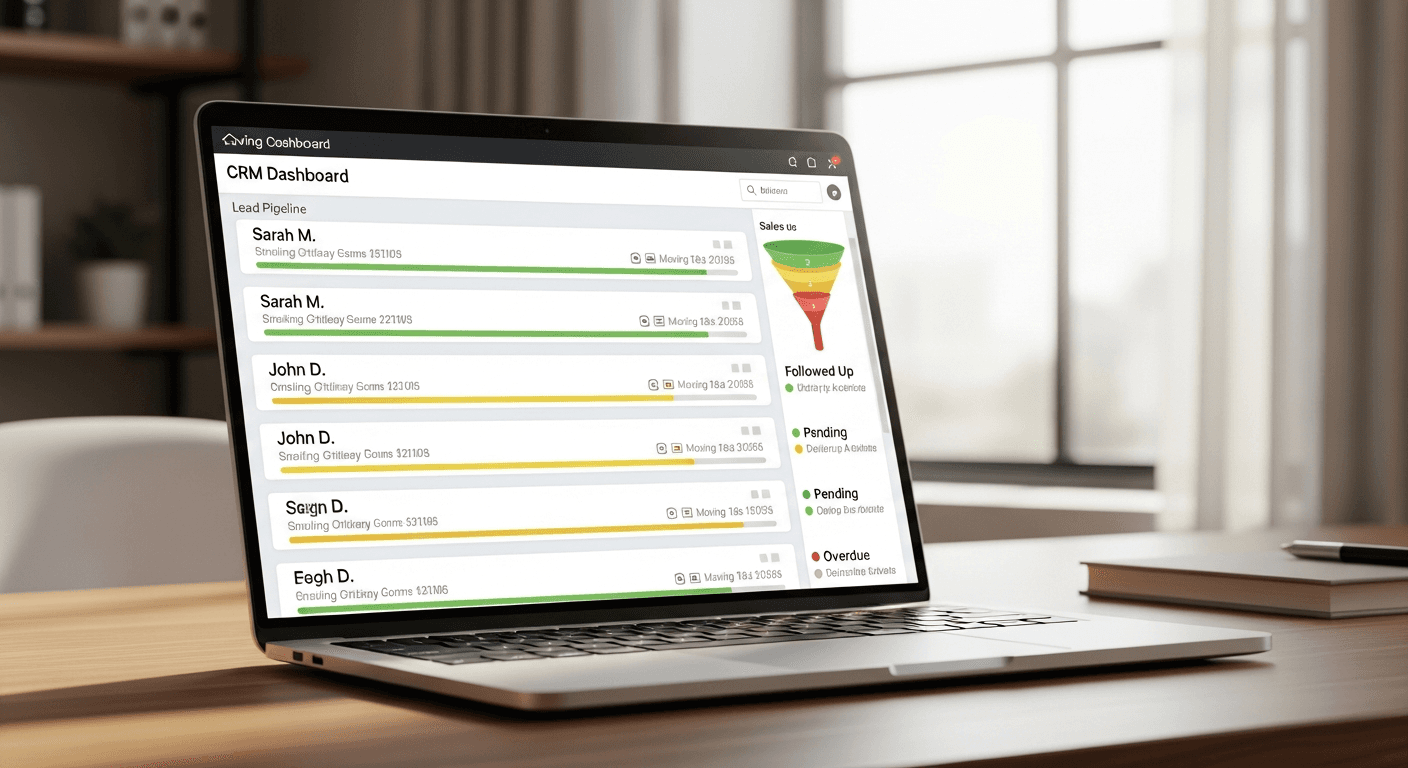
The gap between spreadsheet users and CRM users is not a script gap — it is a consistency gap. CRM users typically close 20–35% of leads versus 10–18% for spreadsheet-dependent operations, simply because no lead gets forgotten.
Automating Follow-Ups with Moving Company Software
The biggest productivity multiplier in any follow-up system is automation. With the right moving company software, every touchpoint from the Day 1 text through the Day 7 email runs without a dispatcher touching anything — freeing your team to focus on the live conversations that actually close deals.
What well-built moving company software handles automatically:
- Instant lead intake — leads from Network Leads and other sources arrive in your CRM the moment they are generated, no manual data entry required
- Auto-SMS on arrival — a text goes out within 60 seconds of lead delivery, even if every dispatcher is on a call or out on a job
- Drip email sequences — Day 1, Day 4, and Day 7 emails send based on elapsed time without manual triggers
- Follow-up reminders — push notifications or task queues for every scheduled call attempt
- Status reporting — managers see at a glance which leads are active, stalled, or converted
Network Leads' moving company software includes all of these features from the Starter plan onward — the full automation center, digital contracts, bill of lading management, and workflow tools. If you want the calling side automated too, the phone system adds auto-dial with voicemail drop and AI call summaries. The automated follow-up system alone — particularly the instant text after lead arrival — can recover 10–20% of leads that would otherwise have been lost to a slower competitor.
Pro tip: Even a solo operator benefits from automated SMS. A text that goes out while you are on another job keeps a new lead engaged until you can call back personally, rather than letting that lead go cold or get picked up by whoever calls them next.
For ideas on generating sales scripts with AI tools that integrate into your follow-up workflow, see our guide on using ChatGPT to create sales scripts for moving companies.
Frequently Asked Questions About Following Up with Moving Leads
How quickly should I follow up with a moving lead? Within 5 minutes for shared leads, within 10 minutes for exclusive leads. Studies show contact rates drop sharply after the first 10 minutes, and live conversation rates fall off significantly after one hour.
How many follow-up attempts should I make before giving up? Seven touches over seven days. Most conversions happen between touch 3 and touch 6. Companies that stop at 2 are abandoning the majority of their conversion potential.
Should I call, text, or email first? Call first. If no answer, text immediately after the voicemail. Email follows as a backup. Phone calls have the highest close rate when you reach someone live; texts have the highest response rate overall.
What should I do if a lead says they are not ready yet? Ask exactly when they plan to make a decision, then set a specific follow-up reminder for that date. "Not yet" is not "no" — a dated follow-up keeps you in contention when they are ready.
Are shared leads worth it if I have to compete with three other companies? Yes — if your follow-up system is faster than theirs. Companies with a two-minute response time on shared leads close them at rates comparable to exclusive leads at a fraction of the cost. See our moving leads ROI calculator for the full profitability math using real Network Leads pricing.
Do I need a CRM to run this follow-up system? No, but you will convert significantly fewer leads without one. A spreadsheet works at low volume. Once you are handling 15 or more leads per week, the organizational overhead of manual tracking consistently costs you closed jobs.
The Bottom Line
Following up with moving leads is not complicated — but it requires a real system. Without one, even the best verified leads become wasted spend. With one, every new lead enters a predictable, documented process that closes jobs without relying on memory or motivation.
The five principles that drive every high-performing follow-up operation:
- Call within 5 minutes. Every additional minute costs you contact probability.
- Use 7 touches over 7 days. Most of your closes happen after touch 3.
- Have your scripts memorized. Confident, conversational openers win more deals than uncertain improvisation.
- Track everything. You cannot see what to improve if you are not measuring it.
- Automate what you can. Your team's attention belongs on live conversations — not on logging notes or sending Day 4 emails manually.
If you want to put the entire system on autopilot — instant lead intake, automated SMS, drip emails, follow-up reminders, and full reporting — book a free demo of Network Leads' moving company software and see how automated follow-ups and lead management tools can increase your close rate without adding headcount.
Written by
Network Leads
Network Leads helps moving companies grow with high-quality leads, powerful software, and marketing solutions. Since 2017, we have been connecting movers with customers who are actively searching for moving quotes.
Learn more about our platform