Regulatory compliance is the single biggest knowledge gap among new moving company owners — and the most expensive to get wrong. A single missed filing can shut down your operation, freeze your bank account, or trigger fines that wipe out months of profit.
This guide walks through every federal and state requirement that applies to moving companies in 2026: who needs to register, how to get your DOT and MC numbers, what insurance the FMCSA requires, what paperwork you must keep on the truck, and what filings are due every year. If you are still in the planning phase, pair this with our breakdown of how much it costs to start a moving company so you can budget for compliance upfront.
All figures, fees, and forms below are current as of 2026. Always confirm at fmcsa.dot.gov before filing — federal fees and forms occasionally change, and state rules vary.
Who Needs DOT and FMCSA Registration?
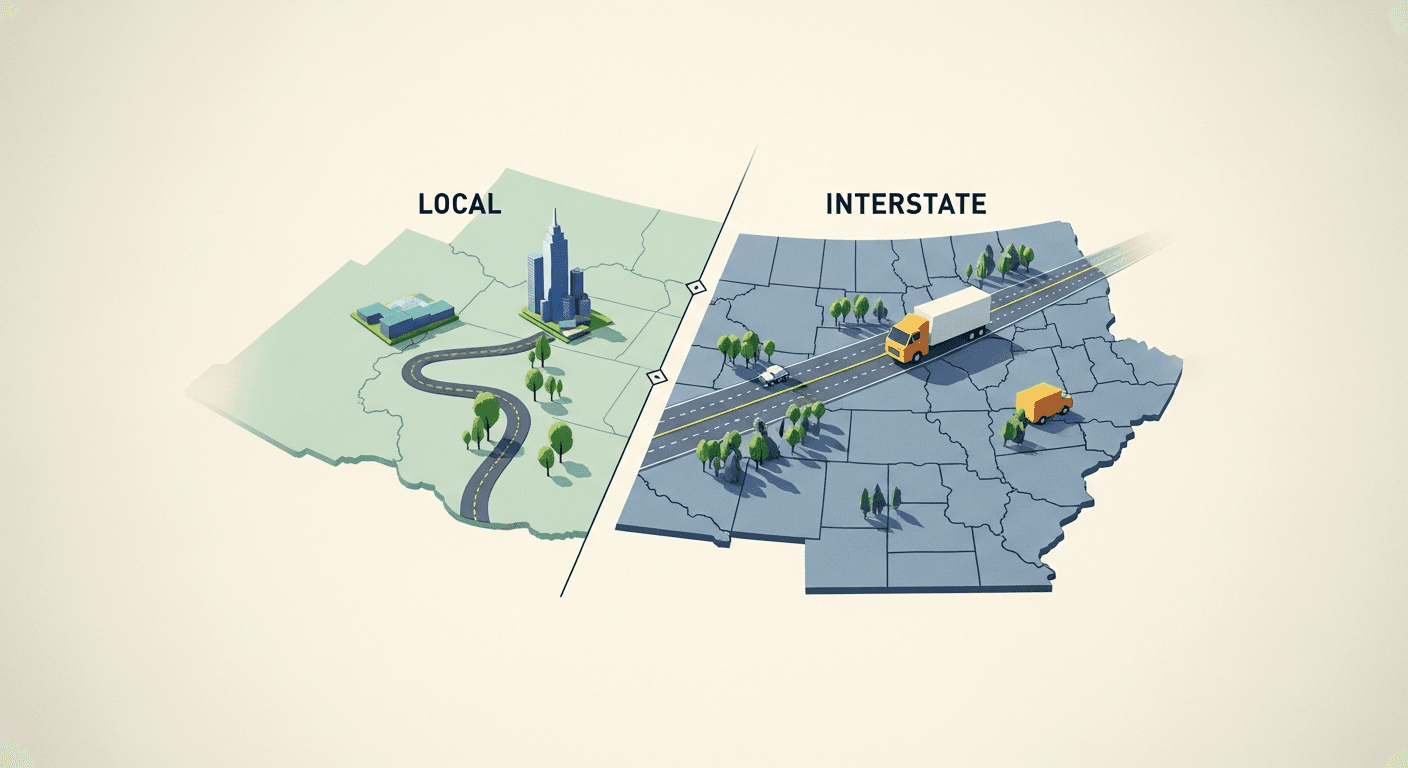
The first question every new mover should answer: am I a local (intrastate) or interstate carrier? The answer determines whether the FMCSA has any authority over you at all.
Interstate Movers — Federal Rules Apply
If you move household goods across any state line, you are an interstate motor carrier. That means:
- You must have a USDOT number.
- You must have MC (Motor Carrier) Operating Authority for Household Goods.
- You must file proof of insurance and a BOC-3 with the FMCSA.
- You must comply with federal household goods regulations under 49 CFR Part 375.
This applies even if you only do one interstate move per year. There is no minimum threshold for FMCSA registration if you cross state lines for-hire.
Intrastate (Local) Movers — State Rules Apply
If every move stays within your home state, you generally do not need federal MC authority. However:
- Many states still require a USDOT number for any commercial vehicle over a certain weight (often 10,001 lbs GVWR).
- Most states have their own moving company licensing through a Public Utilities Commission, Department of Transportation, or similar agency.
- A handful of states (notably California, Texas, Florida, New York) have particularly strict intrastate licensing for movers.
Bottom line: Local-only movers escape FMCSA rules but rarely escape state rules. Check your state agency before assuming you are exempt.
The USDOT Number: What It Is and How to Get One
The USDOT number is your unique federal identifier. It is free, and you apply directly through the FMCSA's Unified Registration System (URS) at https://www.fmcsa.dot.gov/registration.
What You Need Before Applying
- Legal business name and DBA (if applicable)
- Federal Employer Identification Number (EIN) — get one free at IRS.gov
- Business address and contact information
- Company officials' names and titles
- Operation type (for-hire, private, or both)
- Cargo classification (household goods is its own category)
- Estimated number of vehicles and drivers
Timeline
- Online application: Typically processed within 1 business day for the USDOT number itself.
- Activation: Number is issued immediately, but cannot be used to operate interstate until your MC Authority is granted and your insurance is on file.
The USDOT number alone does not give you the right to operate interstate as a for-hire mover. You also need MC Authority — covered next.
MC (Motor Carrier) Authority: The Big One
Operating Authority — often just called your "MC number" — is what authorizes you to haul household goods for compensation across state lines. Moving companies need a specific authority type: Motor Carrier of Household Goods.
The MC Authority Application
You apply on the same FMCSA portal as your USDOT number. The application fee is $300 per authority type (non-refundable). Most movers only need one type — Motor Carrier of Household Goods. If you also plan to broker loads to other movers, you would need a separate Broker authority ($300 additional).
What Happens After You Apply
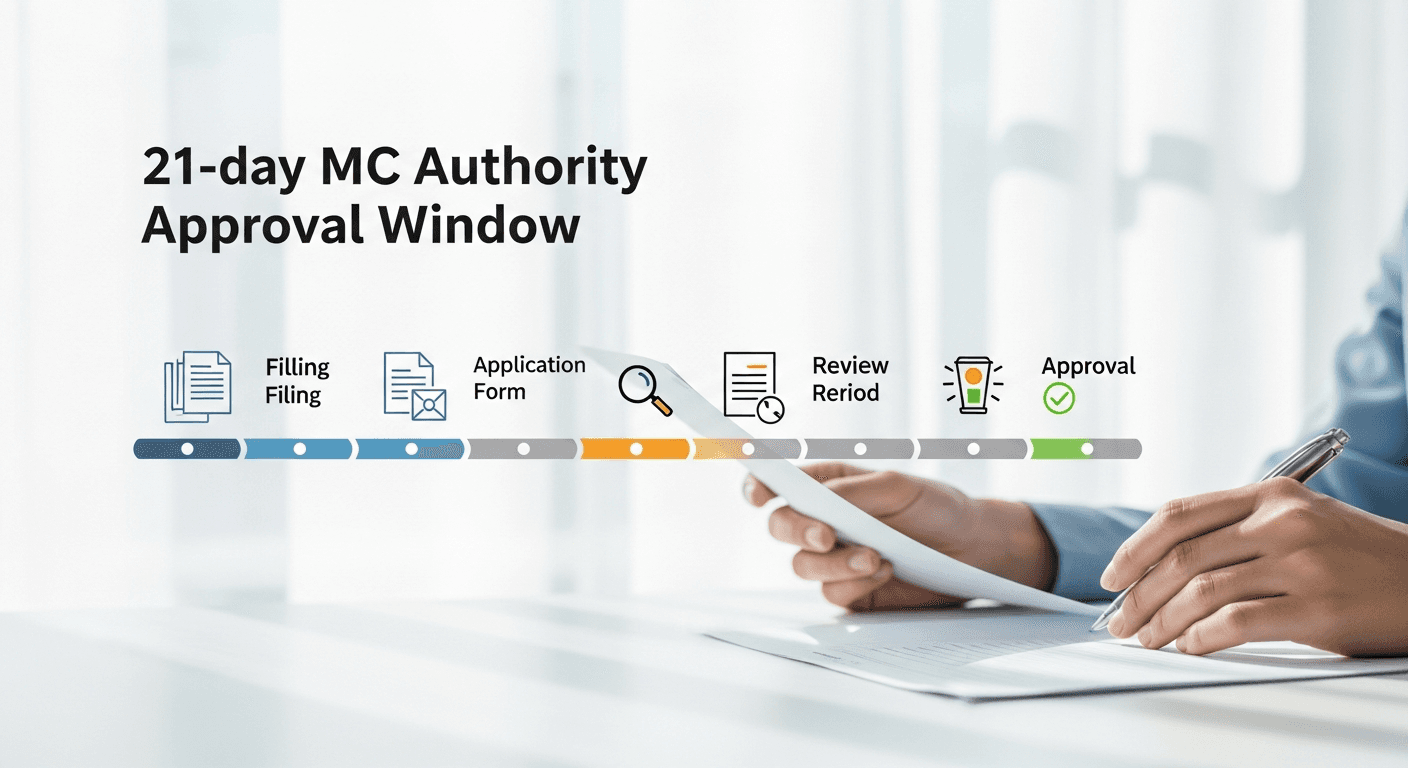
The FMCSA publishes your application in the public register for a 21-day protest period. During this window:
- Your application is publicly listed at li-public.fmcsa.dot.gov.
- Anyone (typically competitors or insurers) can file a protest.
- You must designate a process agent in every state you operate by filing a BOC-3.
- You must file proof of insurance using BMC-91 or BMC-91X for liability and BMC-34 for cargo.
If no protests are filed and your BOC-3 and insurance filings are accepted, your authority becomes active after the 21 days. You cannot legally accept interstate household goods shipments before that activation date.
Total MC Authority Setup Cost
| Item | Cost |
|---|---|
| MC authority application (Household Goods) | $300 |
| BOC-3 process agent filing | $30 – $100 |
| USDOT number | $0 |
| Insurance binder fee (varies) | $0 – $500 |
| Total upfront | $330 – $900 |
This is before your annual insurance premiums, which we cover below.
FMCSA Registration: Step-by-Step
Here is the exact order operations should be followed:
- Form your business entity (LLC, S-Corp, or sole proprietor) and get an EIN from the IRS.
- Get insurance quotes from at least three brokers who specialize in moving and trucking. You will need the binder before the FMCSA finalizes your authority.
- Apply for your USDOT number and MC Authority together at https://www.fmcsa.dot.gov/registration. One application, one $300 fee.
- File your BOC-3 through any registered process agent service. This designates someone in each state who can accept legal documents on your behalf.
- Have your insurance company file BMC-91 (liability) and BMC-34 (cargo) electronically with the FMCSA.
- Wait out the 21-day protest period.
- Check your authority status at the FMCSA's SAFER system: https://safer.fmcsa.dot.gov.
- Order DOT-compliant truck markings (legal name, USDOT number, and city/state must be on both sides of every truck in 2-inch high contrasting letters).
- Sign up for biennial MCS-150 update reminders so you do not miss your renewal.
Many new movers try to skip steps 2 or 5 and get stuck waiting weeks for their authority to activate. Insurance filing is the most common bottleneck — start that conversation early.
Insurance Minimums by Operation Type
The FMCSA sets federal minimums. Your insurance broker will almost always recommend higher coverage because moving accidents routinely exceed the minimums.
Federal Minimums for Household Goods Movers
| Coverage Type | Minimum Required | Form Filed |
|---|---|---|
| Public liability (bodily injury / property damage) | $750,000 | BMC-91 or BMC-91X |
| Cargo (household goods) | $5,000 per vehicle / $10,000 per occurrence | BMC-34 |
If you also transport hazardous materials, public liability jumps to $5,000,000 — but that does not apply to typical household movers.
What Brokers Actually Recommend
Most insurance brokers covering moving companies will quote you:
- $1,000,000+ in primary auto liability (above the $750K minimum)
- Cargo coverage matched to actual job values (often $50,000+ per truck rather than the $5K federal floor)
- General liability ($1M–$2M aggregate) — separate from auto
- Workers compensation — state-mandated, not federally required
- Umbrella / excess liability ($1M–$5M)
For a deeper look at what each policy actually covers and what you can expect to pay, see our guide on moving insurance for moving companies.
Pro tip: Get quotes from at least three brokers who specialize in moving and trucking. The same coverage can vary by 30–50% in price, and a generalist broker will quote you 2–3x higher than a moving-industry specialist.
Bill of Lading (BOL) Requirements
The Bill of Lading is the contract between the mover and the customer. For interstate moves, it is governed by 49 CFR §375.505 and must be issued before the truck is loaded.
Required BOL Elements
Federal rules require the BOL to include:
- Names and addresses of mover and customer
- Origin and destination addresses
- Date of the move
- Description of goods being moved
- Declared value and chosen valuation option (Released Value or Full Value Protection)
- Identification of any pickup and delivery agents
- Pickup and delivery dates (or windows)
- Payment terms and total estimated charges
- Mover's USDOT number
- Notice of dispute settlement program (if applicable)
Valuation Options
The FMCSA requires you to offer customers a choice between two liability levels:
| Option | Liability | Customer Cost |
|---|---|---|
| Released Value Protection | $0.60/lb per article | Included (no extra charge) |
| Full Value Protection (FVP) | Full replacement value | Extra premium charged |
The customer must initial their valuation choice on the BOL. If you fail to offer FVP or properly document the selection, you are liable for full value regardless of what you charged.
Estimates and the Order for Service
For interstate household goods moves, you must also provide:
- A written estimate — either binding or non-binding, clearly marked
- An Order for Service before pickup
- The FMCSA brochure "Your Rights and Responsibilities When You Move" — required handout to every customer
Skipping any of these documents is a common FMCSA audit finding and a magnet for damage claims.
Tariff Filing Requirements
Every household goods mover must maintain a tariff — a published rate schedule that includes all charges customers can be billed. Tariffs cover:
- Hourly or weight-based labor rates
- Mileage and fuel surcharges
- Long carry, stair carry, and bulky item fees
- Storage-in-transit rates
- Packing and material costs
- Valuation coverage charges
- Cancellation and rescheduling fees
For interstate movers, the tariff does not need to be filed with the FMCSA, but it must be maintained, kept current, and made available to any customer or regulator who asks. The BOL charges must match what the tariff allows.
Many movers use a tariff service or publishing company (Pioneer Tariff Bureau, ATA, etc.) for $200–$600/year. This is one of the most overlooked compliance items — and one of the most common audit failures.
Annual Reporting: The MCS-150 Update
Every motor carrier with a USDOT number must update the MCS-150 form on a biennial schedule (every 24 months). The schedule is determined by the last digit of your USDOT number and the second-to-last digit:
- Even second-to-last digit = update in even years
- Odd second-to-last digit = update in odd years
- The last digit determines which month: 1 = January, 2 = February, and so on.
For example, USDOT 2,345,678 updates every even year in August (the 8). Missing the update can result in your USDOT number being deactivated, which automatically suspends your MC Authority.
You can update your MCS-150 online for free at the FMCSA registration portal. The whole process takes about 15 minutes — but missing it is a costly mistake.

Common Compliance Violations and Fines
The FMCSA tracks violations through roadside inspections, customer complaints, and compliance reviews. Here are the most common — and what they cost.
| Violation | Typical Fine |
|---|---|
| Operating without active MC authority | $10,000+ per violation |
| Failure to file MCS-150 biennial update | Up to $1,000/day until corrected |
| No proof of insurance on file | Authority revocation + per-day penalties |
| Missing or incorrect BOL | Up to $2,500 per occurrence |
| Failing to provide "Your Rights and Responsibilities" booklet | Up to $1,000 per move |
| Holding goods hostage for inflated charges | $10,000+ and criminal exposure |
| Trucks without proper DOT markings | $1,100 per truck per inspection |
| Drivers without valid DOT medical card or CDL (where required) | $1,000 – $10,000 per driver |
Beyond fines, the FMCSA can place a mover into "Out of Service" status, which immediately stops all operations. A single bad compliance review can effectively end the business.
State-Specific Requirements
Federal rules are only half the story. Even if you do interstate work, your home state typically requires its own licensing. A quick overview:
| State | Intrastate Licensing Agency | Notable Requirement |
|---|---|---|
| California | CPUC (Public Utilities Commission) | "T" permit, separate from any federal authority |
| Texas | TXDMV Motor Carrier Division | Annual TX DOT registration |
| Florida | Department of Agriculture & Consumer Services | IM number for intrastate movers |
| New York | NY Department of Transportation | Special tariff filing for intrastate moves |
| Illinois | Illinois Commerce Commission | ICC certificate for intrastate household goods |
| Pennsylvania | PA PUC | A-number license |
| Georgia | GA Department of Public Safety | State motor carrier permit |
This is a partial list — every state has its own variation. Some require separate insurance filings, separate tariffs, and separate annual renewals. Treat your home state license as an additional layer, not a substitute, for your FMCSA registration.
How to Check If a Moving Company Is Properly Licensed
This is one of the most-searched compliance topics, and a useful trust signal to put on your own website. The FMCSA offers two free public tools:
-
SAFER System — https://safer.fmcsa.dot.gov Enter a USDOT number or company name to see current authority status, insurance filings, fleet size, and safety record.
-
FMCSA Mover Search — https://www.fmcsa.dot.gov/protect-your-move Consumer-friendly version focused on household goods movers.
What to Look For
- Operating Status: Authorized for HHG — anything else is a red flag.
- Insurance: Yes on file — both BMC-91 and BMC-34 should be current.
- Out-of-Service Status: None — any OOS designation means active operations are illegal.
- Complaint history — visible in the FMCSA database.
Showing customers how to verify your license on your website builds trust and separates you from the unlicensed operators flooding the market.
Resources and Official Links
Bookmark these — you will use them throughout the life of your business:
- FMCSA Registration Portal: https://www.fmcsa.dot.gov/registration
- SAFER System (license lookup): https://safer.fmcsa.dot.gov
- Licensing & Insurance public records: https://li-public.fmcsa.dot.gov
- Protect Your Move (consumer): https://www.fmcsa.dot.gov/protect-your-move
- 49 CFR Part 375 (Household Goods rules): Full federal regulations text on eCFR.gov
- Your Rights and Responsibilities When You Move: Required customer brochure, downloadable from FMCSA
Compliance Checklist for New Movers
Print this and keep it where you can see it:
- Business entity formed and EIN issued
- USDOT number active in SAFER
- MC Authority status: "Active" for Household Goods
- Insurance filed: BMC-91 (liability) and BMC-34 (cargo)
- BOC-3 process agents filed in all operating states
- Tariff published and current
- Trucks marked with legal name, USDOT number, and city/state
- Driver qualification files maintained for every driver
- BOL template approved and in use
- "Your Rights and Responsibilities" booklets stocked
- MCS-150 biennial update calendared
- State licensing renewed
- Workers comp in force
Treat compliance as a recurring operational task, not a one-time setup. The movers who scale are the ones who never let any of these items lapse.
The Bottom Line
DOT and FMCSA compliance feels overwhelming the first time through, but it is genuinely a one-month project that protects you for the life of your business. The steps are straightforward:
- Pick interstate or intrastate-only operation.
- Get insurance lined up before you apply.
- File your USDOT number, MC Authority, BOC-3, and insurance forms together.
- Wait out the 21-day protest period.
- Set calendar reminders for your biennial MCS-150 update and annual state renewals.
The cost of doing it right ($330 to $900 upfront, plus insurance premiums) is trivial compared to the cost of getting caught operating without authority — fines easily reach five figures, and one customer complaint can trigger a full FMCSA compliance review.
Once you are properly licensed, the next challenge is the same one every mover faces: finding customers. If you are interstate-authorized and looking for verified, high-intent moving leads ready to book, Network Leads connects your company directly with customers actively requesting quotes. Start receiving leads today — no long-term contracts, pay only for the leads you receive.
If you have not yet built the operational side of your business, our guide on how to start a moving company covers the day-to-day operational setup that pairs with this compliance work.
Written by
Network Leads
Network Leads helps moving companies grow with high-quality leads, powerful software, and marketing solutions. Since 2017, we have been connecting movers with customers who are actively searching for moving quotes.
Learn more about our platform