
Starting a moving company can be one of the most rewarding business ventures — but only if you go in with your eyes open about the real costs. Too many aspiring movers underestimate what it takes, burn through their cash in the first six months, and close their doors before they ever turn a profit.
This guide breaks down every cost you will face, from your DOT number to your first set of moving blankets. Whether you are planning a lean one-truck startup or a larger five-truck operation, you will find real numbers — not vague "$10K to $50K" ranges that help no one. If you have already read our guide on how to start a moving company, this article goes deeper on the financial side.
Licensing and Registration Costs
Before you move a single box, you need to be legal. The exact requirements depend on whether you are doing local moves (within one state) or interstate moves (across state lines).
Local Moving (Intrastate)
| Requirement | Estimated Cost |
|---|---|
| Business registration (LLC or Corp) | $50 – $500 |
| State moving license or permit | $100 – $1,000 |
| Local business license | $50 – $400 |
| Sales tax permit (if applicable) | $0 – $50 |
Every state is different. Some states like California and Texas have specific moving company licensing requirements through their public utilities commission. Others, like Florida, require registration with the Department of Agriculture and Consumer Services. Check your state's requirements before spending a dollar on anything else. For a deeper look at choosing your business entity, see our guide on why the LLC structure is the key for moving companies.

Interstate Moving (DOT and FMCSA)
If you plan to move customers across state lines, the federal requirements kick in:
| Requirement | Estimated Cost |
|---|---|
| USDOT Number | $0 (free to apply) |
| MC (Motor Carrier) Authority | $300 |
| BOC-3 Process Agent filing | $30 – $100 |
| Unified Carrier Registration (UCR) | $69 – $73 (for small fleets) |
| FMCSA insurance filing (BMC-91 or BMC-32) | Included with insurance |
The USDOT number itself is free, but the MC Authority application costs $300 per authority type. You will also need to file proof of insurance with the FMCSA before your authority becomes active — which typically takes 21 days after approval.
Total licensing cost estimate: $600 – $2,400 depending on your state and whether you go interstate.
Insurance Costs
Insurance is your single biggest ongoing expense after labor, and it is non-negotiable. Operating without proper coverage is illegal and one accident away from bankruptcy.
Required Insurance Types
| Insurance Type | Annual Cost Estimate | What It Covers |
|---|---|---|
| General liability ($1M) | $2,000 – $5,000 | Property damage, bodily injury on job sites |
| Commercial auto insurance | $3,000 – $12,000 | Your trucks — collision, liability, comprehensive |
| Cargo / goods-in-transit | $1,000 – $3,000 | Customer belongings during the move |
| Workers compensation | $3,000 – $15,000 | Employee injuries on the job |
| Umbrella / excess liability | $1,000 – $3,000 | Extra coverage beyond primary policy limits |
Workers comp costs vary wildly by state and your claims history. Moving is classified as a high-risk occupation, so expect higher premiums than most industries.
For interstate movers, the FMCSA requires a minimum of $750,000 in liability insurance. Most insurers will quote you above the minimum, which is smart — a serious accident can easily exceed $750K.

Total insurance cost estimate (year 1): $10,000 – $38,000 depending on fleet size, state, and coverage levels.
Pro tip: Get quotes from at least three insurance brokers who specialize in moving and trucking. Rates can vary by 40% or more for the same coverage.
Vehicle Costs
Your trucks are the backbone of your operation. You have three options, each with different financial implications.
Option 1: Buy Used Trucks
| Truck Type | Price Range | Pros | Cons |
|---|---|---|---|
| 16-ft box truck | $15,000 – $30,000 | Lower cost, no monthly payments | Maintenance risk, no warranty |
| 20-ft box truck | $20,000 – $40,000 | Good capacity for most moves | Higher upfront cost |
| 26-ft box truck | $25,000 – $55,000 | Handles large moves | CDL may be required (varies by state) |
Where to find used moving trucks: commercial truck dealers, online auction sites, fleet liquidation sales, and other moving companies upgrading their fleet.
Option 2: Lease Trucks
| Lease Type | Monthly Cost | Term |
|---|---|---|
| Full-service lease (includes maintenance) | $1,200 – $2,500/mo | 3–5 years |
| Finance lease (you handle maintenance) | $800 – $1,800/mo | 3–7 years |
Leasing keeps your upfront costs low and includes maintenance on full-service plans. The downside: you are locked into monthly payments and do not build equity.
Option 3: Rent Trucks (Seasonal or Startup)
| Provider | Daily Rate | Weekly Rate |
|---|---|---|
| Penske | $100 – $200/day | $500 – $900/week |
| Ryder | $100 – $180/day | $500 – $850/week |
| Enterprise | $90 – $170/day | $450 – $800/week |
Renting is the smartest play when you are just starting. You pay only when you have jobs, keep your fixed costs near zero, and can test demand in your market before committing to a purchase or lease.
Vehicle cost estimate (first year):
- Renting: $10,000 – $25,000 (based on job volume)
- Leasing: $14,400 – $30,000
- Buying used: $15,000 – $55,000 (one-time)
Equipment and Supplies
You cannot show up to a move with just a truck. Here is what you need:
| Equipment | Cost |
|---|---|
| Moving blankets (24-pack) | $150 – $300 |
| Furniture dollies (2-4) | $200 – $600 |
| Appliance dolly | $100 – $250 |
| Hand trucks (2) | $100 – $200 |
| Ratchet straps and tie-downs | $50 – $150 |
| Tool kit (basic) | $50 – $100 |
| Moving boxes and packing supplies | $200 – $500 |
| Furniture pads and shrink wrap | $100 – $300 |
| Floor runners and door jamb protectors | $50 – $150 |
| Uniforms and company shirts | $200 – $500 |
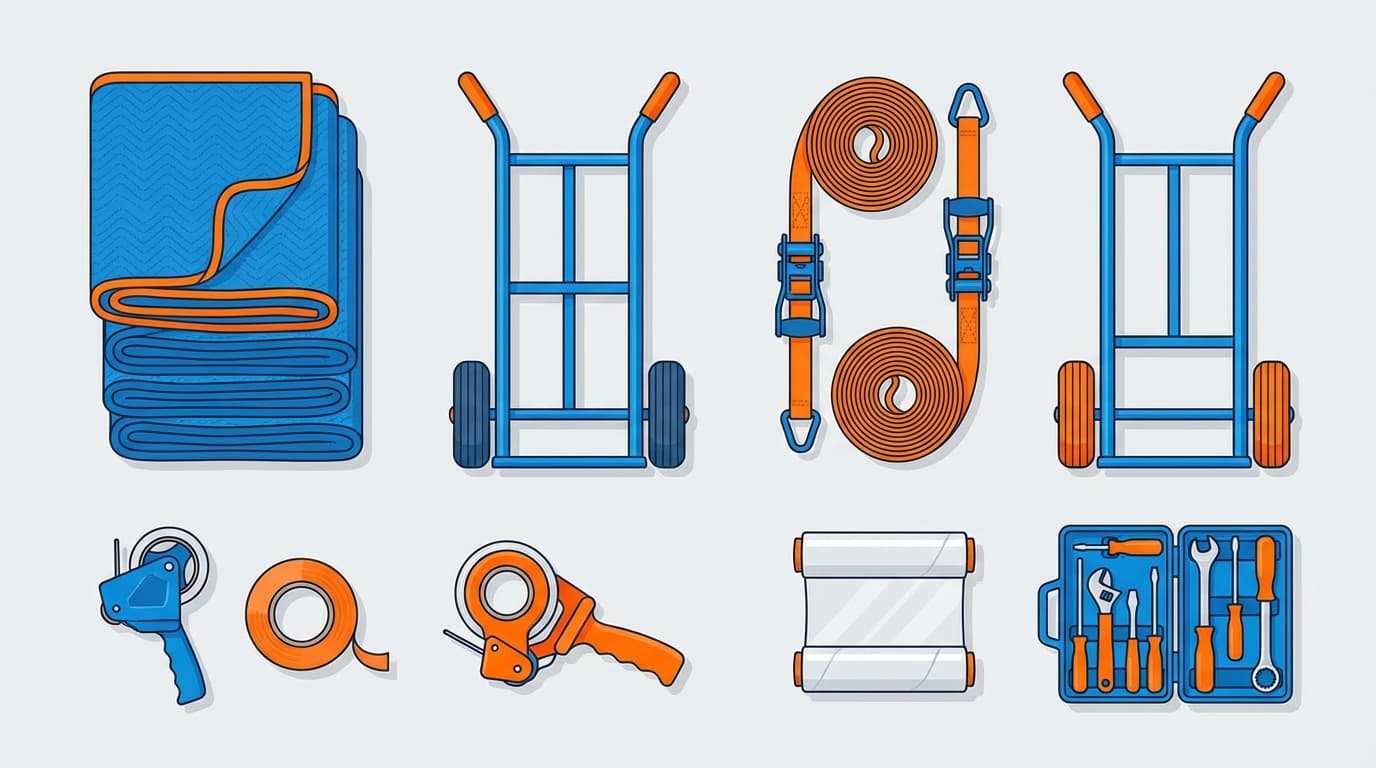
Total equipment cost: $1,200 – $3,050
Buy quality equipment upfront. Cheap dollies break mid-move, cheap blankets do not protect furniture, and both cost you money in damage claims and reputation hits. Speaking of reputation — learn how to boost customer reviews once you are up and running.
Office and Technology Setup
You do not need a fancy office to start — most successful moving companies run from a home office in year one. But you do need systems.
| Item | Cost |
|---|---|
| Business phone number (VoIP) | $25 – $50/month |
| Website (basic professional site) | $1,500 – $5,000 (one-time) |
| CRM / moving company software | $100 – $400/month |
| Accounting software (QuickBooks, etc.) | $30 – $80/month |
| Google Workspace (email, calendar) | $7 – $18/month per user |
| Business cards and printed materials | $100 – $300 |
A CRM is not optional — it is how you track leads, schedule jobs, send estimates, and follow up with customers. Without one, you are leaving money on the table from day one. Learn more about how moving company software can streamline your operations.
Total technology cost (year 1): $3,500 – $8,500
Marketing and Lead Generation Budget
You can have the best trucks, the best crew, and the best insurance in town — none of it matters if the phone is not ringing.
| Marketing Channel | Monthly Cost | What You Get |
|---|---|---|
| Google Business Profile optimization | $0 (DIY) | Local search visibility |
| Moving leads (shared, per lead) | $15 – $20/lead | Verified customers ready for quotes |
| Moving leads (exclusive, per lead) | $45 – $85/lead | Exclusive access, higher close rate |
| Google Ads (PPC) | $500 – $2,000/month | Top of search results |
| Facebook/Instagram ads | $300 – $1,000/month | Brand awareness, local reach |
| SEO (content and optimization) | $0 – $500/month (DIY to agency) | Long-term organic traffic |
| Vehicle wraps and branding | $2,000 – $5,000 (one-time) | Mobile billboard, brand recognition |
For most startups, the fastest path to revenue is buying leads. You pay per lead, only spend when you are ready, and start getting calls immediately — no waiting months for SEO or ad optimization to kick in. Want to know exactly what the return looks like? Read our moving leads ROI calculator to see real profitability math.

Marketing cost estimate (first 6 months): $3,000 – $15,000
Working Capital (Cash Reserve)
This is the cost most people forget — and the one that kills the most businesses.
You need cash to cover:
- Payroll for crews between jobs (your biggest cash drain)
- Fuel costs before customers pay
- Insurance premiums (often quarterly)
- Slow months when phone calls drop
- Unexpected expenses (truck repairs, damage claims, equipment replacement)
Rule of thumb: Have 3 to 6 months of operating expenses in reserve before launching.
For a one-truck operation with two crew members, that means:
| Monthly Expense | Estimated Cost |
|---|---|
| Crew wages (2 movers, part-time) | $4,000 – $8,000 |
| Truck payment or rental | $800 – $2,500 |
| Insurance (prorated monthly) | $800 – $3,200 |
| Fuel | $500 – $1,500 |
| Marketing and leads | $500 – $2,500 |
| Software and phone | $200 – $300 |
| Miscellaneous | $200 – $500 |
| Total monthly operating cost | $7,000 – $18,500 |
Working capital needed (3 months): $21,000 – $55,500
Startup Budget Templates
One-Truck Startup (Lean Launch)
| Category | Low End | High End |
|---|---|---|
| Licensing and registration | $600 | $1,500 |
| Insurance (first year) | $10,000 | $20,000 |
| Vehicle (used truck purchase) | $15,000 | $35,000 |
| Equipment and supplies | $1,200 | $2,500 |
| Technology and software | $3,500 | $6,000 |
| Marketing (first 6 months) | $3,000 | $10,000 |
| Working capital (3 months) | $21,000 | $40,000 |
| Total | $54,300 | $115,000 |
If you rent trucks instead of buying and keep marketing lean with leads-only, you can bring the low end down to around $30,000 – $40,000.
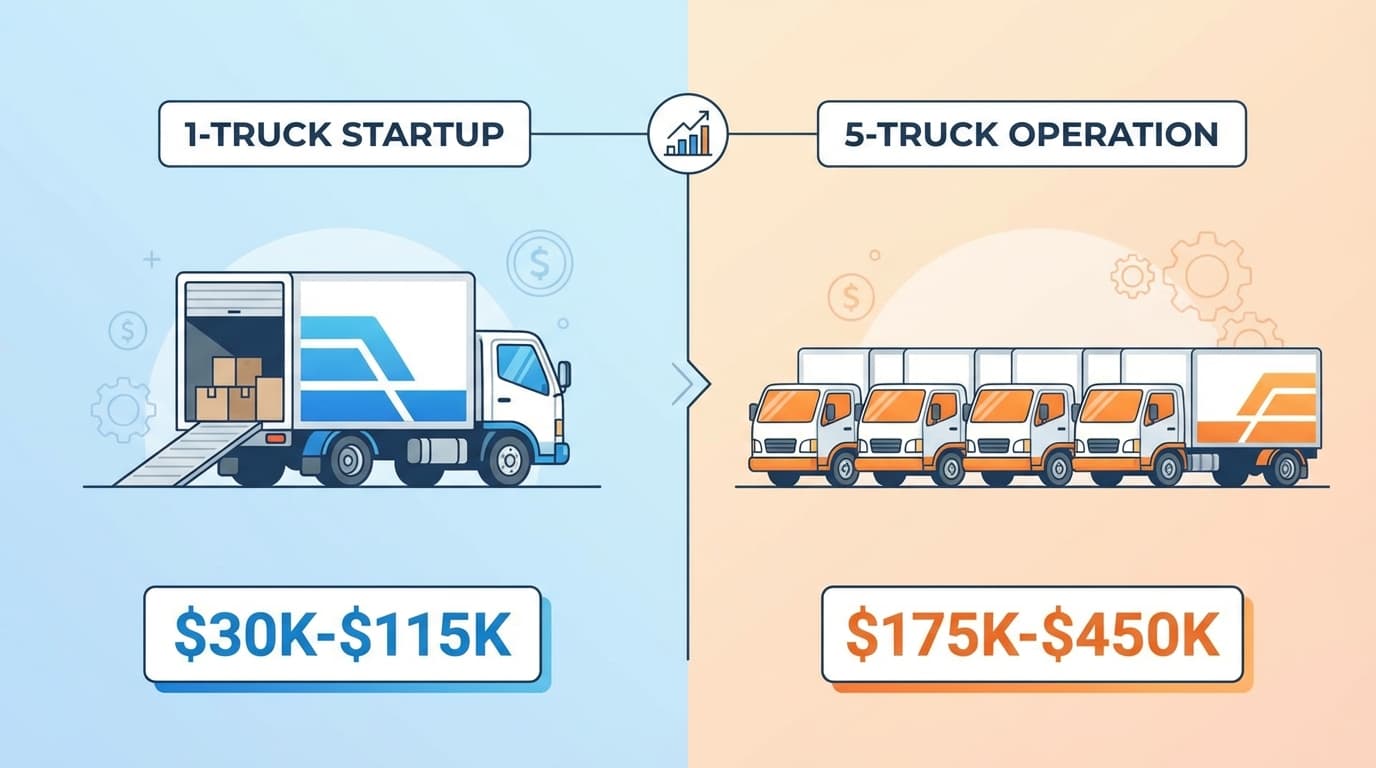
Five-Truck Operation (Growth Launch)
| Category | Low End | High End |
|---|---|---|
| Licensing and registration | $1,000 | $2,400 |
| Insurance (first year) | $30,000 | $55,000 |
| Vehicles (5 used trucks) | $75,000 | $200,000 |
| Equipment and supplies (5 sets) | $5,000 | $12,000 |
| Technology and software | $5,000 | $10,000 |
| Marketing (first 6 months) | $10,000 | $25,000 |
| Working capital (3 months) | $50,000 | $150,000 |
| Total | $176,000 | $454,400 |
Most people do not start with five trucks. They start with one, prove the model, reinvest profits, and scale from there. That is the smart approach.
How to Reduce Startup Costs Without Cutting Corners
- Rent trucks instead of buying — Pay only when you have jobs. Scale up as demand grows.
- Start local only — Skip the DOT/MC costs and interstate insurance requirements until you have revenue.
- Buy used equipment — Moving blankets, dollies, and hand trucks are often available from companies that are closing or upgrading.
- Work from home — No office lease needed. A phone, laptop, and CRM are all you need.
- Buy leads instead of running ads — No upfront ad spend, no learning curve, no wasted budget on bad campaigns. Pay only for verified customers.
- Start as the crew — Move alongside your team in the beginning. Save on labor costs while learning the operation firsthand.
- Get multiple insurance quotes — Rates vary dramatically. Three quotes minimum, ideally from brokers who specialize in moving/trucking.
ROI Timeline: When to Expect Profitability
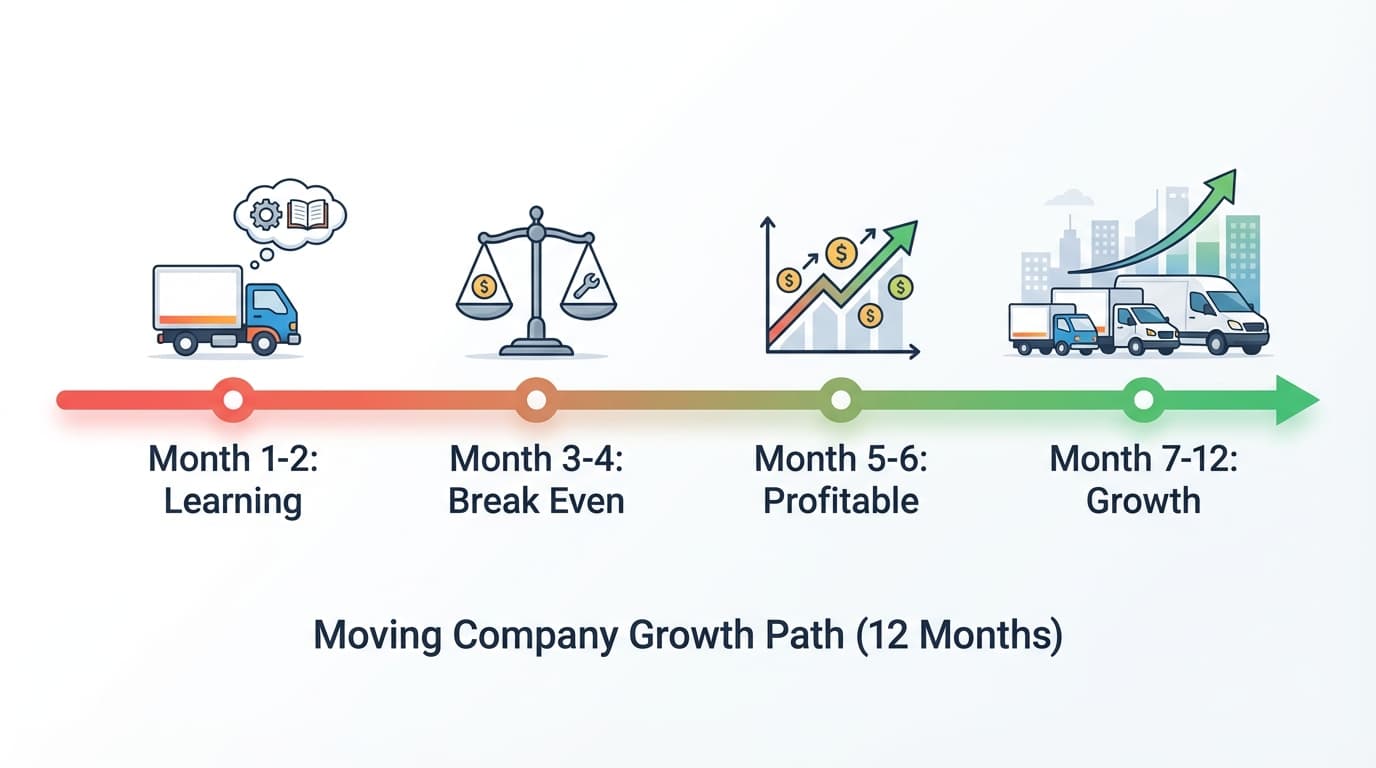
With disciplined spending and consistent lead flow, most one-truck moving companies reach profitability within 3 to 6 months. Here is a realistic timeline:
Month 1-2: Learning curve. You are figuring out operations, closing your first jobs, and building reviews. Expect to lose money or break even.
Month 3-4: Momentum builds. Word of mouth starts. Your close rate improves. Revenue covers operating costs.
Month 5-6: Profitability. You have a steady stream of leads, a working system, and repeat customers referring new business.
Month 7-12: Growth mode. You are ready to consider a second truck, additional crew, and expanding your service area.
The key variable is lead flow. Companies that invest in leads from day one reach profitability faster because they are not waiting months for organic marketing to produce results. If you want to generate some leads without spending money first, check out 5 ways to generate free leads for your moving company.
The Bottom Line
Starting a moving company costs somewhere between $30,000 and $115,000 for a lean one-truck operation, depending on whether you buy or rent trucks and how much working capital you set aside.
The biggest mistake is not the amount you spend — it is spending on the wrong things. Fancy office space, expensive branding, and overbuilt websites do not move the needle in year one. What matters is:
- Legal compliance (licensing and insurance)
- A reliable truck
- Quality equipment
- A system to manage leads and jobs
- A steady flow of customers
Get those five things right, and the rest will follow.
Ready to start getting customers? Network Leads connects your moving company with verified, high-intent customers actively looking for quotes. Start generating leads today — no long-term contracts, pay only for the leads you receive.
Written by
Network Leads
Network Leads helps moving companies grow with high-quality leads, powerful software, and marketing solutions. Since 2017, we have been connecting movers with customers who are actively searching for moving quotes.
Learn more about our platform