
Starting a moving company without a business plan is like loading a truck without knowing the destination. You might get somewhere eventually, but you will waste time, money, and momentum along the way. Whether you are seeking an SBA loan, pitching an investor, or simply forcing yourself to think through the numbers before spending a dollar, a solid moving company business plan is the foundation every new mover needs — especially in 2026, when competition is tighter and customer acquisition costs are higher than ever.
This guide walks through every section of a complete business plan, built specifically for the moving industry — with fill-in-the-blank templates for each part. If you are still in the early research phase, start with our full overview of how to start a moving company first, then come back here to put your strategy on paper.
What every moving company business plan needs — at a glance:
| Section | What It Covers |
|---|---|
| Executive Summary | Your company, model, market, and financial goals in one concise page |
| Company Description | Legal structure, services offered, location, and differentiation |
| Market Analysis | Local demand, target customers, seasonal patterns, and market size |
| Competitive Analysis | Who you are up against and where you have the advantage |
| Marketing and Sales Plan | How you will attract customers and convert them into booked jobs |
| Operations Plan | Trucks, crew, dispatch, scheduling, and software tools |
| Financial Projections | Revenue, expenses, P&L, and break-even analysis |
| Funding Requirements | Capital needed, use of funds, and repayment or equity plan |
Why a Moving Company Business Plan Matters in 2026
Most moving company owners skip the business plan. They buy a truck, get a business license, and start chasing jobs — figuring the plan can come later. The problem is that "later" usually arrives in the form of a cash crisis, an underbid job that does not cover payroll, or a bank loan rejection because there is no financial plan on paper.
A business plan does four things your instincts cannot:
- Forces financial reality. It makes you calculate your actual cost per move, your break-even job count, and how much cash you need in reserve before you start spending.
- Satisfies lenders. The U.S. Small Business Administration requires a business plan for most loan programs. Most commercial banks will not open a business account for a new LLC without one.
- Accelerates decision-making. When you have a written marketing strategy, you do not waste months testing random tactics. You execute the plan.
- Sets measurable goals. A year-one milestone timeline gives you targets to hit and tells you early when something is off track.
The moving industry also has specific financial realities — peak season cash surpluses followed by slow-season droughts, high insurance costs, major capital tied up in trucks — that generic business plan templates completely miss. A plan built for movers, using real mover cost structures, is a fundamentally different document from a generic template downloaded from a business school website.
What Your Moving Company Business Plan Should Include
A complete moving company business plan runs 15 to 30 pages for most small operators. Longer is not better — clarity is. Use this structure as your blueprint:
- Executive Summary — One to two pages. Written last, placed first.
- Company Description — Who you are, what you offer, and why customers choose you.
- Market Analysis — Who is moving in your area and how big the opportunity is.
- Competitive Analysis — Who else is serving this market and what you do differently.
- Marketing and Sales Plan — How you will get customers, at what cost, and through which channels.
- Operations Plan — The day-to-day: trucks, crew, dispatch, scheduling, and tools.
- Financial Projections — Revenue and expense forecasts with a break-even analysis.
- Funding Requirements — How much capital you need and exactly what it will be used for.
A lender, investor, or business partner reading your plan should be able to understand your model, your market, your financials, and your growth plan in under 20 minutes. Every section below is required. The order matters — most readers stop at the financials if the earlier sections do not add up.

How to Write Your Executive Summary
The executive summary is the most important section of your business plan — and the last one you should write. It is a distillation of everything else: your model, your market, any traction you already have, and your financial ask. Keep it to one to two pages. Investors and loan officers read executive summaries first. If yours does not hook them, the rest of the document does not get read.
Executive Summary Fill-In Template
[Company Name] is a [local / interstate / both] household goods moving company based in [City, State]. We provide [residential / commercial / specialty] moving services to customers throughout [Service Area Description]. Founded in [Year], the company is operated by [Founder Name], who brings [X years] of experience in [the moving industry / logistics / operations].
We serve [target customer description — e.g., "homeowners and renters making local moves within the greater [City] metro area"]. Our primary competitive advantage is [unique differentiator — e.g., "same-day availability, transparent flat-rate pricing, and a growing portfolio of five-star reviews"].
Our local market includes an estimated [X] households, with a significant portion changing residence each year based on [Census Bureau / local data source]. We project [X] jobs in Year 1, generating approximately [$X] in gross revenue, with profitability expected by Month [X].
We are seeking [$X] in [SBA 7(a) loan / bank financing / investor equity] to fund [truck acquisition / working capital / marketing launch / equipment]. Funds will be deployed over [12/18/24] months to achieve [specific milestone — e.g., "a three-truck fleet serving the full [City] market"].
Pro tip: Write the executive summary last, after completing every other section. You cannot effectively summarize a plan you have not yet built — most people who write it first end up rewriting it anyway.
Company Description and Services Offered
The company description tells your full story: what your company is, what services you offer, who owns it, and why customers should choose you over every other mover in your market.
Legal and Structural Information
Include the following:
- Official business name and DBA (doing business as), if applicable
- Business entity type (LLC, S-Corp, or sole proprietor) and state of formation
- Federal EIN (Employer Identification Number)
- USDOT number and MC authority status — required for any interstate moves (see our complete DOT and FMCSA compliance guide for moving companies if you are still working through registration)
- Primary business address and service area
Services Offered
List every service you provide — or plan to provide within Year 1:
- Local residential moves (within your home state)
- Interstate / long-distance moves (across state lines)
- Commercial and office moving
- Packing and unpacking services
- Storage-in-transit
- Specialty services: piano moving, senior relocations, fine art, high-value items
Mission Statement and Value Proposition
Write one to two sentences explaining why your company exists. Avoid vague language like "we provide excellent service." Instead: "We help [City] families move with zero surprises — on time, on budget, and with every item arriving in the same condition it left."
Then define your competitive advantage in one paragraph. Are you the fastest to respond to leads? The most transparent on pricing? The only mover in your area offering guaranteed delivery windows? Write it here with specifics.
Market Analysis: Sizing Your Local Moving Opportunity
The market analysis proves you understand the demand in your area and that there is enough of it to support a profitable business. This is one of the sections that new movers write weakest — and one that lenders scrutinize most.
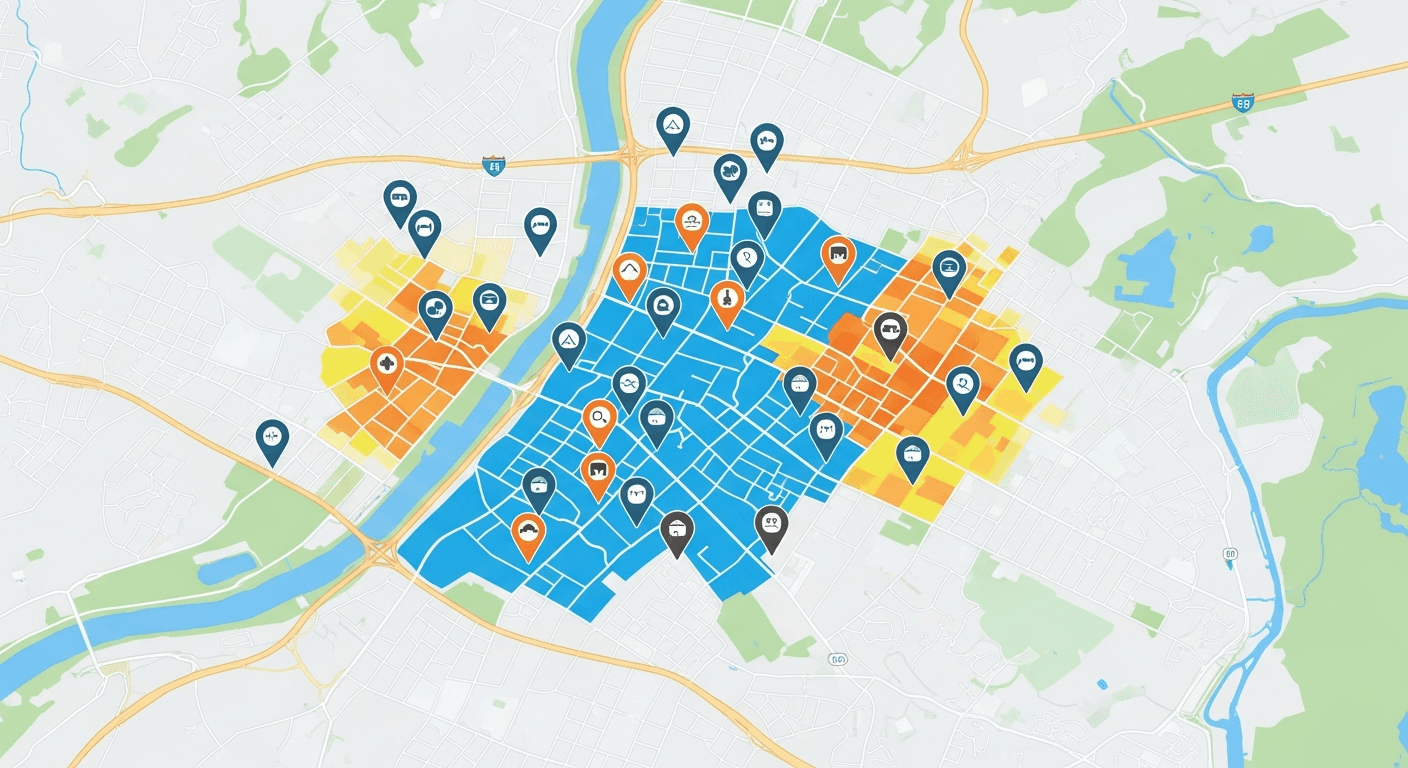
How to Size Your Local Market
You do not need a market research firm. You need four numbers:
-
Total households in your service area. Find this at Census.gov by searching your county or metro area. Data is available at the zip code level and is updated regularly through the American Community Survey.
-
Annual mobility rate. The U.S. Census Bureau tracks household mobility — historically, roughly 9–12% of American households move in any given year. Verify the most current rate directly on the Census Bureau website before including it in your plan.
-
Average job value in your market. Research local rates by requesting quotes from competitors or checking published data from the American Moving and Storage Association (AMSA). Rates vary significantly by city and move type.
-
Your realistic market share assumption. For a one-truck startup in a city of 500,000 people, capturing 0.1% to 0.5% of the annual move market is a defensible starting target. Show how you arrived at this number.
Seasonal Demand Patterns
Moving is highly seasonal. Roughly 60–70% of annual moves occur between May and September in most U.S. markets, with June, July, and August being peak. Build this into your financial projections — your revenue in January will be a fraction of your revenue in July. Lenders want to see that you have modeled for the slow season and have a cash plan to cover it.
Target Customer Profile
Define who your ideal customer is:
- Homeowners or renters?
- Local moves only, or interstate as well?
- Budget-focused or full-service premium?
- Age range, family size, and typical move trigger (job relocation, home purchase, downsizing)?
The more precisely you define your target customer, the more targeted and efficient your marketing becomes. Vague targeting leads to wasted ad spend and low conversion rates.
Competitive Analysis: Identifying Your Advantage
Every moving market has competition. Your business plan should prove you have studied your competitors, understand the landscape, and have a concrete reason customers will choose you.
How to Research Your Competitors
Start with Google. Search "[Your City] moving company" and note:
- Who appears in the Google Maps pack (the top three local results)
- Their star rating and total review count
- Their pricing (call for a quote or check their website)
- Their service areas and specializations
- How quickly they respond to inquiries
List your top five to eight competitors and evaluate them in a comparison table across these dimensions.
Finding Your Competitive Advantage
After cataloguing the competition, answer this directly: Why would a customer choose you?
Common differentiators in the moving industry:
- Lower price for comparable service
- Higher-rated or more-reviewed on Google
- Faster availability (same-day or next-day bookings)
- Specialization in a niche (piano moving, senior relocations, high-value art)
- Greater pricing transparency (flat-rate vs. open-ended hourly)
- Superior communication and follow-up at every step
- Speed of lead response — reaching the customer first, before competitors call
Pro tip: Speed of response is the most underrated competitive advantage in the moving industry. Data consistently shows that the first company to contact a customer after a quote request wins the job at a disproportionately high rate — often 50% or more of the time. If you can build your systems to respond within five minutes of a lead coming in, you will outperform most local competitors without being the cheapest.
Your Marketing and Lead Generation Plan
Your marketing plan answers a single question: how will customers find you, and what will it cost to get each one?
Lead Generation Channels for Movers
| Channel | Estimated Cost Per Lead | Time to First Lead | Best For |
|---|---|---|---|
| Shared moving leads | $15 (local) / $20 (interstate) | Immediate | New companies who need volume fast |
| Exclusive moving leads | $45–$85 | Immediate | Companies with strong close rates |
| Live call transfers | $60–$100 per call | Immediate | High-value interstate moves |
| Google Local Service Ads | Varies by market | Days to weeks of setup | Established companies with reviews |
| Organic SEO | Time investment only | 3–12 months to rank | Long-term traffic building |
| Facebook and Instagram ads | $20–$60 per lead | Days to optimize | Awareness and retargeting |
| Realtor partnerships | $0 (relationship-based) | Weeks to build | Consistent long-term pipeline |
For most new movers, buying verified moving leads is the fastest path to revenue. You pay per lead, set your geographic area, and calls start coming in immediately — no waiting months for SEO rankings or ad optimization to take hold.
Budget Allocation
Build your marketing budget around your target job count and your expected lead-to-booking conversion rate. A typical new mover converts 15–25% of leads into booked jobs.
Example math: If your average job is worth $850 and you want 20 booked jobs in Month 1 — at a 20% close rate, you need about 100 leads. At $15–$20 per shared lead, that is $1,500–$2,000 in lead spend. A single closed move pays for half the month's lead budget. The ROI compounds quickly as your close rate improves.
Your business plan should include a marketing channel breakdown and monthly budget for each of the first 12 months, with expected lead volume and projected job count per channel.
Operations Plan: Trucks, Crews, and Scheduling
The operations section explains how your company actually delivers the service. It should cover everything from how you take a booking to how you follow up after the move.
Truck Fleet Plan
List your planned vehicles, how you are acquiring them, and their capacity:
| Option | Truck Size | Acquisition Method | Monthly Cost |
|---|---|---|---|
| Option 1 | 20 ft | Rented (Penske / Ryder) | $800–$1,500 |
| Option 2 | 26 ft | Purchased used | No monthly payment (one-time purchase) |
| Option 3 | 26 ft | Full-service lease | $1,200–$2,500 |
For a full cost comparison of owning, leasing, and renting, including total cost of ownership over three and five years, see our startup cost breakdown for moving companies.
Crew Structure
Define your crew model:
- Move captain / foreman: Responsible for paperwork, customer communication, and the loading plan on every job
- Crew members: Typically one to three per truck depending on move size
- Driver qualifications: A commercial driver's license (CDL) is required for trucks over 26,001 lbs GVWR in most states — verify your state's exact threshold and requirements
Also specify whether your crew will be W-2 employees or 1099 subcontractors, and your pay structure (hourly, per-job, or salary). Lenders want to see that you have thought through labor compliance.
Dispatch, Scheduling, and Technology
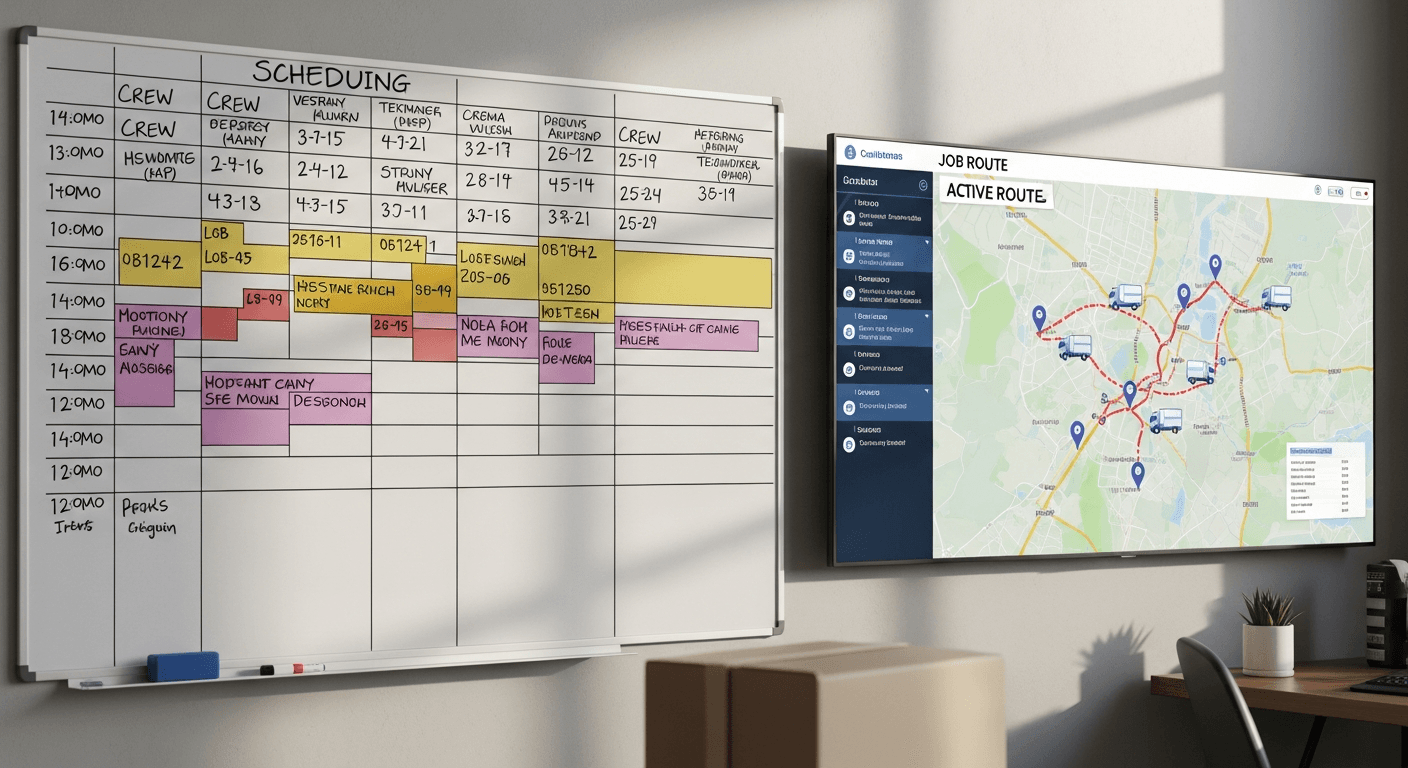
How do you take bookings, assign crews, manage the daily schedule, and generate paperwork? Describe your system — whether it is a whiteboard, a spreadsheet, or a dedicated platform. A moving company CRM and operations software handles bookings, quotes, crew assignments, bill of lading generation, and customer communication in one place — which reduces errors and saves hours per week at the operational level.
List every tool in your technology stack:
- CRM and dispatch platform
- Accounting software (QuickBooks, Wave, or similar)
- Payment processing
- Customer communication (phone, text, email sequences)
- GPS and fleet tracking
Financial Projections: Revenue, Expenses, and Profit
The financial projections section is the most scrutinized part of any business plan. Lenders want to see that your revenue assumptions are grounded in reality, that you understand your true cost structure, and that the business generates enough cash to service any debt you are taking on.
Revenue Projection Model
Build your revenue from the ground up, not from the top down:
| Variable | Year 1 | Year 2 | Year 3 |
|---|---|---|---|
| Trucks in active operation | 1 | 2 | 3 |
| Average jobs per truck per week | 5 | 7 | 8 |
| Operating weeks per year (accounting for seasonal slowdown) | 44 | 47 | 50 |
| Average revenue per job | $900 | $1,000 | $1,100 |
| Projected Gross Revenue | ~$198,000 | ~$658,000 | ~$1,320,000 |
These are illustrative figures. Your numbers will vary based on your market, pricing, and service mix. Use ranges you can defend with real competitive data from your local market — not national averages.
Annual Cost Structure (1 Truck, Year 1)
| Cost Category | Low Estimate | High Estimate |
|---|---|---|
| Crew labor (foreman + movers) | $45,000 | $80,000 |
| Truck payments, lease, or rental | $10,000 | $30,000 |
| Fuel | $6,000 | $18,000 |
| Insurance (auto, liability, cargo, workers comp) | $10,000 | $38,000 |
| Marketing and lead generation | $5,000 | $20,000 |
| Moving company software and technology | $2,500 | $5,000 |
| Equipment maintenance and replacement | $2,000 | $5,000 |
| Accounting and professional services | $1,500 | $3,000 |
| Contingency (buffer for unexpected costs and repairs) | $5,000 | $20,000 |
| Total Annual Operating Costs | $87,000 | $219,000 |
For detailed cost breakdowns by category — including insurance quotes, equipment lists, and working capital requirements — see our full cost to start a moving company guide.
Break-Even Analysis
Your break-even is the number of jobs per month you need to cover all fixed and variable costs. Calculate yours with this formula:
Break-even jobs = Fixed Monthly Costs ÷ (Average Job Revenue − Variable Cost Per Job)
Example: $7,000 in fixed monthly costs ÷ ($900 average job revenue − $350 variable cost per job) = 12.7 jobs per month to break even.
Cash Flow Projection
Include a month-by-month cash flow projection for Year 1. This is critical for moving companies because of the seasonal revenue swings. Your statement should show:
- Peak season (May–September): Positive cash flow — rebuild your reserve
- Shoulder season (April, October): Near break-even
- Off-season (November–March): Potential cash draw-down from reserves
Lenders want to confirm you have enough working capital to survive the slow months, not just the average.
Funding Requirements and Your Year 1 Milestones
Funding Requirements Template
If you are seeking capital, this section tells lenders exactly how much you need, what you will use it for, and how you will repay it.
[Company Name] is seeking $[X] in [SBA 7(a) loan / bank financing / investor equity] to launch operations in [City/Market].
Use of Funds Estimated Amount Vehicle (purchase, first-year lease, or rental deposit) $10,000–$55,000 Insurance premiums (Year 1) $10,000–$38,000 Equipment and supplies $1,200–$3,000 Marketing and lead generation (first 6 months) $3,000–$10,000 Working capital (3 months of operating costs) $21,750–$54,750 Technology and software setup $2,000–$5,000 We project break-even operations by Month [X] and plan to service the loan from operating cash flow over [X] months. We have committed [personal equity / family funding / existing cash] of $[X] toward the total startup cost.
The SBA 7(a) loan program is the most commonly used vehicle for small business startups, covering equipment, working capital, and real estate. As of 2026, loan terms and eligibility requirements are subject to change — verify current program details directly at SBA.gov or with a certified SBA lender before applying.
Year 1 Milestone Timeline
| Timeframe | Key Milestone |
|---|---|
| Month 1 | Legal entity formed, EIN issued, USDOT filed, insurance bound, first truck operational |
| Month 2 | First 20+ jobs completed, Google Business Profile live, first 10 reviews collected |
| Month 3 | Break-even reached, lead pipeline fully operational, CRM configured |
| Month 4–6 | Consistent weekly lead flow, close rate improving, revenue covering all operating costs |
| Month 7–9 | Cash reserve rebuilt to 3-month level, second crew member added, reviews at 25+ |
| Month 10–12 | Evaluating second truck, interstate authority considered (if applicable), Year 2 plan drafted |
Common Business Plan Mistakes Moving Companies Make
Even movers who do write a business plan undermine it with these recurring errors:
-
Revenue projections based on wishful thinking. The most common and damaging mistake: projecting 30 jobs per week in Month 1 with one truck, no reviews, and no existing customer base. Base your numbers on conservative, defensible assumptions. Include a bear-case scenario alongside your base case.
-
Ignoring compliance costs. USDOT registration, MC authority, BOC-3 filing, insurance filings — these costs are real and can total $330–$900 in federal fees alone before your first interstate job, plus annual renewals. Budget for them from the start. Our DOT and FMCSA compliance guide for moving companies covers every required filing and associated cost.
-
No working capital buffer. Starting with zero cash reserve is the number-one reason new moving companies close in year one. Payroll is due before customers pay. Operating costs hit before revenue is consistent. Build in at least three months of operating expenses as a cash cushion before you launch.
-
Generic or missing market analysis. Copying national moving industry statistics into your plan does not tell a lender anything meaningful about demand in your specific city. Do the local work — actual competitor counts, local pricing benchmarks, seasonal demand patterns in your service zip codes.
-
Skipping the competitive analysis. Most new movers write "there is definitely room for a great mover in our city" and leave it there. Lenders want specifics: who are your top five competitors, what are their ratings and pricing, and exactly why will customers choose you instead?
-
Treating the plan as a one-time document. Write the business plan before you launch, then review and update it at six months and at the twelve-month mark. A document that reflects current reality is far more valuable — and more honest — than one that reflects what you hoped would happen.
-
Underestimating seasonal cash flow gaps. Revenue in January can be 20–30% of what you earn in July. A plan that does not model the off-season will leave you cash-short when slow months hit.

Frequently Asked Questions
How long should a moving company business plan be? For a small startup — one to three trucks — 15 to 25 pages is appropriate. Focus your length on the financial projections, market analysis, and operations plan. Those sections are where lenders spend most of their review time.
Do I need a business plan if I am not seeking outside funding? Yes. Even if you are fully self-funded, the process of writing a plan forces you to confront financial realities you might otherwise avoid — especially the working capital requirement and the seasonal cash flow gap. Most movers who skip the plan end up undercapitalized within the first six months.
How often should I update my business plan? Review it at your six-month mark and at the end of Year 1. Update the financials with actual performance data, revise your milestones to reflect what you learned, and adjust your marketing plan based on which channels are producing the best ROI.
What revenue should I realistically project in Year 1? A conservative one-truck operation doing 15–20 jobs per month at an average of $800–$1,000 per job generates $144,000–$240,000 in gross revenue. Net margins depend heavily on your cost structure — particularly insurance and labor. Run your own break-even analysis with real numbers from your market before committing to a projection.
What is the most common reason moving company business plans get rejected by SBA lenders? Unrealistic revenue projections with no supporting market data. Lenders want to see how you arrived at your numbers — the logic and the research behind them, not just the spreadsheet. Include competitor research, local Census data on household mobility, and a realistic ramp-up assumption that accounts for your starting review count and lead volume.
Can I use this template to apply for a business bank account? Many banks require a business plan before opening a business checking account for a new LLC. A plan that includes your company description, services, and projected revenue statement will satisfy most basic banking requirements. Some banks will also want a copy of your operating agreement and EIN confirmation letter.
The Bottom Line
A moving company business plan is not just a document you create to satisfy a lender. It is the operational roadmap that tells you when you are on track, when to push harder, and when to cut your losses and adjust. The movers who build lasting businesses are not always the most experienced — they are the most deliberate. They know their cost-per-move, their break-even job count, their close rate, and their competitive advantage before they load their first box.
Use the section templates in this guide to build your plan piece by piece. The financial projections will feel uncomfortable the first time through — that discomfort is the point. It is far better to stress-test your numbers on paper than to discover they do not work after you have committed to a truck lease and a payroll.
Work through the section templates above and adapt each one to your specific market and operation. Once your plan is on paper, the next step is filling the customer-acquisition side of it. Book a free demo and we will walk you through how to set up your lead flow, configure your service area, and start booking jobs from day one — with real data from your local moving market.
Written by
Network Leads
Network Leads helps moving companies grow with high-quality leads, powerful software, and marketing solutions. Since 2017, we have been connecting movers with customers who are actively searching for moving quotes.
Learn more about our platform