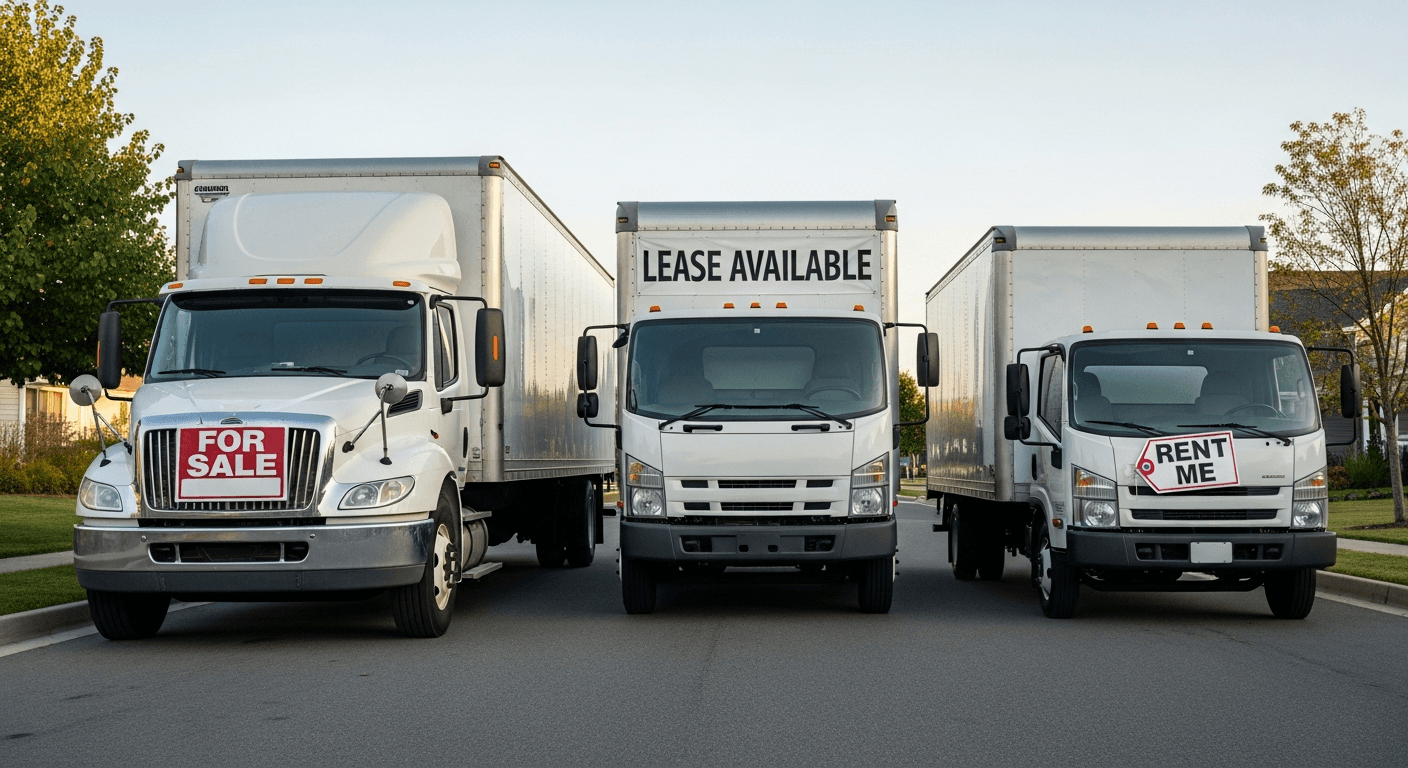
Your trucks are your business. They are your single largest capital decision as a moving company owner — and the moving company truck lease vs buy vs rent question is one that will follow you from your first day in operation to the day you scale to a ten-truck fleet. Choose wrong and you lock yourself into years of unnecessary costs or leave yourself scrambling for vehicles during your busiest season.
This guide breaks down the real numbers behind each option in 2026 so you can decide based on math, not instinct. If you are still calculating your full startup picture, pair this with our complete moving company cost breakdown — trucks will be the biggest line item on that spreadsheet.
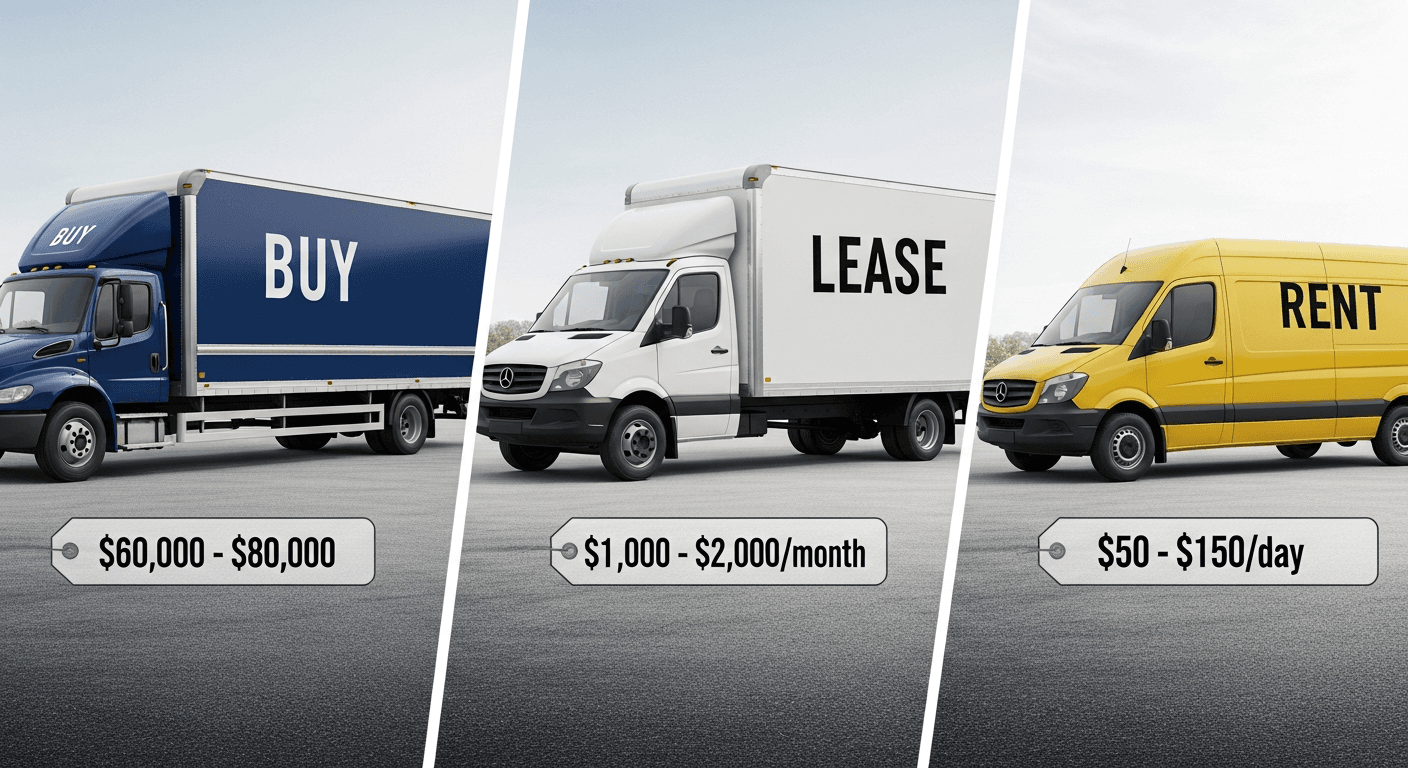
Buying, Leasing, or Renting: The Three Options at a Glance
Before diving into costs, it helps to understand exactly what you are choosing between:
- Buying means you own the truck outright or through a loan. It appears on your balance sheet as an asset. You handle maintenance, and you can sell or brand it however you like.
- Leasing means you pay for the right to use a truck for a fixed term — typically 3–5 years. At the end, you return it, buy it out, or roll into a new lease. Equity does not build the way it does with a purchase.
- Renting means short-term access — daily, weekly, or monthly — with no long-term commitment and no upfront capital.
Here is a quick comparison before going deeper on each:
| Factor | Buy | Lease | Rent |
|---|---|---|---|
| Upfront cost | High ($15K–$55K+) | Low ($0–$3K) | None |
| Monthly commitment | None (if paid cash) or loan payment | $800–$2,500/mo | Pay as you go |
| Ownership at end | Yes | Usually no | No |
| Maintenance responsibility | Owner | Varies by lease type | Rental company |
| Tax strategy | Depreciation, Section 179 | Lease payment deduction | Rental expense deduction |
| Flexibility | Low (selling takes time) | Medium | High |
| Best for | Established, steady volume | Growing businesses | Startups and seasonal spikes |
Should Moving Companies Buy Trucks Outright?
Buying makes the most financial sense when you have consistent job volume, the capital or financing to acquire the truck, and a plan to use it continuously for five years or more.
New vs Used — The Cost Reality
New moving trucks carry price tags that most startups simply cannot absorb. A new 26-foot box truck from a commercial dealer runs $80,000 to $120,000. For a growing moving company, that capital is almost always better deployed into leads, operations, and working capital.
Used trucks are the practical choice for most movers:
| Truck Size | Used Price Range | Typical Mileage | Estimated Remaining Life |
|---|---|---|---|
| 16-foot box truck | $12,000 – $25,000 | 100K–200K miles | 3–7 years |
| 20-foot box truck | $18,000 – $38,000 | 80K–180K miles | 4–8 years |
| 24-foot box truck | $22,000 – $45,000 | 80K–160K miles | 4–8 years |
| 26-foot box truck | $25,000 – $55,000 | 75K–150K miles | 5–9 years |
Pros of buying:
- No monthly payment once paid off
- Build equity in an asset you can later sell
- No restrictions on use, branding, or mileage
- No return-condition clauses or end-of-term fees
Cons of buying:
- Large upfront capital requirement
- Maintenance and repair risk falls entirely on you
- Selling takes time — limited flexibility if volume drops
- Older trucks can surprise you with expensive repair bills
Pro tip: Before committing to any used truck, budget $2,000–$5,000 for an immediate mechanical inspection and deferred maintenance catch-up. A truck that looks clean can be hiding a failing transmission or a compromised frame. Always use a commercial truck mechanic — not a general automotive shop — for the pre-purchase inspection.
Financing a Truck Purchase
If you do not have cash to pay outright, commercial truck loans are available through banks, credit unions, and specialty commercial lenders. Expect:
- Down payment: 10–30% of purchase price
- Interest rate: 5–12% depending on credit and lender (verify current rates — these change with market conditions)
- Loan term: 36–84 months
- Example payment: $25,000 truck, 20% down ($5,000), 7% over 5 years ≈ $396/month
The monthly loan payment creates a fixed cost regardless of job volume — which is the central risk of buying before your volume is proven.
Is Leasing the Right Move? Pros, Cons, and Typical Terms
Leasing has grown in popularity among mid-size moving companies because it solves the upfront capital problem without the full flexibility sacrifice that renting requires.
Full-Service vs Finance Lease: A Critical Distinction
There are two fundamentally different lease types, and confusing them is a common mistake:
| Feature | Full-Service (Operating) Lease | Finance Lease |
|---|---|---|
| Maintenance included | Yes | No |
| Monthly cost | $1,400 – $2,800 | $900 – $1,800 |
| Ownership at end | No | Option to purchase |
| Best for | No in-house mechanic | In-house maintenance capacity |
| Major providers | Penske, Ryder, NationaLease | Local dealers, bank financing |
Full-service leases — where scheduled maintenance is bundled into the monthly payment — eliminate unpredictable repair costs. Ryder, Penske, and NationaLease are the dominant players in this space. For a moving company without a dedicated mechanic, the cost predictability is often worth the premium.
Finance leases function more like loans — you make monthly payments, handle your own maintenance, and typically have a buyout option at the end. These work better for operations with in-house maintenance capacity.
Pros of leasing:
- Minimal upfront cost
- Predictable monthly payments
- Option to upgrade to newer equipment at lease end
- Full-service leases eliminate surprise repair costs
Cons of leasing:
- No equity built over time
- Mileage caps with overage charges ($0.08–$0.15/mile is common)
- Return-condition requirements can result in end-of-lease charges
- Long-term cost exceeds buying if you hold the equipment 7+ years
Pro tip: Moving trucks rack up miles fast. Negotiate your mileage cap carefully before signing. A local moving company often runs 25,000–40,000 miles per year per truck. A lease capped at 20,000 miles will generate significant overage charges before the first year is out. Get the per-mile overage rate in writing.
Renting Trucks — The Right Call for Startups and Seasonal Spikes
Renting is the most underrated option — and often the smartest starting point for new moving companies or established operations facing seasonal volume swings.
When Renting Makes the Most Sense
- You are just starting out — No proven volume yet. Renting keeps fixed costs near zero until you know how many jobs you consistently close each month.
- Peak season overflow — You have two trucks leased but need four in June. Renting fills the gap without a year-round commitment.
- One-way long-distance jobs — Some movers rent specifically for interstate moves to avoid deadheading an empty owned truck back home.
- Market testing — Expanding to a new city? Rent there for 60–90 days to validate demand before committing capital to a truck. For more on expansion strategy, see our guide on how to start a moving company.
Commercial Rental Pricing (2026 Estimates — Verify Directly with Providers)
| Provider | 16-ft Daily | 26-ft Daily | 16-ft Weekly | 26-ft Weekly |
|---|---|---|---|---|
| Penske | $100–$160 | $130–$200 | $450–$750 | $600–$950 |
| Ryder | $95–$155 | $125–$190 | $430–$700 | $580–$900 |
| Enterprise Fleet | $90–$150 | $120–$180 | $400–$680 | $550–$850 |
Note: Commercial rental rates differ from consumer rates. Set up a commercial account with each provider for better rates and priority availability during peak season.
The key math: At a daily rate of $140, running a truck 18 days per month costs $2,520 — enough to lease a comparable truck outright. The break-even between renting and leasing falls around 15–18 working days per month. Below that threshold, renting wins. Above it, leasing wins.
Cons of renting as a long-term strategy:
- Expensive at high volume
- Availability is not guaranteed during peak season
- No permanent branding on rental vehicles (a significant missed marketing opportunity — more on this below)
Total Cost of Ownership — 3-Year and 5-Year Comparison
This is where the decision becomes clearest. The following table compares the same 20-foot truck across all three options over 3 and 5 years.
Assumptions: 20-foot truck, 24,000 miles/year, consistent average job volume, maintenance at industry-average rates.
| Cost Category | Buy (Used $30K) | Full-Service Lease | Rent (18 days/mo avg) |
|---|---|---|---|
| Year 1 | |||
| Upfront / down payment | $6,000 | $0 | $0 |
| Monthly payments (×12) | $4,752 | $19,200 | $30,240 |
| Maintenance and repairs | $2,000 | Included | Included |
| Year 1 Total | $12,752 | $19,200 | $30,240 |
| 3-Year Total | ~$38,000 | ~$57,600 | ~$90,720 |
| 5-Year Total | ~$52,000 | ~$96,000 | ~$151,200 |
| Resale value at year 5 | ~$10,000–$14,000 | $0 | $0 |
| 5-Year Net Cost | ~$38,000–$42,000 | ~$96,000 | ~$151,200 |
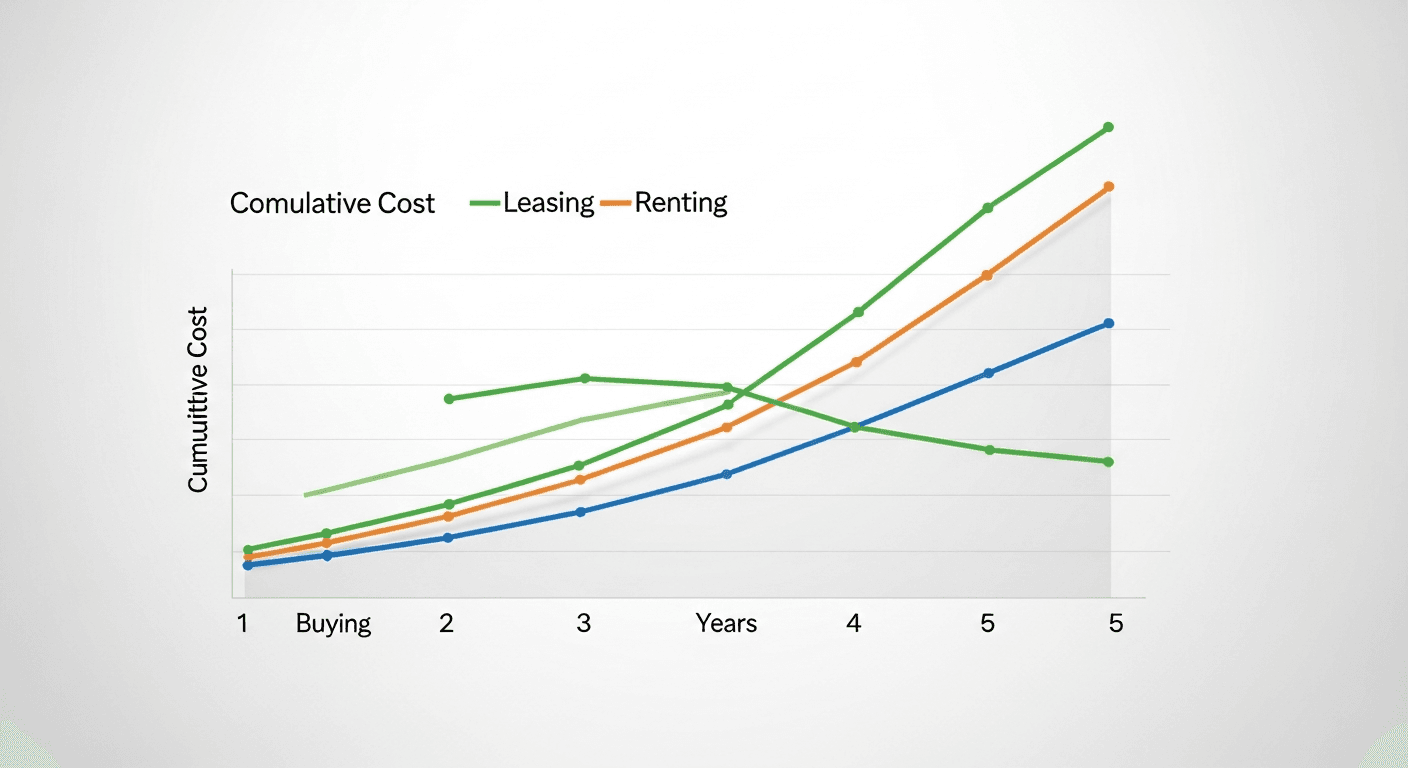
Over five years of continuous use, owning a truck delivers the lowest net cost by a substantial margin. The trade-off is upfront capital and maintenance risk. Leasing narrows the gap compared to renting, especially when you factor in maintenance costs being bundled into the monthly payment on full-service leases.
For context on how truck costs fit into your full operational picture, our guide on maximizing warehouse and operational efficiency for moving companies covers the broader operational framework alongside fleet decisions.
Tax Implications — Section 179, Depreciation, and Deductions
Tax strategy materially affects the real-world cost of each option. This section covers the general framework — always consult an accountant for advice specific to your situation and current-year tax rules.
Buying a Truck: Section 179 and Depreciation
When you purchase a truck for business use, you can generally deduct the cost from taxable income through one of these methods:
- Section 179 expensing: Allows immediate first-year deduction of the full purchase price of qualifying business vehicles, up to annual caps. As of 2026, the limits and phase-outs apply — verify current figures with your accountant or at irs.gov before making a purchase decision based on tax strategy alone.
- Bonus depreciation: For vehicles not fully covered by Section 179, bonus depreciation allows an accelerated first-year deduction.
- MACRS depreciation: Spreads deductions over 5 years for most commercial vehicles.
Box trucks over 6,000 lbs GVWR — which includes virtually all moving trucks — typically qualify for full Section 179 treatment. A $30,000 used truck fully expensed under Section 179 could reduce taxable income by $30,000 in year one, saving $6,000–$10,000 in federal taxes depending on your effective tax rate. Confirm current eligibility at irs.gov/forms-pubs/about-form-4562.
Leasing a Truck: Lease Payment Deductions
Lease payments are generally fully deductible as a business operating expense in the year paid. For a full-service lease at $1,600/month ($19,200/year), you deduct $19,200 annually. No depreciation calculation required.
Renting a Truck: Rental Expense Deduction
Same principle as leasing — rental payments are operating expenses, fully deductible in the year incurred.
The tax bottom line: Buying offers the largest potential upfront tax benefit via Section 179 or bonus depreciation. Leasing and renting provide consistent annual deductions but no asset on your books. Consult your accountant to model the actual after-tax cost difference for your specific tax situation before finalizing the decision.
Maintenance and Insurance by Ownership Model
Two costs that routinely get underestimated in truck financial projections.
Annual Maintenance Cost Estimates
| Ownership Model | Annual Maintenance Cost | Notes |
|---|---|---|
| Owned truck | $1,500 – $6,000 | Varies widely with truck age and condition |
| Finance lease | $1,500 – $6,000 | You handle repairs — same exposure as owned |
| Full-service lease | Included | Scheduled maintenance covered; wear items vary by contract |
| Rental | Included | Provider handles all mechanical upkeep |
Older used trucks carry the highest maintenance risk. A transmission rebuild on a 26-foot box truck runs $3,000–$6,000. An engine overhaul can reach $8,000–$15,000. These are realistic outcomes for trucks with 180,000–220,000 miles.

Insurance Costs by Ownership Model
| Model | Annual Insurance Cost | Why It Differs |
|---|---|---|
| Owned truck | $3,000 – $12,000 | Full policy: liability + cargo + collision + comprehensive |
| Leased truck | $3,500 – $13,000 | Lessor requires comprehensive coverage plus gap insurance |
| Rented truck (collision waiver only) | $500 – $2,000 | Daily collision damage waiver — does not cover your cargo |
Critical note: Rental collision waivers from Penske, Ryder, and Enterprise do not cover your cargo liability or the customer's belongings. You need your own cargo and liability policy regardless of which truck model you choose. See the complete moving company cost guide for a full insurance breakdown.
Pro tip: Leasing companies typically require gap insurance — coverage for the difference between the truck's current market value and your remaining lease balance if it is totaled. Add this to your lease cost comparison when modeling true monthly cost.
How Many Trucks Does Your Moving Company Actually Need?
Fleet sizing is directly tied to job volume and crew capacity. The formula is simpler than most movers expect:
Daily jobs needed ÷ jobs per truck per day = trucks required
For a typical local operation:
- Most local jobs consume a truck for 4–8 hours
- One truck can handle 1–2 jobs per day with a standard two-person crew
- One truck = roughly 20–44 jobs per month at full utilization
| Monthly Job Volume | Trucks Needed | Estimated Monthly Revenue |
|---|---|---|
| 20–40 jobs | 1 truck | $16,000 – $40,000 |
| 40–80 jobs | 2 trucks | $32,000 – $80,000 |
| 80–150 jobs | 3–4 trucks | $64,000 – $150,000 |
| 150+ jobs | 5+ trucks | $120,000+ |
Revenue estimates assume a blended average of $800–$1,000 per local job. Long-distance mixes will push revenue per job significantly higher.
The key principle: One fully utilized truck is more profitable than two half-utilized trucks — especially on a lease with fixed monthly payments on both. Match fleet size to proven volume, not projected volume.
Scaling Strategy — Start Renting, Grow to Owning
The most proven path for moving company fleet growth follows a three-phase model:
Phase 1 — Validate (Month 0–6): Rent trucks on demand. Zero fixed fleet costs. Test your market, build reviews, and refine your operations before committing capital. Your goal is proving demand, not building a fleet.
Phase 2 — Stabilize (Month 6–18): Once you consistently run 20+ jobs per month, transition to a lease or buy your first truck. Leasing works for cash-constrained businesses; buying wins for those with capital or financing access. Keep renting as overflow capacity during peak months.
Phase 3 — Scale (Month 18+): Buy or lease additional trucks as volume demands. By this stage you have the revenue history to qualify for better loan rates, negotiate bulk lease terms, and understand your market's seasonal patterns well enough to right-size the fleet.
Pro tip: Keep at least one commercial rental arrangement active even after you own trucks. The cost of being one truck short on a busy Saturday — losing jobs, disappointing customers, burning out your crew — exceeds the occasional rental fee every time.
Where to Find Reliable Used Moving Trucks
Not all sources are equal. Here are the most reliable places to source used box trucks:
- Commercial truck dealers — Ford, Freightliner, Isuzu, and International dealers often carry used commercial inventory with service records. Prices are higher but trucks are vetted.
- Fleet liquidation auctions — Ritchie Bros. Auctioneers and IronPlanet list commercial vehicles from retiring fleets at lower prices. Pre-auction inspection is essential — condition varies significantly.
- Moving company liquidation — Companies closing or downsizing their fleets. Check regional moving association networks and industry forums.
- Penske Used Trucks (penskeusedtrucks.com) — Ex-rental trucks maintained under Penske's full-service program. Known maintenance history at competitive prices.
- Enterprise Fleet Management — Similar to Penske; ex-rental trucks with documented service records.
- Commercial Truck Trader, TruckPaper — Aggregate dealer and private-party listings. Filter by GVWR and mileage range.
Avoid buying trucks through general consumer platforms without a pre-purchase inspection from a commercial truck mechanic. A truck that looks good in photos can be hiding frame damage, a failing differential, or previous heavy-load stress that does not show until the next job.
Truck Branding — Wraps, Logos, and the Hidden Marketing ROI
Your moving trucks are mobile billboards. Every mile driven through your service area is free advertising. This factor alone often tips the buy-vs-rent equation for established businesses.
| Branding Option | Cost per Truck | Daily Impressions | Notes |
|---|---|---|---|
| Full vehicle wrap | $2,500 – $5,000 | 30,000–70,000 | Best ROI; professional appearance |
| Partial wrap / magnetics | $800 – $2,000 | 15,000–40,000 | Removable; lower cost |
| Cab door magnetics only | $150 – $400 | 5,000–15,000 | Entry-level brand presence |
| No branding | $0 | 0 | Lost opportunity every mile |
A $3,500 truck wrap running for five years generates an estimated CPM (cost per thousand impressions) of under $0.01 — one of the most cost-effective advertising vehicles available to a local service business.
You generally cannot wrap a rental truck. This is one of the strongest practical arguments for owning at least one truck early, even if you rent additional capacity during peak season.
Frequently Asked Questions
Is it better to buy or lease a moving truck? For businesses past the startup phase with consistent monthly volume, buying delivers the lowest long-term net cost. Leasing is better when capital is limited, you want predictable monthly costs, or you prefer upgrading to newer equipment every few years without going through the sale process.
Can I use Section 179 to deduct a moving truck purchase? Box trucks over 6,000 lbs GVWR typically qualify. Annual caps and phase-out rules change — verify current limits with your accountant or at irs.gov before making a purchase decision based on expected tax savings.
How many miles per year do moving trucks typically log? Local moving trucks generally run 15,000–30,000 miles annually. Interstate or long-distance trucks can log 50,000–80,000+ miles per year. Mileage is the primary driver of maintenance costs and resale value decline.
What size truck do I need to start a moving company? Most residential movers start with a 20-foot or 26-foot box truck. A 26-foot truck handles most 3-bedroom homes. Some companies add a 16-foot truck for small apartments or studio moves. For commercial moves, needs vary significantly by job type.
When should I stop renting and buy my first truck? The practical threshold is 20+ consistent jobs per month. Below that, renting keeps your fixed costs near zero while you validate demand. Once you cross that threshold and see it holding for 2–3 consecutive months, the buy or lease math starts working in your favor.
The Bottom Line
There is no single right answer in the moving company truck lease vs buy vs rent decision — it depends on your capital position, proven job volume, and where you are in building the business.
Here is the straightforward framework:
- Starting out / fewer than 20 jobs per month: Rent on demand. Keep fixed costs at zero until volume is proven.
- 6–18 months in / 20–40 consistent jobs per month: Lease or buy your first truck. Leasing for capital efficiency; buying for lowest long-term cost.
- 18+ months / 40+ consistent jobs per month: Buying makes the most financial sense. Keep renting as a peak-season overflow option regardless of how many trucks you own.
The truck decision is one piece of a larger operational picture. If you want help optimizing everything around it — lead flow, scheduling, dispatch, and customer follow-up — book a free walkthrough of Network Leads moving company software to see how the whole system connects.
Written by
Network Leads
Network Leads helps moving companies grow with high-quality leads, powerful software, and marketing solutions. Since 2017, we have been connecting movers with customers who are actively searching for moving quotes.
Learn more about our platform