
For most moving companies, Google is the single most important source of new customers. When someone types "movers near me" or "moving company [city]" into the search bar, the businesses on the first page — particularly the three listings in the Maps pack — capture the overwhelming majority of clicks. The movers buried on page two might as well be invisible.
In 2026, moving company SEO is both more competitive and more achievable than it has ever been. This guide covers every component that drives rankings for local movers: Google Business Profile optimization, citation building, on-page SEO, service area pages, content strategy, link building, and technical fundamentals. If you have not yet claimed your Google Business Profile, start with our walkthrough on claiming and setting up your Google business listing before applying the tactics below.
Moving Company SEO at a Glance
| SEO Component | Ranking Impact | Typical Time to Results |
|---|---|---|
| Google Business Profile optimization | Very High | 2–6 weeks |
| Review generation | Very High | Ongoing |
| Local citations and NAP consistency | High | 4–8 weeks |
| On-page SEO (titles, headers, copy) | High | 4–12 weeks |
| Service area pages | High | 2–6 months |
| Technical SEO (speed, mobile, schema) | High (foundation) | 2–4 weeks |
| Content marketing / blogging | Medium–High | 6–12 months |
| Link building | High | 3–9 months |
Why Google Rankings Matter for Moving Companies
Being on page one of Google is worth more than most paid advertising channels combined — and unlike ads, organic traffic builds in value over time rather than stopping the moment you stop spending. Moving is a high-intent, time-sensitive purchase: when someone searches for a mover, they typically need one within days or weeks and are ready to call.
A company that earns and holds the top two or three positions for its target keywords generates dozens of free inbound leads every month. According to industry research tracked by BrightLocal, the Maps pack (the three local listings with a map at the top of results) captures a disproportionate share of clicks for local service searches — making it the single highest-value real estate on the page for any moving company.
How to Optimize Your Google Business Profile
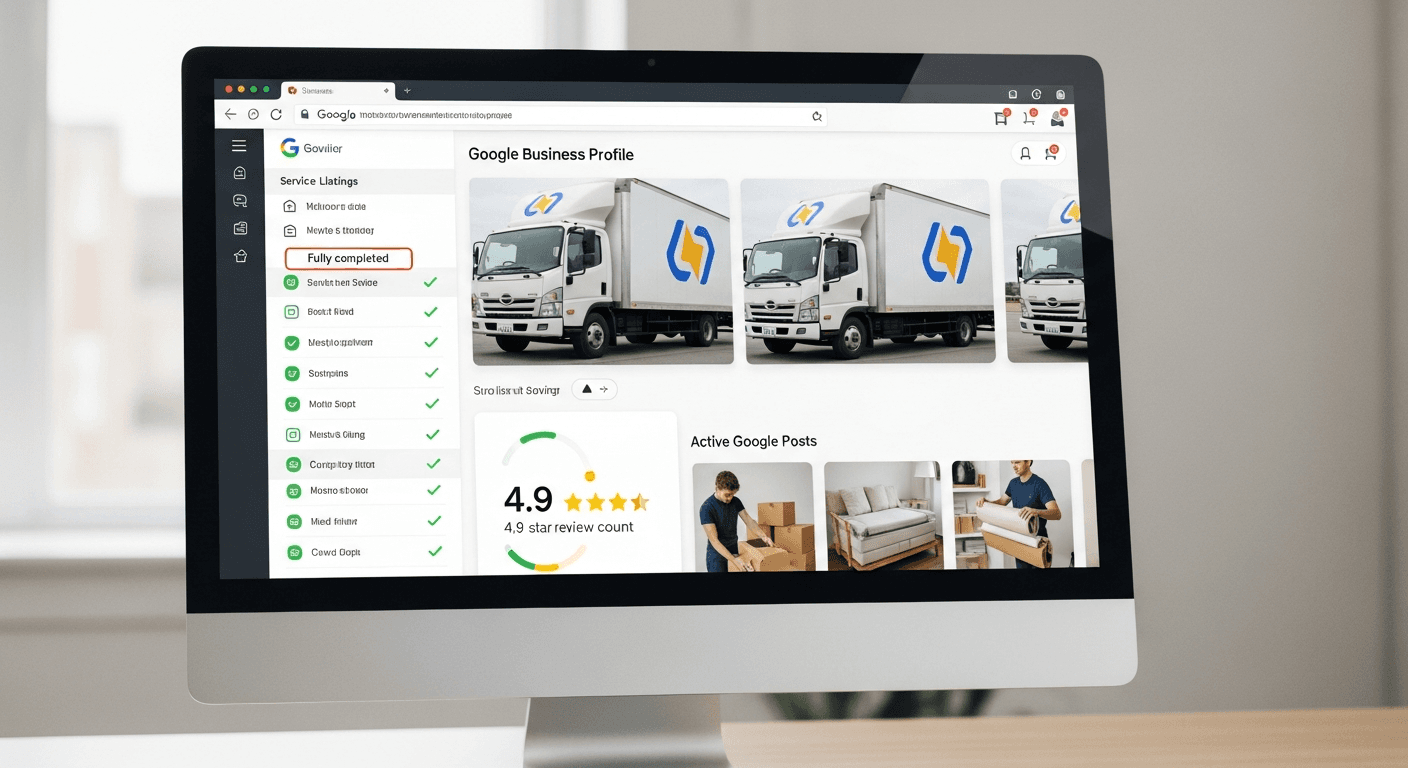
Your Google Business Profile (GBP) is the highest-ROI item on any mover's SEO checklist. It controls what appears in the Maps pack, in the local knowledge panel, and when someone searches your company name directly — and optimization here produces results faster than any other tactic.
Fill Every Section Completely
- Business name: Use your legal business name exactly. Do not keyword-stuff (no "Best Dallas Movers LLC" if that is not your real name — it violates Google's guidelines and risks suspension).
- Primary category: "Moving Company." Add secondary categories that apply: "Moving and Storage Service," "Piano Moving Service," "Long Distance Movers."
- Description: Write 250–750 words about your services, service area, years in business, and what makes you different. Naturally include phrases like "licensed and insured movers" and your primary city name.
- Services: Add every specific service — local moving, interstate moving, packing and unpacking, storage, piano moving, senior moving, office relocation. Each service supports a separate description.
- Service area: Set your service area to every city and county you actually cover. Google uses this to determine Maps pack eligibility for area-based searches.
- Hours: Keep hours accurate and current. Inaccurate hours are a trust signal problem with both Google and customers.
- Attributes: Check every relevant attribute — "Identifies as veteran-owned," "Online estimates available," "Certified movers," and so on.
Upload Photos — and Keep Adding Them
GBP profiles with more than 100 photos consistently receive higher engagement than those with fewer than 20. For a moving company, upload:
- Trucks (exterior, branded, clean)
- Crew in uniform and in action
- Before-and-after move photos
- Packing jobs and loaded trucks
- Your office or warehouse (if applicable)
- Awards, certifications, or community involvement
Aim for 20+ photos to start, then add new ones every month. Recent photos signal an actively managed profile.
Post Weekly with Google Posts
Google Posts appear directly on your GBP listing and tell Google the profile is actively maintained. Post at least weekly with seasonal promotions, customer testimonials, moving tips, or service announcements. Every post can include a CTA button — use "Get a quote" or "Book" linking directly to your quote form.
Local SEO: Citations, NAP Consistency, and Review Generation
Local SEO encompasses the signals Google uses to verify that your business is real, established, and relevant to a nearby searcher. The three pillars are citations, NAP consistency, and reviews.
Citations: Get Listed in the Right Directories
A citation is any online mention of your business name, address, and phone number. Google cross-references citations across the web to confirm your business information is accurate and consistent. For moving companies, the most important citation sources are:
| Directory | Priority Level |
|---|---|
| Google Business Profile | Must-have |
| Yelp | Must-have |
| Bing Places for Business | Must-have |
| Apple Maps (Apple Business Connect) | Must-have |
| Facebook Business Page | Must-have |
| BBB (Better Business Bureau) | High |
| Angi | High |
| Thumbtack | High |
| HomeAdvisor | High |
| American Moving & Storage Association (AMSA) | High |
| Houzz | Medium |
| Manta | Medium |
| YellowPages | Medium |
Target the top 10 in month one, then work down the list. A citation management tool like BrightLocal or Whitespark can find and audit existing listings you may not know about — many movers have duplicate or incorrect listings from old addresses or phone numbers.
NAP Consistency: One Format, Everywhere
NAP stands for Name, Address, Phone number. These three pieces of information must be exactly identical across every platform where your business appears. Small variations — "St." vs. "Street," "(312) 555-1234" vs. "312.555.1234" — confuse Google and dilute your local authority.
Before building new citations, decide on your canonical format and use it everywhere:
ABC Moving Company
1234 Oak Street, Suite 101
Chicago, IL 60601
(312) 555-1234
Audit and correct all existing listings before adding new ones.
Review Generation: Your Most Valuable Local SEO Asset
Google factors review count, average rating, and recency into Maps pack rankings. More critically, a company with 150 reviews at a 4.7 average wins more calls than one with 4.2 stars and 10 reviews — even if they rank identically.
An effective review system looks like this:
- Ask every customer within 24 hours of the move — call or text them directly: "We hope everything went smoothly. If you have two minutes, a Google review means the world to us." Include the review link.
- Send an automated follow-up email 48 hours later for customers who did not respond to the first ask.
- Never incentivize reviews with discounts or gifts — Google detects this and can suspend your profile.
- Respond to every review, positive and negative. A professional, empathetic response to a 1-star review often converts it from a liability into a trust signal.
Pro tip: Put your Google review link in your post-move invoice, booking confirmation email, and at the bottom of your website. Every friction point removed means more reviews you actually receive.
On-Page SEO: Titles, Meta Descriptions, and Headers for Movers
On-page SEO refers to the elements on your website pages that signal to Google what each page is about and why it should rank. For moving companies, the most critical pages are the homepage, individual service pages, and service area pages.
Title Tags and Meta Descriptions
Every page has a title tag (visible in the browser tab and in search results) and a meta description (the 155-character summary below the title). These are what a searcher reads before deciding whether to click.
Effective title tag formula for movers:
[Service] in [City], [State] | [Company Name] | Licensed & Insured
Examples:
Local Movers in Dallas, TX | Quick Move Co. | Licensed & InsuredLong Distance Moving Company Chicago | ABC Movers | Free QuotesPiano Moving Service Atlanta | Expert Piano Movers | Damage-Free Guarantee
Effective meta description formula: State your primary keyword, a key differentiator, and a call to action in under 155 characters.
"Trusted moving company in Dallas since 2015. Licensed, insured, rated 4.9 stars. Get a free quote in 60 seconds — call or book online."
Header Structure: H1, H2, H3
Use a clear, logical heading hierarchy on every page:
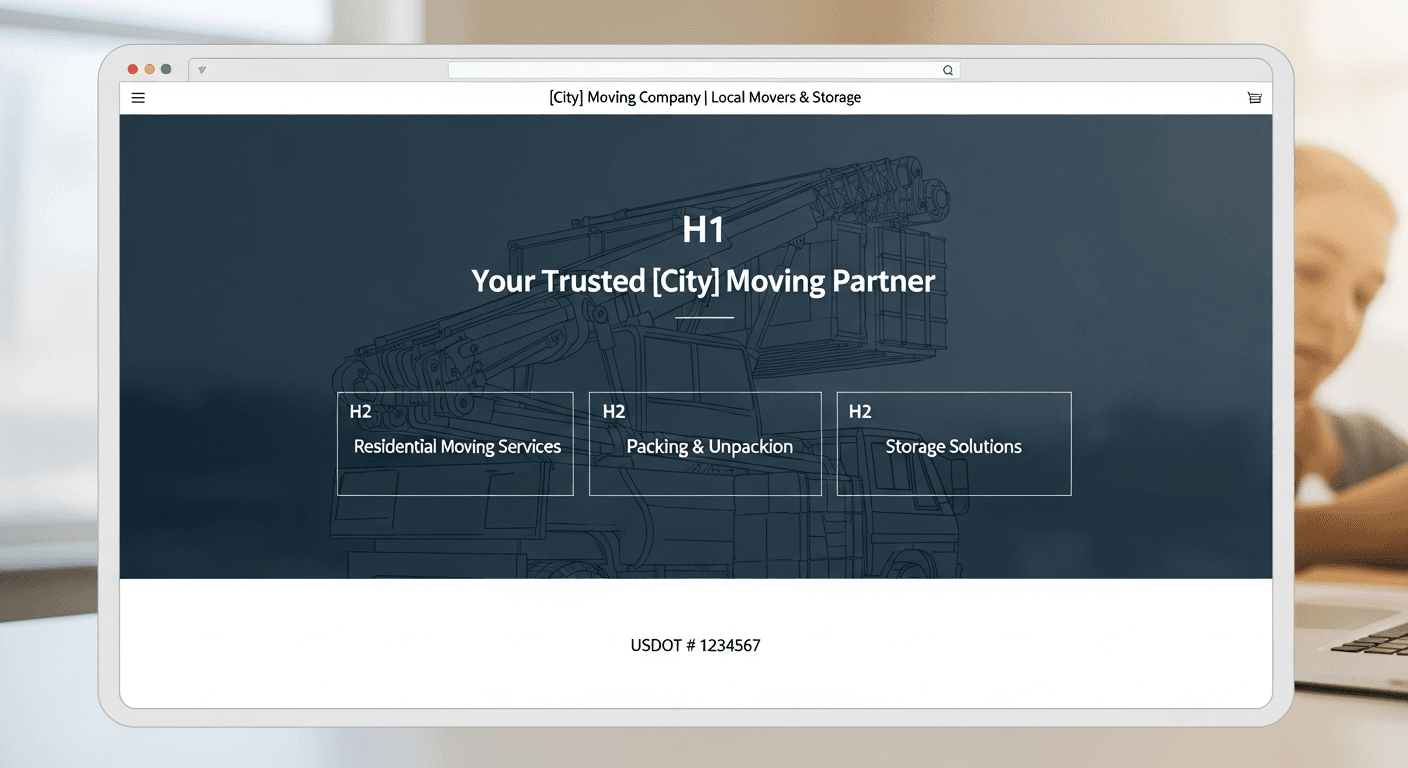
- H1: One per page, includes the primary keyword — "Dallas Moving Company | Licensed & Insured Movers"
- H2: Major sections — "Our Dallas Moving Services," "Service Areas," "Why Choose ABC Movers"
- H3: Subsections within each H2 — "Residential Moving," "Long-Distance Moving," "Storage Solutions"
Never skip heading levels (no H2 jumping to H4). Google's ranking algorithms and AI assistants use your heading structure to understand the hierarchy and completeness of information on the page — and a broken structure is a ranking signal that works against you.
Body Content Requirements
Your homepage and service pages need at least 500–800 words of descriptive copy. Include your primary keyword — "moving company + city" — naturally in the first 100 words, and use variations throughout: "local movers," "residential movers," "professional moving company in [city]."
Pro tip: Display your USDOT number and MC authority number directly on your website. It is a trust signal for customers evaluating multiple movers and demonstrates to search engines that you are a verified, licensed carrier.
Service Area Pages: How to Rank in Multiple Cities
A single homepage cannot rank well for every city you serve. If your moving company covers 15 suburbs, you need up to 15 dedicated service area pages — one per target market.
What Goes on a Service Area Page
A well-built service area page for "movers in Naperville, IL" should include:
- H1 with the target city: "Moving Company in Naperville, IL — Licensed & Insured"
- 400–700 words about your services in that specific market — what neighborhoods you serve, local knowledge, how long you have been operating there
- Local references: landmarks, popular moving destinations in the area, nearby communities
- Customer reviews from clients in or near that city
- A Google Maps embed showing your service radius
- Your phone number and a quote form (with city pre-filled if your CMS allows)
- Internal links to your homepage and other related area pages
Scale Your Service Area Pages Gradually
Build pages for your most profitable markets first, then expand outward. Avoid copying content between pages — Google will not rank two near-identical pages for different cities. Write unique copy for every page.
For a professionally built website that is structured to rank in multiple cities from day one, see what Network Leads' moving company website service includes.
Content Strategy: What to Blog About for Moving Company SEO
Blogging builds long-tail keyword rankings, earns inbound links, and signals to Google that your site is an active, authoritative resource. For movers, the best blog topics answer real questions that customers type into search bars.
High-Value Blog Post Types for Movers
- Local cost guides: "How Much Does It Cost to Move a 2-Bedroom Apartment in [City]?"
- Comparison posts: "Local Movers vs. Renting a Truck: Which Is Actually Cheaper?"
- How-to posts: "How to Pack a Kitchen for a Move (Room-by-Room Guide)"
- Moving tips: "10 Things to Do 30 Days Before You Move"
- Neighborhood guides: "Best Neighborhoods to Live in [City] in 2026" — attracts people actively planning a move
- FAQ posts: "How Much Do Movers Charge Per Hour in [State]?"
- Checklist posts: "Long-Distance Moving Checklist: 90-Day Timeline"
Posting Consistency Beats Volume
One well-researched, thorough post per week outperforms four thin posts per month every time. Google rewards content that fully answers the searcher's question — depth and clarity matter more than keyword density.
For moving companies that want a managed content strategy alongside citation building and on-page optimization, Network Leads' moving company SEO services cover these elements as part of a complete local SEO program.
Link Building Tactics That Work for Local Movers
Links from other websites to yours remain one of the strongest signals in Google's ranking algorithm. For local service businesses, link building is largely about earning mentions from nearby and industry-relevant sources.
Local Link Building Opportunities
- Chamber of commerce membership: Most local chambers maintain a business directory with do-follow links. Membership typically costs $100–$500/year and comes with a citation and a link.
- Real estate agent partnerships: Offer to be the preferred mover for local agents in exchange for a listing on their website and periodic client referrals. Agents who work with relocating buyers are an especially valuable source.
- Local news and media: Sponsor a community event, donate to a school fundraiser, or participate in a charity move. Local news sites frequently link to sponsors.
- Home service directories: Angi, Thumbtack, and Houzz provide a backlink alongside their lead generation value.
- Moving industry associations: The American Moving & Storage Association (AMSA) and their ProMover program provide directory listings with links and a trust badge you can display on your website.
- Supplier and partner sites: Your insurance broker, equipment supplier, or technology vendor may maintain a "clients" or "partners" page. Ask to be listed.
What to Avoid
Buying links from link farms, reciprocal link schemes, and low-quality directory submissions do not just fail to help — they can result in manual penalties from Google that are difficult to recover from. Build links through genuine relationships and real-world presence.
Pro tip: Create one genuinely useful, shareable resource — a local moving cost calculator, a packing checklist PDF, or a neighborhood relocation guide — and use it as a reason to reach out to local bloggers, real estate websites, and home improvement publications for a link. Resources that serve a real purpose earn links organically over time.

Technical SEO Basics: Speed, Mobile, and Schema Markup
Technical SEO covers the behind-the-scenes factors that affect how well Google can access, understand, and rank your site. You do not need to be a developer to handle the essentials.
Page Speed
Google uses Core Web Vitals as a ranking factor, and slow pages get penalized across both desktop and mobile rankings. The most common speed problems on moving company websites are oversized images, cheap shared hosting, and excessive third-party scripts.
Test your site at Google PageSpeed Insights — aim for a score above 70 on mobile. A score below 50 is almost certainly costing you rankings and conversions.
Mobile Optimization
The majority of local service searches happen on mobile devices. Your website must be fully responsive: buttons tappable, text readable without zooming, quote forms easy to complete on a phone. Test your current site at Google's Mobile-Friendly Test.
Schema Markup
Schema markup is structured code that tells Google exactly what kind of business you are and what information appears on each page. For moving companies, implement:
- LocalBusiness schema — name, address, phone number, URL, geographic coordinates, hours
- Service schema — one entry for each moving service you offer
- AggregateRating schema — pulls your average review score into search results as a rich snippet (stars visible in results without clicking)
Most modern website platforms (WordPress, Squarespace, Wix) have plugins or built-in tools for local business schema. If you use a custom site, ask your developer to add it — it is an hour of work with a measurable impact on click-through rates.
How to Get Into the Google Maps Pack
The Maps pack — the three business listings that appear with a map at the top of local search results — drives a disproportionate share of phone calls for moving companies. Understanding what Google uses to rank these results is the first step to appearing in them.
The Three Core Maps Pack Factors
- Relevance: How closely your GBP profile and website match the search query. Your categories, listed services, and on-site copy all contribute.
- Distance: How close your verified business address (or designated service area) is to the location of the searcher.
- Prominence: How well-known and credible Google considers your business to be — driven by review volume, citation count, domain authority, and website quality.
What Actually Moves the Needle
| Action | Maps Pack Impact |
|---|---|
| Complete, verified GBP with all fields filled | Very High |
| 50+ Google reviews with 4.5+ average rating | Very High |
| NAP consistent across 20+ citation sources | High |
| Responding to every review promptly | High |
| Weekly Google Posts on your GBP | Medium |
| Website linked to GBP with local content | High |
| Local backlinks from area businesses and directories | High |
The fastest path to the Maps pack is completing your GBP fully and generating reviews aggressively. Moving companies with 100+ reviews and a 4.6+ average consistently outrank competitors with fewer reviews, even in markets where those competitors have more years in business.
How to Track Your SEO Progress
Without tracking, you are guessing. These free tools give you the data to see what is working and what is not.
| Tool | What It Tracks | Where to Find It |
|---|---|---|
| Google Search Console | Rankings, click-through rates, index coverage, crawl errors | search.google.com/search-console |
| Google Analytics 4 | Website traffic, traffic sources, user behavior, lead form completions | analytics.google.com |
| Google Business Profile Insights | GBP views, searches, direction requests, phone calls | Inside your GBP dashboard |
| BrightLocal (free tier) | Citation audit, GBP rank position tracking | brightlocal.com |
Metrics to Review Monthly
- GBP calls and direction requests: Are more people finding and contacting you through Google?
- Organic website traffic: Is it growing month over month?
- Rankings for target keywords: Are you climbing toward page one?
- New reviews added: Are you generating at least 4–8 new reviews per month?
- Citation consistency score: Are your listings accurate across directories?
SEO Timeline: Realistic Expectations for Moving Companies
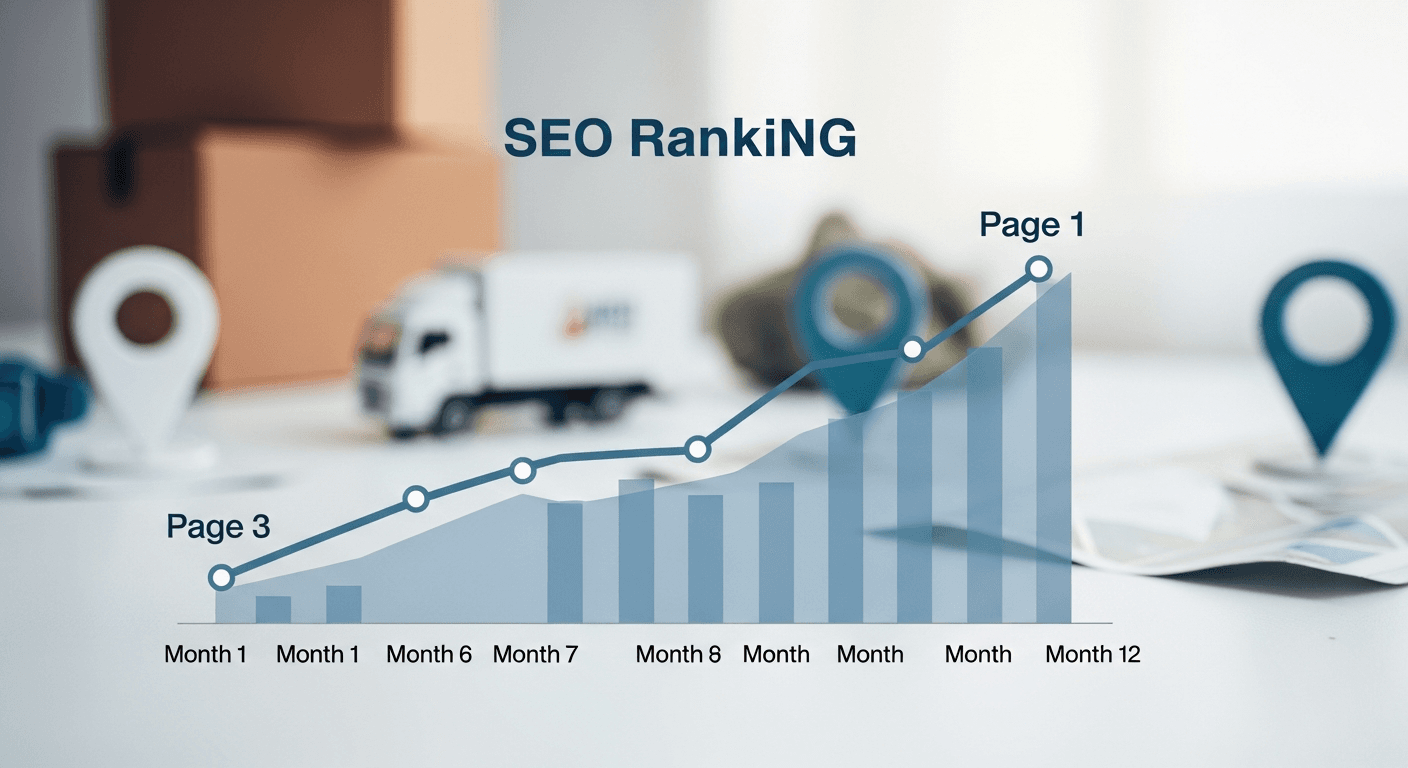
The most common SEO mistake is quitting too early. Here is an honest, realistic timeline for a moving company starting from scratch or rebuilding from a weak foundation:
| Month | Expected Milestones |
|---|---|
| 1–2 | GBP fully optimized. Initial citations submitted. On-page SEO fixes applied. No visible ranking change yet. |
| 3–4 | GBP ranking improves for branded searches. Organic traffic begins slowly climbing. First long-tail keywords showing movement. |
| 5–6 | Service area pages starting to rank. Maps pack position improves for nearby searches. |
| 7–9 | Consistent rankings for city-level keywords. Organic leads becoming a meaningful part of the pipeline. |
| 10–12 | Established first-page presence for 3–5 primary keywords. Results compounding — less effort required for the same output. |
SEO is not a short-term tactic. But unlike paid ads, the results compound — each month builds on the last, and a company that invests consistently for 12 months earns a marketing channel that is both free and increasingly difficult for competitors to displace.
DIY SEO vs. Hiring a Professional
Not every moving company owner wants to manage their own SEO. Here is an honest breakdown of both paths:
DIY SEO
Best for: Owners with 3–5 hours per week to invest, comfortable using basic online tools.
What you can do yourself:
- GBP optimization and weekly posting
- Citation building (manual directory submissions)
- Review generation (phone and text system)
- Title tag and meta description updates
- Blogging (one post per week)
- Monitoring rankings in Search Console
Monthly cost: $0–$100 (Google Search Console is free; BrightLocal's starter plan is around $35/month).
Hiring a Professional
Best for: Owners who are in highly competitive markets, have limited time, or want faster results than DIY typically produces.
What a professional handles:
- Full technical audit and remediation
- Ongoing citation management and correction
- Link building outreach
- Content creation (service pages, blog posts, location pages)
- Monthly performance reporting and strategy adjustments
Monthly cost: $500–$2,000 for a reputable moving-industry SEO specialist. Be skeptical of agencies promising first-page rankings in 30 days — that is not how SEO works for any competitive keyword.
Middle path: Network Leads' professional moving company website service delivers a properly structured, SEO-ready website with local optimization built in — the right foundation for any moving company that wants results without the cost of a full agency engagement.
Frequently Asked Questions: Moving Company SEO
How long does it take to rank on the first page of Google for moving company keywords? Most moving companies see meaningful ranking improvements within 3–6 months of consistent SEO work. Ranking in the Maps pack for competitive city-level queries typically takes 6–12 months.
Is Google Business Profile more important than my website for local SEO? Both matter, but your GBP delivers results faster. A fully optimized GBP can land you in the Maps pack before your website ranks organically. Your website then builds and reinforces GBP authority over time — they work together, not in competition.
How many Google reviews do I need to rank in the Maps pack? There is no fixed threshold, but moving companies with 50+ reviews and a 4.5+ average have a significant advantage. In highly competitive markets such as New York, Los Angeles, or Chicago, 100+ reviews is often required to reach the top three.
Should I target multiple cities with one page or create separate pages for each city? Always separate pages. A single page cannot rank well for multiple distinct cities. Create a dedicated, unique page for every market you want to rank in.
What is the single most impactful thing I can do for moving company SEO today? Complete every field in your Google Business Profile and put a review request system in place that contacts every customer after the move. These two actions, done consistently, have more immediate impact than anything else for most moving companies.
Does running paid ads affect my organic SEO rankings? No — Google Ads and organic rankings are separate systems. Paid ads do not boost organic rankings. They are complementary channels that capture different parts of the search results page.
The Bottom Line
Ranking on the first page of Google is the most scalable, highest-ROI marketing channel a moving company can build. The fundamentals are not complicated: a complete and active Google Business Profile, a consistent review generation system, accurate citations, well-structured service pages for every city you serve, and steady content and link building over time.
The realistic roadmap:
- Month 1: Complete your GBP, audit and fix your citations, update your on-page SEO.
- Months 2–3: Launch service area pages for your top markets. Start a review request system. Build your first 15–20 citations.
- Months 4–6: Add blog content weekly. Pursue local links. Monitor rankings monthly.
- Months 7–12: Optimize what is gaining traction. Expand into new service area pages. Let the compounding begin.
SEO takes time to build — but you do not have to wait 12 months for leads. While your organic rankings grow, Network Leads connects moving companies with verified, high-intent customers who are actively requesting quotes right now. Start receiving moving leads today and build your SEO foundation in parallel.
Written by
Network Leads
Network Leads helps moving companies grow with high-quality leads, powerful software, and marketing solutions. Since 2017, we have been connecting movers with customers who are actively searching for moving quotes.
Learn more about our platform