
Running Facebook ads for a moving company is not as simple as boosting a post and waiting for the phone to ring. But when set up correctly, Facebook and Instagram advertising can generate a consistent pipeline of moving inquiries in 2026 at a cost per lead that competes with almost any other paid channel.
Unlike Google search ads — where someone is actively hunting for a mover right now — Facebook reaches customers earlier, before they have started comparing quotes. That changes the strategy entirely. This guide covers everything you need to run a profitable Facebook ads program: Business Manager setup, campaign objectives, audience targeting, ad creative, lead form ads, budget allocation, conversion tracking, and retargeting. It closes with an honest cost-per-lead comparison against buying verified moving leads directly. If you are also weighing search advertising, our complete Google Ads guide for moving companies covers PPC in depth. For a broader view of how all digital marketing channels fit together, see our guide on navigating the digital marketing landscape for moving companies.
Facebook Ads for Moving Companies: Quick Reference
Before diving into setup, here is what to expect from this channel, as of 2026:
| Factor | What to Expect |
|---|---|
| Average cost per lead — local moves | $20–$45 |
| Average cost per lead — long-distance | $40–$80 |
| Best campaign objective | Lead Generation (Instant Form) |
| Minimum viable daily budget | $20–$30/day per campaign |
| Best starting audience | Homeowners, ages 25–55, within 25–50 miles |
| Best ad formats | Short video (15–30 sec) or single image |
| Time to exit learning phase | 2–4 weeks (requires 50+ conversions per ad set) |
| Most common mistake | Targeting too broadly — entire state or region |
Should Your Moving Company Advertise on Facebook?
Facebook advertising works best for moving companies operating in active residential markets where your team can follow up on new inquiries within minutes. The platform's targeting tools let you reach the right geography, the right demographics, and users who have recently signaled moving intent — all before they have opened Google to search for a mover.
The tradeoff is intent level. A Facebook user scrolling their feed was not looking for you — your ad interrupts their session. That means Facebook leads require faster follow-up and more nurturing than search leads, and close rates are correspondingly lower. The upside is higher volume and lower cost per impression.
Facebook Ads vs. Google Ads for Movers
The two platforms serve fundamentally different roles in the customer acquisition funnel:
| Facebook / Instagram Ads | Google Search Ads | |
|---|---|---|
| Customer intent at ad exposure | Low to medium — not actively searching | High — actively looking for a mover |
| Typical cost per click (local) | $0.50–$2.00 | $5–$20 |
| Typical cost per lead (local) | $20–$45 | $40–$80 |
| Lead close rate (typical) | 10–20% | 15–25% |
| Best role | Brand awareness + pipeline volume | High-intent bookings |
Most moving companies that scale past a few trucks run both channels simultaneously: Google to capture high-intent searchers already comparing movers, and Facebook to build a larger top-of-funnel pipeline at lower cost per impression. Neither channel replaces the other.
Setting Up Facebook Business Manager and Your Ad Account
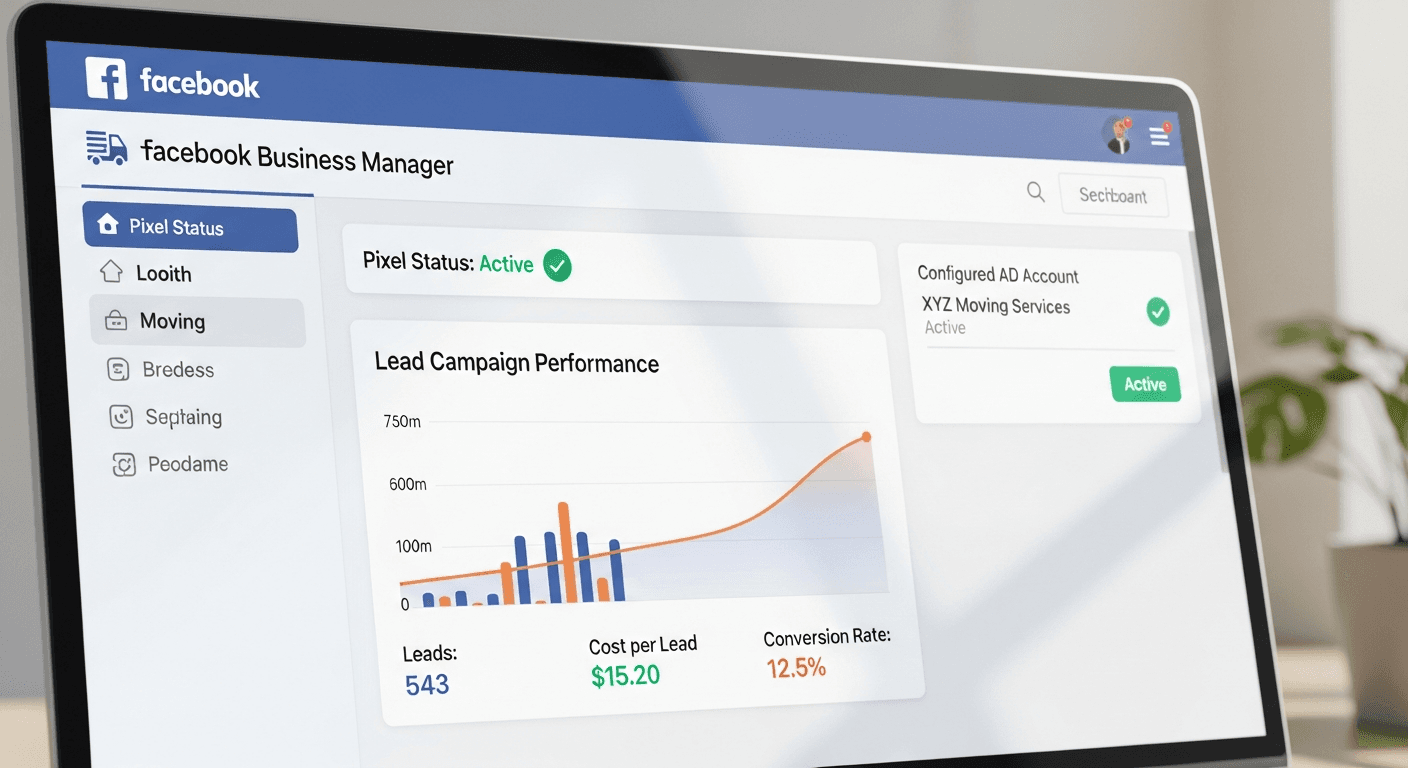
Correct account setup prevents the most common Facebook ads failure mode: losing access mid-campaign, having your ad account suspended, or running ads with no conversion data because the tracking pixel was never installed.
The correct setup sequence:
- Create a Meta Business Manager account at business.facebook.com. Use a business email — not a personal Facebook account — to avoid account restrictions.
- Add or create your Facebook Business Page. Every ad runs in the name of a Page. If you do not have one, create it before anything else.
- Create an Ad Account inside Business Manager. Set your time zone and billing currency at this step — neither can be changed after creation.
- Add a payment method. Credit card or bank account. New accounts start on a prepay basis — Facebook charges as you accrue costs.
- Install the Meta Pixel on your website. This script tracks page views, quote form submissions, and booking confirmations. Install it before spending a dollar on ads.
- Set up custom conversion events in Events Manager. Create a conversion event tied to your quote form thank-you page URL (e.g.,
/thank-you). This is your primary optimization signal. - Set up Conversions API (CAPI). Browser privacy changes have reduced pixel-only attribution by 20–40% in many markets. CAPI sends conversion data directly from your server to Meta, independent of browser restrictions. Most website platforms have native CAPI integrations.
Pro tip: Run everything through a single Business Manager, even if you operate in multiple service areas. Business Manager gives you controlled team access, separate billing from your personal account, and a recovery path if one ad account gets flagged.
Choosing the Right Campaign Objective for a Moving Business
The campaign objective tells Meta's algorithm which users to show your ads to. Choose the wrong one and your budget goes to users who take the action you selected — not the action you actually want.
Objectives Ranked for Moving Companies
| Objective | What Meta Optimizes For | Best Use Case |
|---|---|---|
| Leads | Instant Form completions | Primary strategy for most movers |
| Traffic | Clicks to your website | Strong if your site has a fast, optimized quote form |
| Awareness | Reach and impressions | New market entry only |
| Engagement | Likes, comments, shares | Building Page social proof |
For the overwhelming majority of moving companies, Leads is the right starting objective. The Instant Form keeps users inside Facebook or Instagram — no website load required — which eliminates the friction that causes drop-off between ad click and form submission. If your website quote form loads in under 2 seconds and converts at above 15%, Traffic is worth A/B testing against Leads.
Campaign Structure That Works
Organize by move type and audience temperature — not by ad format:
- Campaign 1 — Local moves prospecting: Homeowners within your service radius, interest or lookalike targeting
- Campaign 2 — Long-distance moves prospecting: Homeowners in your state, filtered for interstate intent signals
- Campaign 3 — Retargeting: Website visitors, video viewers, lead form openers who did not submit
Keeping campaigns separated by move type gives you clean ROI measurement by revenue category and prevents the algorithm from mixing optimization signals.
Audience Targeting: How to Reach People Planning to Move
Audience targeting is where most moving company Facebook campaigns succeed or fail. The instinct is to target broadly and let the algorithm figure it out. The correct approach is the opposite: start narrow and specific, then expand only when you have cost data to justify it.
The core targeting stack for a local moving company:
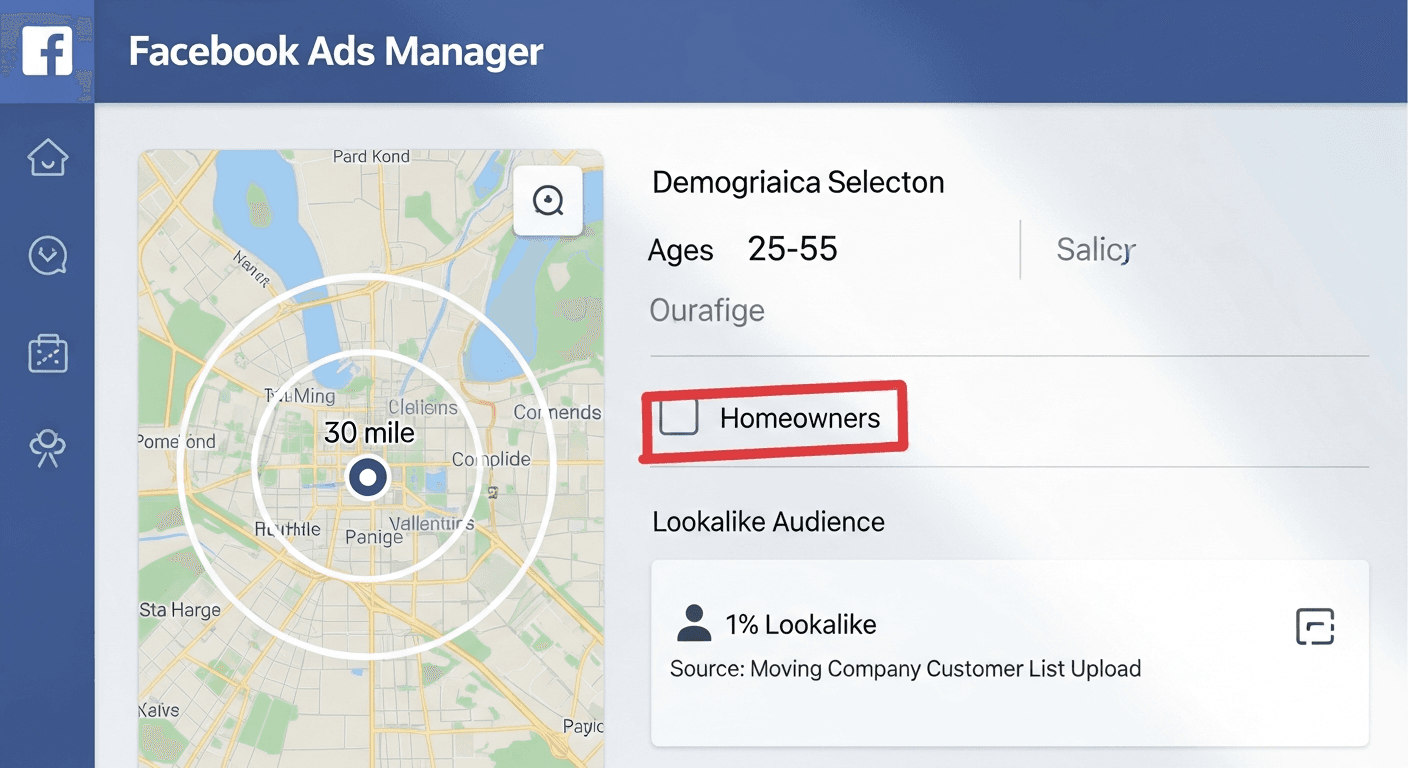
- Location: Radius around your base — typically 25 to 50 miles, adjusted for how far your crews realistically travel. In metro areas with distinct neighborhoods, layer in specific ZIP codes.
- Age: 25–55. Under 25 skews toward low-budget, low-close-rate moves; above 55 moves less frequently but often books higher-value jobs if messaging is tailored correctly.
- Homeownership: Detailed Targeting → Demographics → Home Ownership → Homeowners. Homeowner leads have higher average job values and lower cancellation rates than renter leads.
- Life Events: Detailed Targeting → Life Events → Moving Soon or Recently Moved. Meta identifies users who have signaled a move through profile changes or content engagement.
- Income: $75K+ household income tends to produce better leads for full-service moving companies. Budget movers can skip this filter.
What to avoid:
- Targeting an entire state, DMA, or nationwide — moving is local and geography is your most important filter
- Broad interest categories like "home improvement" or "interior decorating" without a location radius restriction
- Age ranges under 22 — low job values, high no-show rate
Custom Audiences and Lookalikes
Once your pixel has data and you have an initial customer list, these audiences typically outperform any standard interest targeting:
| Audience Type | How to Build It | Best Use |
|---|---|---|
| Website visitors — last 30 days | Meta Pixel | Core retargeting pool |
| Website visitors — last 7 days | Meta Pixel | Hottest retargeting layer |
| Customer email list | Upload CSV from CRM | Exclusions + lookalike seed |
| Video viewers (25%+ watch time) | Page video analytics | Warm retargeting at low CPL |
| 1% Lookalike of customer list | Uploaded customer list | Best prospecting audience |
Even 200–300 customer records generate a usable 1% lookalike. This audience finds new users who share behavioral and demographic traits with your past customers — almost always the strongest prospecting segment once your pixel has at least 500 events.
Ad Creative That Converts: Images, Video, and Carousel Ads
Facebook ads live or die by creative. A generic stock photo of two people carrying a cardboard box will not stop anyone mid-scroll. The ads that produce the lowest cost per lead look like content that belongs in the feed — real, local, and specific to the moving experience.
What works by format:
Short-form video (15–30 seconds) — the highest-engagement format:
- Capture an actual move: furniture being wrapped in moving blankets, a crew rolling a refrigerator down a ramp, a neatly loaded truck bed
- Add captions — most Facebook video plays without sound
- Open with motion in the first 2 seconds; static video openers lose viewers before the hook lands
- Close with an on-screen CTA: "Free Quote in 60 Seconds — [Your City]"
Single image — fastest to produce, still effective:
- Real crew and truck photos consistently outperform stock imagery
- Before/after format (cluttered apartment → packed truck) stops the scroll
- Text overlay: city name + one differentiator ("Licensed, Insured & 5-Star Rated in [City]")
Carousel — best for multi-service operations:
- Each card for a different service: local, long-distance, packing, storage
- Sequential storytelling: problem → solution → offer
- Each card can link to a different service page or trigger a separate lead form
Writing Ad Copy for Moving Services
Ad copy for moving services has one job: make the right person stop scrolling. The FTC's guidelines on truth in advertising apply to Facebook ads — do not make claims you cannot back up.
Headline (40 characters max): City name + core offer.
- "Austin Movers — Free Quotes in 60 Seconds"
- "Local Moving Starting at $99/hr — No Hidden Fees"
Primary text (first 125 characters show before "See more"): Address the anxiety before pitching.
- "Moving is stressful enough without worrying about your belongings. Licensed, insured, and local to [city] — get your free quote in under a minute."
CTA button: "Get Quote" or "Learn More." Avoid "Shop Now" — wrong frame for a service business.
Pro tip: Write three versions of each ad with different primary text angles — one price-focused, one trust-focused (license number, insurance, review count), one time-saving (same-week availability, 60-second quote). Run all three in the same ad set for 2 weeks. Meta shifts budget to the winner automatically; you keep the winning copy for future campaigns.
Lead Form Ads: The Fastest Way to Capture Moving Inquiries
Lead Form ads (Instant Forms) keep prospects inside Facebook or Instagram when they respond to your ad. A tap on the ad opens a pre-filled form — name, phone, and email pulled from their Facebook profile — so there is no website to load, no friction, and dramatically less drop-off.
Setting up a lead form for a moving company:
- In Ads Manager, select Leads as your campaign objective.
- At the ad level, click Create Form.
- Form type: Select Higher Intent. This adds a review screen before submission, which filters accidental taps. "More Volume" delivers more completions but significantly lower quality for service businesses.
- Intro card: Short headline + one trust signal. Include your average Google rating, license number, or years in business.
- Questions — 5 fields maximum:
- Name (pre-filled)
- Phone number (pre-filled)
- Email (pre-filled)
- Move date (dropdown: Within 2 weeks / 1 month / 1–3 months / Not sure)
- Move size (dropdown: Studio or 1BR / 2–3BR / 4BR+ / Commercial)
- Privacy policy: Required. Link to your privacy policy page.
- Thank you screen: Confirm next steps and include your phone number so motivated leads can call immediately.
- Integrate leads into your CRM in real time via Zapier or a native integration. Meta deletes lead form data after 90 days — do not rely on manual downloads alone.
Lead quality improvements:
The biggest complaint about Facebook lead form ads is low quality — contacts who do not remember submitting or were never serious. Three settings reduce this sharply:
- Higher Intent form type — review screen before submission
- A qualifying custom question — "What date are you planning to move?" forces active thought and filters browsers
- 5-minute follow-up — quality degrades the longer you wait; the prospect's memory of submitting the form fades within hours

How Much Should Your Moving Company Spend on Facebook Ads?
The most common budget mistake is starting too small. Meta's algorithm needs approximately 50 conversions per ad set per week to exit the "learning phase" and start delivering stable, optimized results. Under-budgeting keeps campaigns in learning mode indefinitely and makes performance data meaningless.
Starting Budgets by Market Size
| Market Size | Daily Budget | Expected Monthly Leads |
|---|---|---|
| Small market (under 200K population) | $20–$30/day | 15–35 leads |
| Mid-size market (200K–500K) | $30–$50/day | 30–70 leads |
| Large / competitive market (500K+) | $50–$100/day | 50–120 leads |
These are starting points. Actual cost per lead varies by market competitiveness, creative quality, and audience fit. Peak moving season (May through August) typically increases CPL by 20–40% as more competitors bid for the same audience.
Budget split across campaign types:
- 70% → Prospecting (new audiences)
- 20% → Retargeting (warm audiences)
- 10% → Lookalike audience campaigns
Scaling rule: When a campaign is profitable, increase the daily budget by no more than 20% at a time. Larger increases restart the learning phase and can temporarily spike your CPL.
Tracking Conversions and Measuring What Matters
ROAS (Return on Ad Spend) is the right metric to optimize toward, but you cannot calculate it without connecting ad spend to actual revenue. Most moving company campaigns measure the wrong things and draw the wrong conclusions.
Core Metrics and Target Benchmarks
| Metric | Definition | Target Benchmark |
|---|---|---|
| Cost per lead (CPL) | Ad spend ÷ leads generated | $20–$45 (local), $40–$80 (long-distance) |
| Lead-to-contact rate | % of leads who answer your first call | 50–70% within 24 hours |
| Lead-to-booking rate | % of leads who become paid jobs | 10–20% for Facebook leads |
| Revenue per lead | Total revenue ÷ leads generated | 5–10x your CPL |
| ROAS | Total revenue ÷ total ad spend | 3x minimum; 5x+ is strong |
Full-funnel tracking setup:
- Meta Pixel + Conversions API running together — CAPI is required for accurate attribution under modern browser privacy restrictions
- Custom conversion event tied to your quote form thank-you page
- CRM integration to pass "job booked" events back to Meta — this shifts optimization from form fills to actual booked jobs over time
- UTM parameters on all website destination URLs so your own analytics platform independently captures attribution
Retargeting: Convert the People Who Almost Called
Retargeting is the highest-ROI campaign type in any Facebook program for moving companies — and the most commonly skipped. People who visited your site or watched your video already know your brand. They just need a reason to act.
Retargeting audience layers by warmth:
| Audience | Warmth | Best Offer |
|---|---|---|
| Website visitors — last 7 days | Hottest | "Your quote is ready — we have openings this week" |
| Lead form openers who did not submit | Very warm | "Finish your quote — takes under 60 seconds" |
| Website visitors — last 30 days | Warm | Customer review screenshot + call to action |
| Video viewers (25%+ watch time) | Medium | Service overview + trust signals |
Retargeting campaigns typically run at $5–$15/day and produce the lowest CPL of any campaign type. Always exclude existing customers (upload their emails as a custom exclusion) to avoid wasting budget on people who already booked.
Creative note for retargeting: Social proof works better than awareness here. A screenshot of a genuine 5-star Google review, a short customer testimonial clip, or a "500+ moves completed in [city] this year" stat ad — these convert warm audiences. Your brand awareness creative is already done; now you need trust.
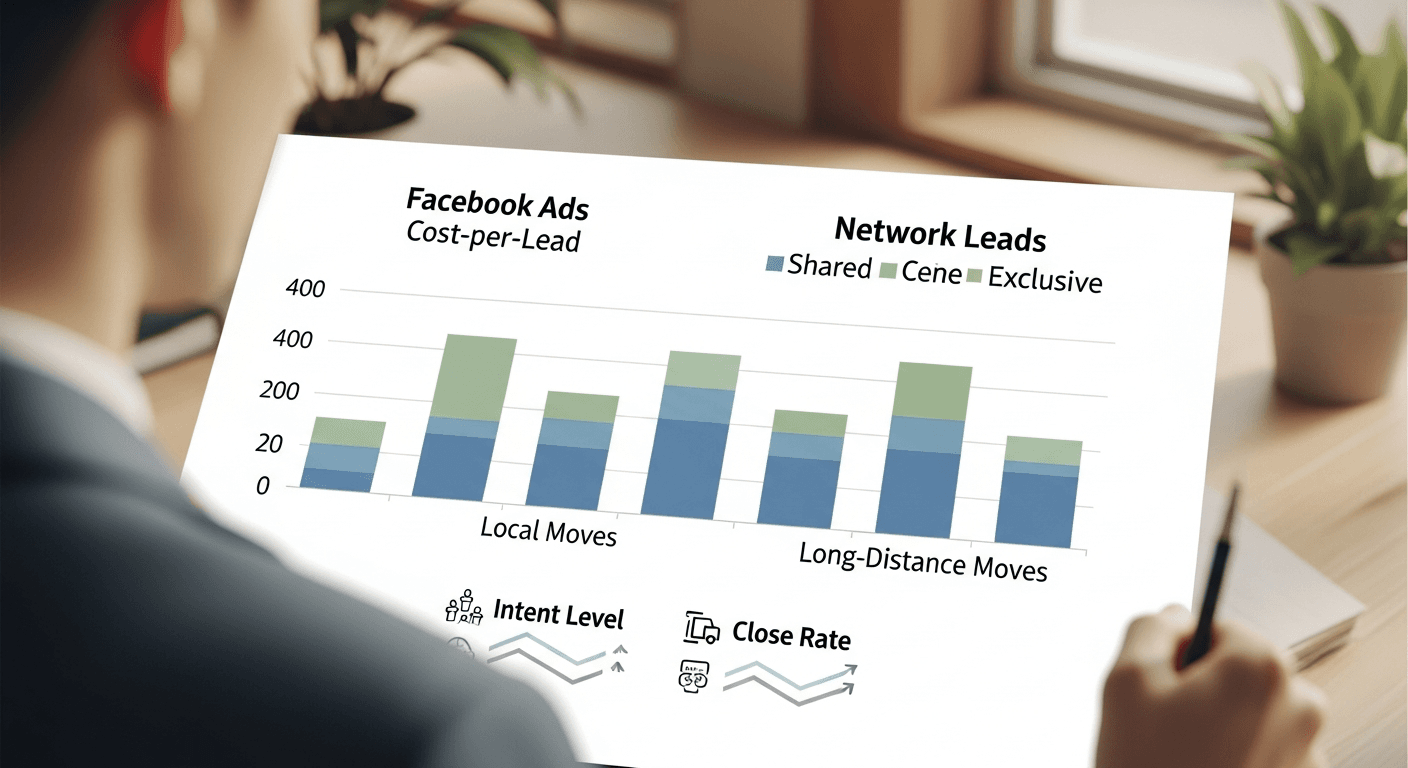
Facebook Ads CPA vs. Buying Moving Leads — An Honest Comparison
Both generate moving inquiries. The right mix depends on your close rate, follow-up capacity, and how much ongoing management overhead your team can absorb.
| Factor | Facebook Ads (Self-Managed) | Buying Leads (Network Leads) |
|---|---|---|
| Cost per lead — local | $20–$45 | $15 shared / $45 exclusive |
| Cost per lead — long-distance | $40–$80 | $20 shared / $85 exclusive |
| Lead intent level | Medium — not actively searching | High — actively requested a quote |
| Setup time | 2–4 weeks to optimize | Same business day |
| Management overhead | Ongoing (creative, bids, testing) | Minimal |
| Lead verification | None by default | SMS and phone verified |
| Typical close rate | 10–20% | 15–30% (varies by follow-up speed) |
| Best role | Brand building + supplemental volume | Core revenue pipeline |
The practical recommendation: Facebook ads and purchased leads are not competitors — they are complementary. Facebook builds awareness and generates a retargeting pool in your market. Purchased leads fill the calendar while Facebook's algorithm ramps up, and they carry higher intent because those customers specifically submitted a moving quote request.
Most high-volume moving companies run Facebook campaigns for brand presence while simultaneously purchasing shared and exclusive leads for their primary revenue pipeline. Use both channels and measure them separately.
If you want immediate lead flow without the 2–4 week optimization ramp, moving leads through Network Leads are verified by SMS and phone — pay only per lead, no long-term contracts.
Frequently Asked Questions
How long do Facebook ads take to produce results for a moving company? Plan for 2–4 weeks to exit the learning phase and stabilize performance. The first week's data is almost never representative — the algorithm is still calibrating.
Can a 1–2 truck moving company run profitable Facebook ads? Yes, if you budget at least $20–$25/day and your team can call leads within 5 minutes of submission. One additional booked local move per week at $800–$1,500 typically covers weeks of ad spend.
Should I advertise on Instagram as well as Facebook? Yes — Instagram placements are included by default when you create a campaign in Meta Ads Manager. Let the algorithm allocate budget between platforms for the first 2–4 weeks, then review the placement breakdown to see where your CPL is lower.
What is the single biggest mistake moving companies make with Facebook ads? Targeting too broadly — running ads to an entire state or region. Moving is local. Defining a tight location radius is the most important targeting decision you will make, and skipping it burns more budget than any other mistake.
Are Facebook lead form submissions lower quality than Google or purchased leads? Facebook leads generally have lower initial intent because the user was not searching for a mover when they saw your ad. Using the Higher Intent form type, adding a qualifying question, and calling within 5 minutes of submission closes most of the quality gap.
The Bottom Line
Facebook ads for moving companies work — not as a replacement for high-intent channels, but as a cost-effective way to build brand presence, generate supplemental lead volume, and create a retargeting pool you can convert over time. The setup that produces consistent results in 2026:
- Business Manager configured with Pixel and Conversions API before any ads launch
- Lead Generation campaigns with Higher Intent Instant Forms targeting homeowners in your service area
- Qualifying questions that filter intent at the form level
- Retargeting campaigns running at $5–$15/day against warm audiences
- Creative refreshed every 3–4 weeks to prevent ad fatigue
- Conversion tracking connected through to booked jobs, not just form submissions
Facebook works best alongside a core purchased lead program — the two channels complement each other. While your Facebook campaigns ramp up, a steady stream of verified leads keeps the calendar full.
Ready to start receiving verified moving leads today? No setup period, no long-term contracts — pay only for the leads you receive: https://setup.network-leads.com
Written by
Network Leads
Network Leads helps moving companies grow with high-quality leads, powerful software, and marketing solutions. Since 2017, we have been connecting movers with customers who are actively searching for moving quotes.
Learn more about our platform